Same reel, opposite verdicts: what is each of you grading?
You and a colleague have just watched the same agency reel. One of you says it is brilliant. The other says it is not for them, and cannot quite say why. Ten minutes later you are both repeating yourselves.
The argument that is not about the work
Picture the scene. A short vertical post: one deadpan joke, a held shot, a punchline on the last frame. “That is sharp,” says the first person. “It felt cheap,” says the second. Both are right about what they saw. The first saw a premise that surprised them. The second saw a shaky crop, a default-looking font, and audio that clipped on the laugh.
That is the core of it. A verdict is the output of a criterion, and two people can run different criteria without knowing it. “Brilliant” and “cheap” are summaries of two different tests, so arguing them head to head goes in circles.
This piece is about reviewing work together. It is not about choosing, hiring or managing an agency.
The three criteria that hide inside “I liked it”
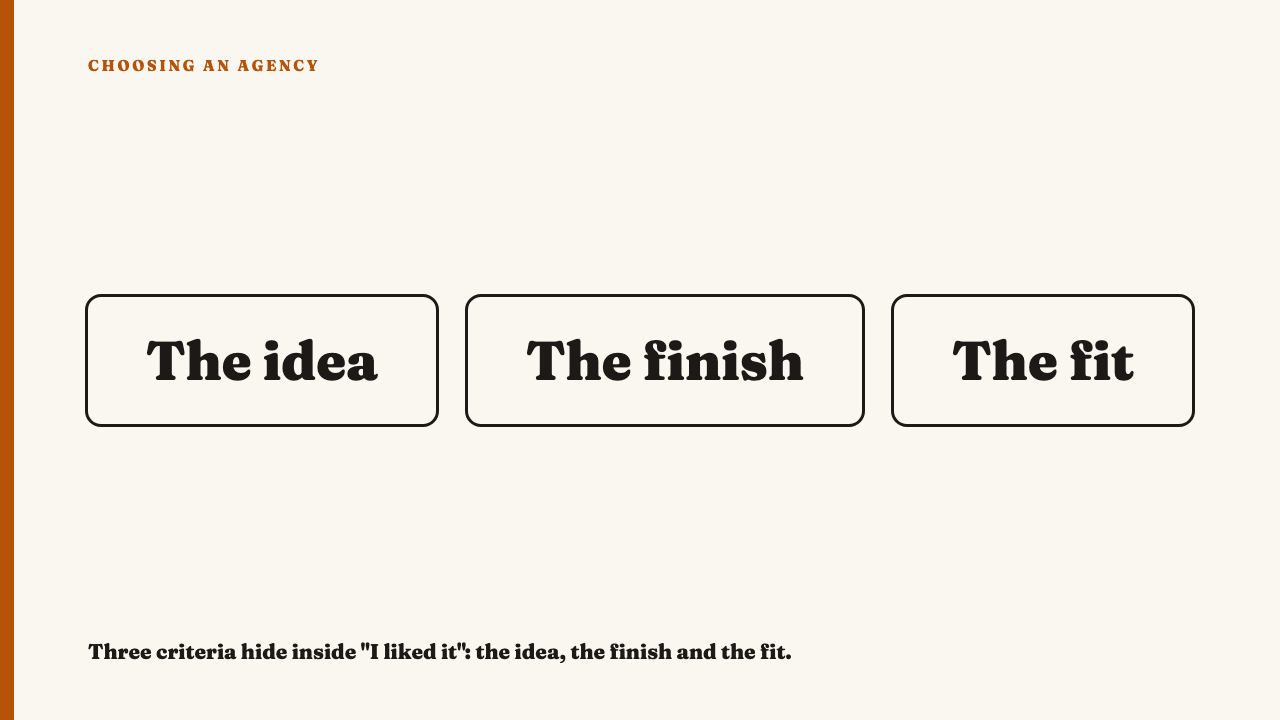
The most common mismatch is between three things a reviewer can be grading: the idea, the finish, and the fit with the audience.
The idea is the one-line premise, and whether it is surprising. A post can score high here and look rough: a clever, slightly absurd premise shot on a handheld camera in an afternoon.
The finish is everything you can point at in the frame: framing, type, where the cuts fall, sound, grade. A post can score high here and be hollow: a gorgeous, evenly lit montage with immaculate typography that says nothing anyone would repeat.
The fit is whether this audience, in this feed, would stop for it. A post can fit perfectly and look plain to outsiders: a dry in-joke for a narrow professional community, instantly recognised by exactly the people it was made for.
Run the opening scene again. The idea reviewer watches the deadpan joke and thinks, that premise is fresh, I would remember it. The finish reviewer watches the same seconds and notices the crop, the type and the clipped laugh, and thinks, nobody cared enough to fix this. Same post. “Love it” from one seat, “weak” from the other.
If one of you is leaning on “I just know,” see why ‘I just know good work when I see it’ is not a standard. An unnamed gut verdict cannot be compared with anyone else’s, which is why these arguments stall.
Say your criterion out loud before you say your verdict
Before anyone defends a score, each person says in one sentence what they were grading. A few stems that work:
- “I was mostly watching for the premise, and whether I had seen it before.”
- “What I was holding it against was how finished it looked.”
- “I kept asking whether the person it was made for would stop scrolling.”
Order matters. A verdict stated first becomes something to defend, and every later remark bends toward protecting it. A criterion stated first is something to compare. Your colleague can say “oh, you were on the idea, I was on the finish,” and the argument has already changed shape.
There is another tell. If one person cannot name a criterion at all, that is information too. The reaction is real but unexamined, and the session below is how to find what it was attached to.
A joint viewing session in four passes
This is a viewing technique, nothing more. Give everyone paper and a pen, and compare written lines only after all of them are written, so nobody anchors on whoever speaks first.
- Pass one, cold. Watch once, at the size and speed it was meant to be seen, in silence. Each person writes one line on what they felt. About a minute beyond the running time.
- Pass two, the idea. Each person writes, separately, a one-sentence premise. Compare the sentences before anyone talks about quality. If the premises differ, you have found part of the gap. A few minutes.
- Pass three, the finish. Rewatch with attention only on framing, type, cut rhythm, sound and colour. Each person names one thing they would keep and one that bothers them. Usually two viewings is enough.
- Pass four, the fit. Say who the post was for, then judge it from that person’s seat, not your own. This is the pass most often skipped. Give it a few minutes of real talk.
What is left over is taste, and that is fine
Sometimes you align the criteria and still disagree. That residue is real, and it should be recognised and left alone.
Here is a test. If both people accept the same facts about the idea, the finish and the fit, and still reach different overall feelings, it is taste. If one of you is still disputing what the premise is, or whether the sound clipped, the passes are not finished.
Record it as a disagreement about taste, note which criterion it lives in (usually the idea or the fit), and stop trying to converge. Pushing further produces pressure, not insight. A single reader meets the same situation alone, and there is a good account of it in when you dislike work that is actually well made.
When the gap will not close
Sometimes the session itself goes wrong. Three patterns are common, and each has a viewing fix.
| Pattern | What it sounds like | Technique |
|---|---|---|
| Seniority sets the verdict | “I think it is strong,” from the most senior person, followed by quiet agreement. | Write your line before anyone speaks, and read the lines out in a shuffled order. |
| The brand’s reputation does the grading | “Of course it is good, look who made it,” or the reverse. | Cover the logo and the account name, and watch it as if anonymous. |
| The criterion changes after a point is lost | “Fine, the premise is weak, but it is the audience that matters.” | Fix the criterion for each pass before it begins, and write it at the top of the page. |
Now return to the reel. Once both criteria are named, the talk sounds different. “I was on the premise, and I thought it was fresh.” “I was on the finish, and the crop and the clipped laugh bothered me.” Neither is wrong. You can agree the idea is strong and the finish unfinished, then ask the pass four question together: would the people it was made for mind the rough edges at all?
Keep looking
For more work to practise on, see this year’s selections, or nominate an agency whose work deserves a closer look.
FAQ
Why do two people see the same social post so differently?
Usually they are applying different criteria without saying so: one is weighing the idea, another the finish, another the fit with the audience. Naming what each of you was grading, in one sentence, before stating a verdict shows where the gap actually is.
How do you review an agency reel as a group?
Use four passes: a cold watch where everyone writes one line, then separate looks at the idea, the finish and the fit, with written notes compared only after everyone has finished writing.
Sources
- Why ‘I Just Know Good Work When I See It’ Is Not a Standard, fetched 2026-10-15
- When good work and good taste in the reader disagree, fetched 2026-10-15