A forty-second video holding a twelve-second idea
You finish a video from an agency’s portfolio and something is off. No single shot was bad, yet your attention left the room a few seconds before the video did, and you cannot say where. That vague drag is usually a runtime problem, and it can be pinned down.
The video that was fine and somehow too long
Length is a craft decision about how big the idea is. It is not a setting you inherit from a format. A runtime is either sized to the idea or chosen for the format, and the second kind is detectable once you know what to watch for: the video keeps going after it has finished saying what it had to say.
This post is about the fit between idea and runtime at any length. Openings are a separate question, covered in judging the first three seconds separately from the edit, and the craft bar changes once a video runs past two minutes. Here we stay on one question: did the time on screen match what the idea needed?
Size the idea before you judge the runtime
Straight after viewing, say the idea out loud in a single sentence. If you cannot produce that sentence, you have found something, but it is a finding about the idea, not the length.
Once you have the sentence, estimate how much time it honestly needs. Idea size is a judgement, not a measurement. Small ideas have one turn, one image, or one line. Large ideas have a sequence of reveals, a change of state, or an argument built in steps where each step depends on the last.
Picture a hypothetical visual joke: a person confidently sets up an elaborate system, and the final shot shows it failing in one small, obvious way. That is a twelve-second idea. One setup, one turn. A forty-second version of it typically contains a slow introduction of the person, a second and third attempt that fail in similar ways, a voiceover explaining the joke, and a closing stretch where the person reflects on what happened. None of it is new.
The cut-the-middle-third test
This is a prompt for your own judgement, run in your head with no editing software.
- Watch the video once, straight through, without pausing.
- State the idea in one sentence, as above.
- Mark roughly where the middle third sits. For a forty-second video, that is about the stretch between the thirteenth and twenty-seventh second.
- Imagine that stretch gone entirely.
- Rewatch the opening third and the closing third back to back, and notice what you miss.
Reading the result is simple. If the idea and its payoff survive intact, the middle was padding. If the payoff stops making sense, because a fact, a change or a build-up is missing, the middle was load-bearing.
Treat this as a prompt, not a verdict. Some videos earn a slow middle: a long, patient build where each moment adds mood, tension or detail the ending depends on. The test should reveal that too.
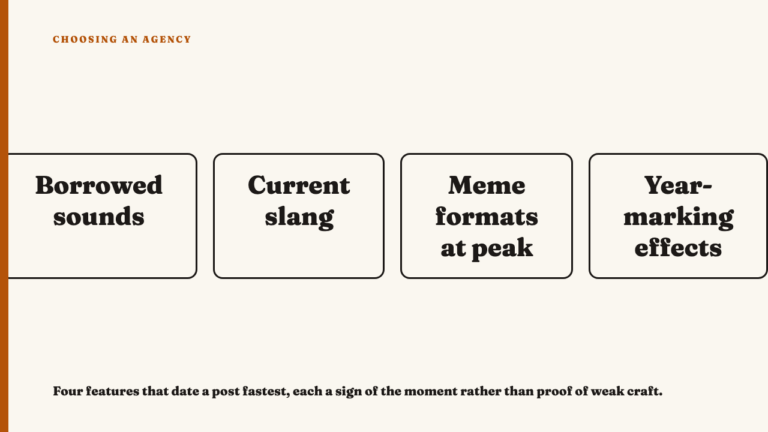
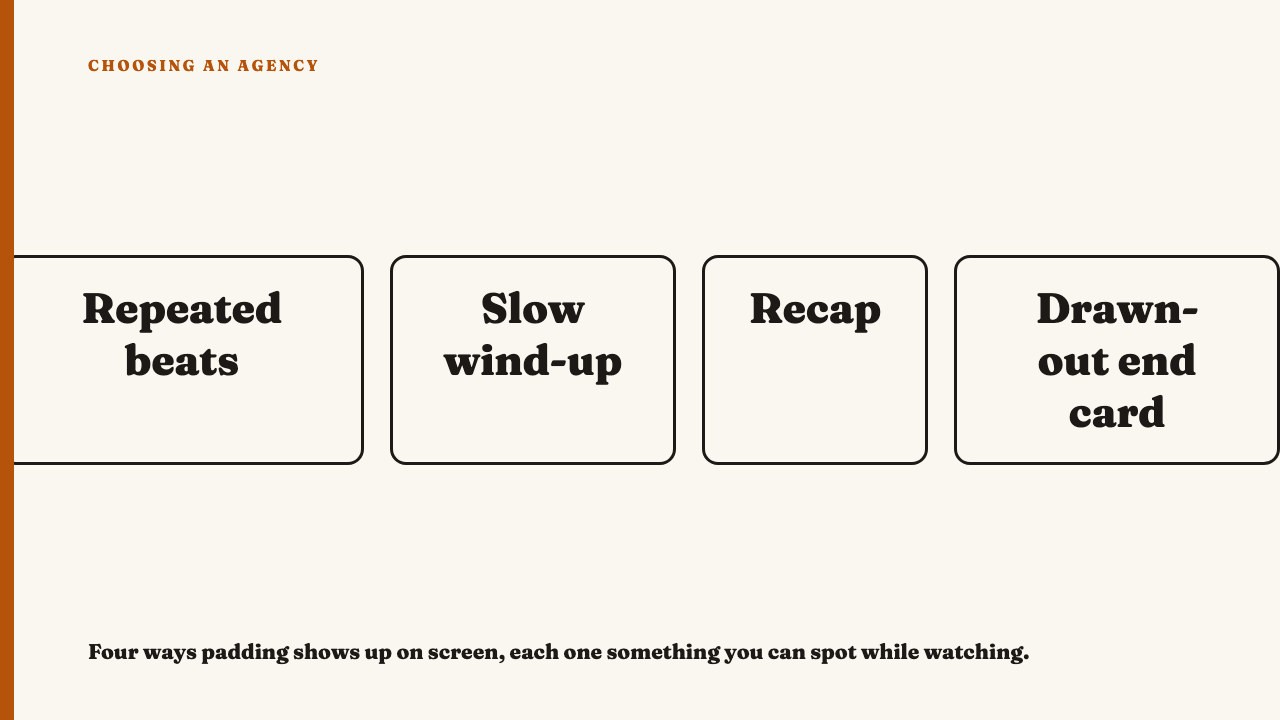
Four ways padding shows up on screen
Repeated beats
The same point is made a second and third time, with different footage or a reworded line. Frame to frame it looks like variety: new location, new angle, new phrasing. Swap the second and third examples and nothing changes, so they are one beat stretched. The tighter version would pick the strongest example and let it land once.
The slow wind-up
The opening spends several seconds explaining what you already understood from the first shot or the title. A product is on screen and a voice says what the product is. The tighter version trusts the image and starts at the first moment of actual content.
The recap
The closing stretch restates what you just watched, often with on-screen text summarising the video in three lines. If the video worked, you do not need the summary. The tighter version ends on the payoff.
The drawn-out end card
A logo or call to action is held long after the idea has landed, with the screen going quiet. The wider question is covered in how a post ends. The tighter version gives the card only as long as it takes to read.
The opposite miss: an idea squeezed into too little time
Short is not automatically disciplined. A compressed idea has cuts too fast for the eye to register the image, a turn that lands before the setup is understood, or on-screen text that disappears before you can finish reading it.
The viewer test is direct: did you need a second viewing just to understand what happened? And if you did, was that deliberate? Some pieces are built to reward a rewatch, with a detail you only catch the second time. A second viewing forced by speed alone is not a choice.
Cutting hard is a skill only when the viewer still gets the idea. If the idea needed room to land and did not get it, the result is another form of the same mismatch, just pointing the other way.
Using this on a whole portfolio reel
One video tells you little. Run the test on three or four pieces from the same reel and look at the set. If every video lands at a similar runtime regardless of how big its idea is, that suggests a house length rather than a considered one.
What good looks like across a set is runtimes that vary with the ideas. The short pieces are short for a reason, one turn and done. The longer pieces hold attention because each beat adds something, and the middle is missed when you imagine it gone. For the cutting decisions behind that pacing, see editing decisions that separate good social video from filler.
A quick note card to keep beside the screen
- What is the idea, in one sentence?
- What would disappear if the middle went?
- Which padding tell appeared: repeated beat, slow wind-up, recap, or drawn-out end card?
- Did anything feel rushed, or need a second viewing it did not earn?
See the taste in practice
Editorial selection is this kind of judgement applied carefully. You can see this year’s selections to look at agencies we picked and why, or nominate an agency whose work you think holds up.
FAQ
How do I know whether a video is padded or just slow on purpose?
Slow on purpose gives you something new in each beat, such as mood, tension or detail. Padding repeats or restates. Run the cut-the-middle test: if the payoff survives losing the middle, it was padding, and if it does not, the slowness was doing work.
Is a shorter video always better?
No. Compression is a craft miss when the idea needed room to land. Watch for cuts too fast to read, a turn that arrives before its setup, and text that vanishes early, then ask whether you needed a second viewing you did not choose.
Sources
- Judging the first three seconds of social video, fetched 2026-10-14
- Judging craft in longer-form social video, fetched 2026-10-14
- Judging how a post ends, fetched 2026-10-14
- Editing craft in social video, fetched 2026-10-14