When a brand voice is distinct and when it is only loud
You are looking at an account whose captions land. The lines are sharp, the timing is good, and you have caught yourself thinking that whoever writes this can write. The reaction is real, but it does not tell you whether the voice was built for this brand’s audience or whether it is a confident general purpose register sitting on this logo for a quarter.
Confidence is not the same as fit
Two traits get collapsed into one judgement because they arrive together. Distinctiveness means the copy reads as confident, has a personality, and stands clear of the corporate default of announcements and adjectives. Fit means the voice is built around specifics only this brand’s audience would recognise. A voice can have the first without the second, and plenty of admired accounts do.
Distinctiveness alone has a look. Exclamation heavy copy. Self aware humour about being a brand online. Short, clipped sentences that land like punchlines, with the turn in the last three words. All of it reads confidently regardless of what it is attached to, which is the problem. The register is doing the work, and a register is portable, a point close to what separates a written caption from a filled in one.
The swap test
Pull three or four representative posts. Not the best one, not the throwaway reposts, a fair sample of the normal output. Read each caption again, mentally replacing the logo, handle and product name with a different brand’s in the same or an adjacent category. A different sneaker brand. A rival coffee chain. Then ask whether the line still reads naturally.
The logic is blunt. If the copy survives the swap unchanged and still sounds like it belongs, the voice was never built around this brand. If it breaks, if the joke loses its subject, if it claims something the substitute could not, that is evidence of fit. This is a silent exercise, ninety seconds a caption, and you do not need a real competitor to stand in, because the test is not about the rival. It is about whether the words are anchored to anything.
What a tailored voice sounds like
Fit shows up as legibility that is uneven by design. Some of the copy only fully lands for someone who uses the product: an in joke about a pain point everyone in the category quietly has, a callback to a step nobody outside would think about. The attitude is anchored to a product mechanic, a ritual or a complaint rather than floating free. The humour has a subject, usually the fiddly bit or the thing customers get wrong first time, not the brand’s cleverness.
Picture a hypothetical cleaning brand whose refill is a concentrate tablet you drop into tap water. A tailored caption might build its joke around watching the tablet fizz at the sink for ninety seconds, treating the pause as an unwanted moment of self reflection. Anyone who owns one knows that pause. Swap the logo for a rival spray that arrives ready mixed and the joke has no referent. That failure to transplant is the point.
What a loud but generic voice sounds like
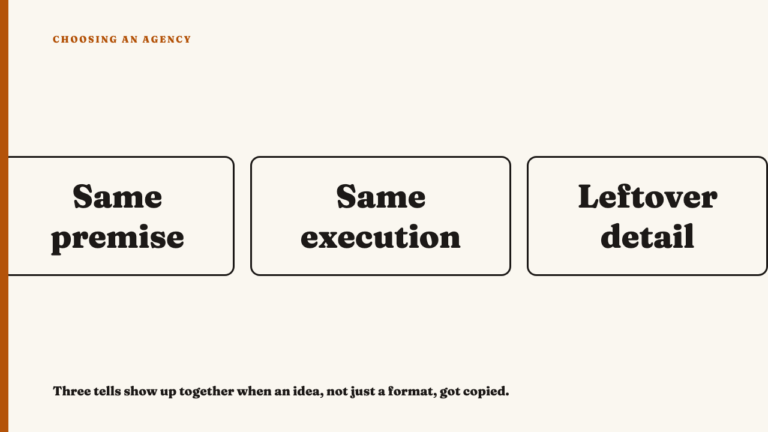
The failure mode has consistent tells:
- Exclamation points and capitals doing the job a point should do.
- Sarcasm and hot take formats untethered from any product claim. The shape of an opinion with no opinion inside it.
- “We are not like other brands” energy that never says what this brand is.
- One liners that could be reposted verbatim under a competitor’s logo with zero rewriting.
What links them is a decision to signal personality through delivery alone, without the harder work of being specific to anything. The test catches it because delivery transplants cleanly and detail does not.
Consistency is not the same as specificity
Here is where good accounts get overrated. Internal consistency means every post sounds like it came from the same place: same rhythm, same length, same register. Audience specificity means the content carried by that voice is built around this category and these customers. An account can score full marks on the first and sit flat on the second, because a house style, applied rigorously, still survives a swap.
Consistency is necessary, not sufficient. It tells you someone wrote guidelines and enforced them. It does not tell you the guidelines were built for this brand, so do not stop evaluating a voice because it reads coherently post to post. The same distinction runs through how to judge a brand account built around a persona.
Running the test across a body of work, not one caption
One caption proves almost nothing. A witty post can pass on one good joke while the rest is interchangeable. Sample across time and formats: captions from months apart, a video script, a campaign and an ordinary week.
Say you run it across six posts from a hypothetical subscription dog food account. Two break the swap cleanly, both built on the business of a dog refusing a new food for three days then pretending it was their idea. Four survive without a scratch: general dog owner humour, a trend format, self aware brand commentary. The verdict is not a tailored voice. It is a portable house style with occasional flashes of specificity, a more useful read than praise or dismissal, and one that sits inside what actually separates good social media work from average.
Take it further
Run the test on the next three accounts you are told to admire. The ratio of specific to portable copy tells you more than any showreel. To see the standard applied to real work, see this year’s selections. If an agency’s writing keeps breaking the test in the right direction, nominate an agency.
FAQ
Does a tailored voice have to be quieter or less punchy than a loud one?
No. Punchy and specific are not opposites, and the test says nothing about volume. Some of the most tightly tailored copy is the loudest, because a joke built for one audience lands harder than a safe one. You are testing whether the substance under the punch belongs to this brand and no other.
What if the same agency writes several accounts in a similar voice?
That is the clearest failure the test catches, and the substitute brands already exist in the agency’s portfolio. If the same joke structures and formats appear across several client accounts with only the product name changed, that is a copy paste voice being resold, not one built per audience. Shared craft is a good sign. A shared script is not.