What a Social Agency Portfolio Leaves Out
You have read every case study on an agency’s site and you are no clearer than when you started. Entry by entry reading answers a question about individual pieces of work. The one you arrived with is about the agency, and it is answered by the shape of the collection.
Every portfolio is an edit, not a record
A portfolio is chosen, not comprehensive, and the choosing is where the information the agency did not mean to give away lives. Each entry is controlled; the set is not, because it can only be built from what exists. An agency can write a beautiful case study about a mediocre project. It cannot write one about a client it does not have or a capability it never delivered.
That is survivorship bias, a recognised error of concentrating on what passed a selection process while overlooking what did not. Curation is not the accusation. It only makes this a different exercise from asking whether a single entry is even real. That is a question about one piece of work; this is about the pattern the set makes.
Check whether every entry is a launch
A launch-only portfolio has a recognisable texture on screen. Hero video at the top of every case study. Campaign key art in film poster style. A results block framed around the first week. Words like rollout, debut, and activation in the headers.
What you will not find is an account at month seven, in a stretch where the brand had nothing new to say. That middle is most of the job, and it photographs badly. The absence does not show the agency cannot sustain that run. It shows the portfolio holds no evidence either way, an open question rather than a reassurance.
Count how many times the same client shows up
Repetition hides well, since each entry reads as a separate achievement. The fix is procedural.
- Open every case study in its own tab before reading a word of it.
- In each tab, find the client name only, usually in the page title, the first line, or a logo above the hero.
- Write the names down and count the duplicates. A client appearing three times in a set of eight is a fact about the agency.
Two explanations fit and the portfolio will not tell you which applies. One is a long relationship that genuinely produced several distinct bodies of work. The other is a thin roster, where the one client who agreed to publication has been stretched across several entries. On the page they read identically.
Check the dates, not just the year on the case study
Picture an undated entry for a regional restaurant group. It looks current. Three things will date it. Any platform link in the entry carries a real post date on the other side. Interfaces change, so work sitting inside a profile layout you no longer recognise is older than the page implies. And a cited follower count can be set against the live account, because a number that has barely moved tells you when the work stopped.
That live account is a reference point, not a verdict, much as an agency’s own account is weak evidence on its own. A portfolio with nothing datable as recent is not evidence of decline. It is evidence of nothing recent, and those are different findings.
Look for a named capability with no example behind it
Services pages and portfolios rarely reconcile. Do it yourself, with a two column check as you browse.
- Left column: every capability claimed on the services or about page. Community management. Paid social. Influencer work. Content strategy.
- Right column: the case study demonstrating each one. A passing mention inside an entry about something else does not count; you want an entry where that capability is the work.
- Read the unmatched rows. Those are the claims the portfolio chose not to prove.
An unmatched capability is not a lie. It may be new, deprioritised, or an add on to a paid engagement. But the agency had the chance to show it and did not, so do not assume it. A matched row still leaves open how much of that work the agency actually did.
Read the selection as a whole before you read any entry again
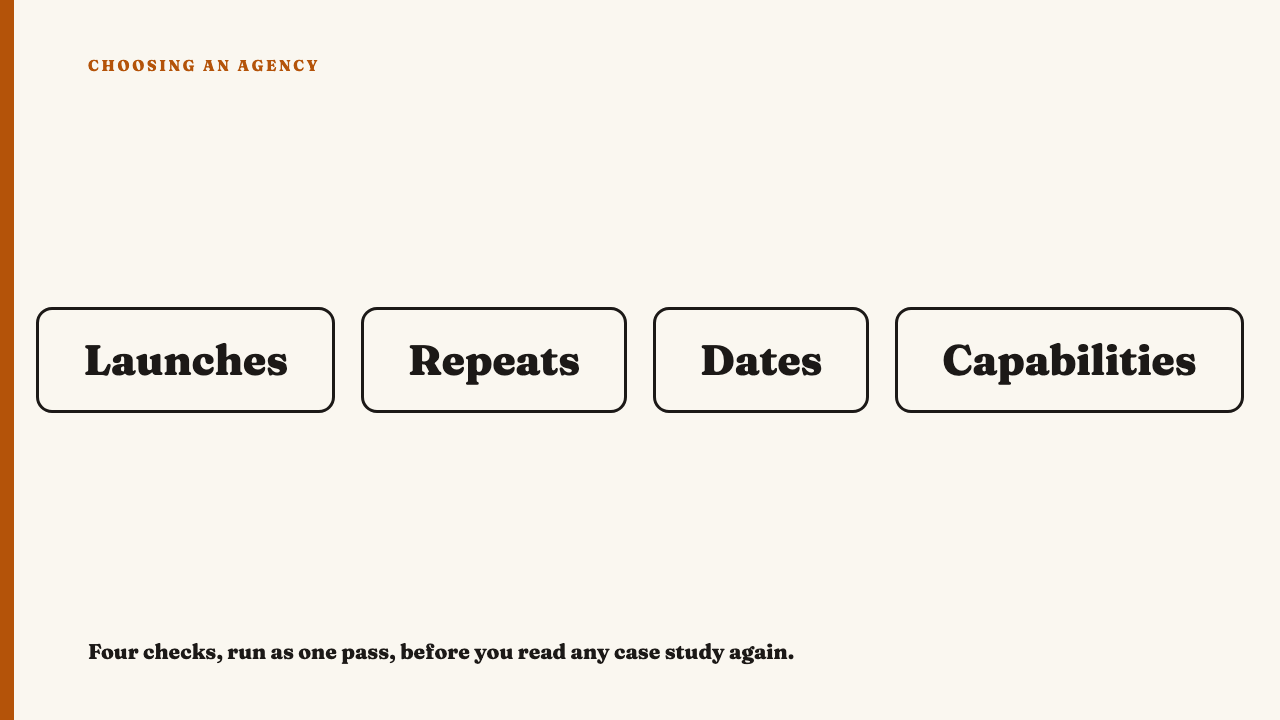
Run in sequence, the four checks are one pass. Open every entry, collect the client names, count them. Note which are launches. Follow the embedded links for real dates. Mark which capabilities are proven. You are not judging whether the work is good. You are describing a set: eight entries, five clients, one of them three times, mostly launches, three capabilities of four proven.
None of that proves the agency is weak. The pass gives you a list of what the agency chose not to show, and what to raise directly if it matters. For the standard on whether the work itself is good, start with what actually separates good work from average.
Where our own selections come from
We read portfolios this way before writing about anyone. Agencies featured here are nominated or scouted, chosen editorially, and we say why. You can see this year’s selections, or nominate an agency.
FAQ
Does a launch-heavy portfolio mean the agency cannot handle the unglamorous middle of an account?
No. Absence of evidence is not evidence of absence, so you have nothing to go on there, and reading silence as a negative finding is as much an error as reading it as reassurance. If ongoing work matters to you, look where it would be visible: a live client account you can scroll back through.
Is it normal for an agency to repeat one client across several portfolio entries?
It is common, and both readings stay live: a strong long relationship, or a thin roster. The copy will not separate them, so read the phases. A launch, then a year of running the account, then a rebrand are three phases of one relationship. The same launch told from the strategy angle, the content angle and the results angle is one piece of work three ways.
How do I check whether a portfolio’s newest case study is actually current?
Date it from the inside, not from the page. Follow any platform link in the case study, since the post on the other end carries a real date. Check whether the interface in the screenshots is the one you see today, and set any cited follower count against the live account.
Sources
- Survivorship bias, Wikipedia, fetched 3 September 2026.