Handheld on Purpose or Handheld by Default: Phone-Shot Video
You are watching an agency reel and most of it was clearly shot on a phone. Some of it looks sharp and some looks like a pocket recording, and you cannot tell whether the gap is taste or accident. Phone footage is not the problem. Footage nobody decided anything about is.
Why phone footage is the hardest thing in a reel to read
A conventional shoot offers proxies for effort: a rig, a lens, a crew in the behind-the-scenes cut. Phone footage strips them away, so the only thing left to judge is decisions. Did someone choose where to stand, where to point, and what the room looked like when the button was pressed?
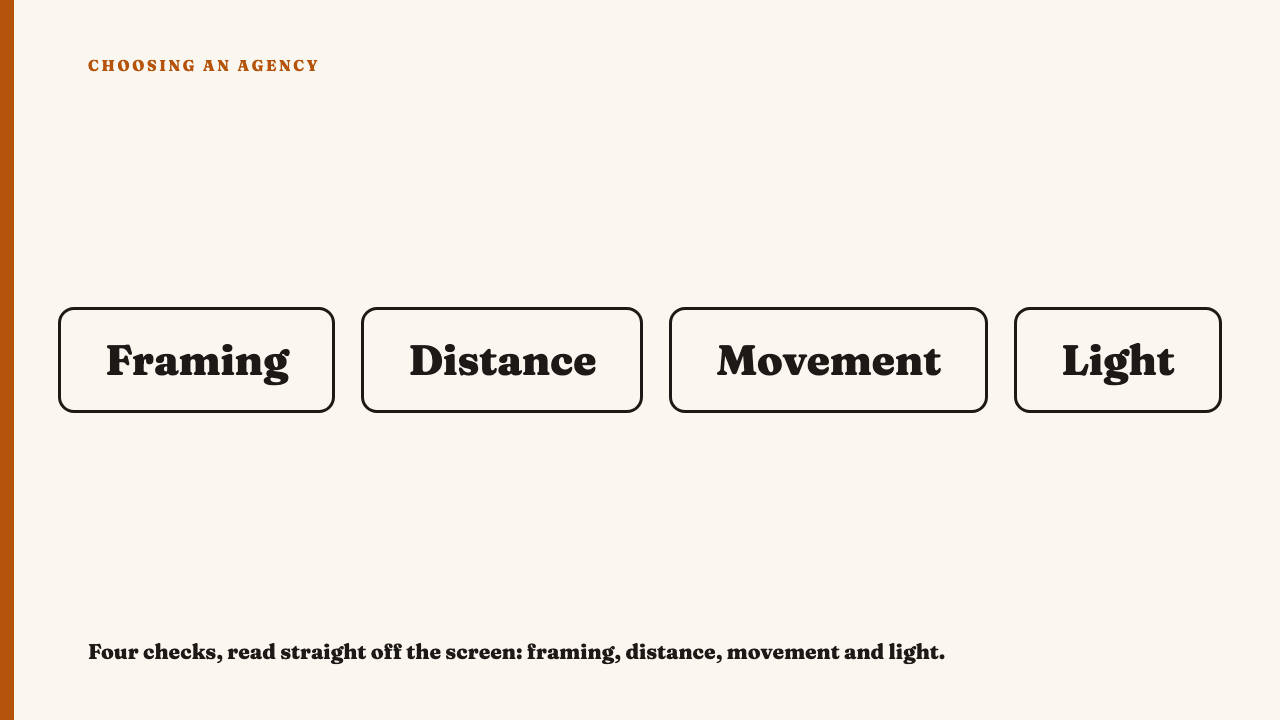
A rough look is not evidence of skill or of carelessness. The only evidence is whether the choices repeat sensibly from shot to shot. This post checks four things: where the subject sits in the frame, how close the camera is, whether movement has a reason, and whether the light was chosen. It reads the screen. No equipment is being judged, and none is recommended.
Where the subject sits in the vertical frame
Picture the default frame. The subject is dead centre, a hand’s width of empty ceiling sits above their head, and the bottom edge cuts through the feet or the table at an arbitrary point. Now picture the chosen one. The subject sits low and off to one side, and the tall empty space above is doing a job: it carries the joke, or leaves room for the product to arrive.
Then run the overlay test. Pause on a frame and ask whether the captions, buttons and account name would cover the thing the shot is about. On most vertical feeds you can see those elements sitting over the lower part of the frame and along one edge. A product held at the bottom of the picture loses to the interface.
Last, compare across cuts in one clip. The same framing from shot to shot suggests a plan. Framing that drifts suggests the phone was pointed at things.
Distance: how close the camera chose to be
Most phone footage starts from the arm’s-length selfie. At that range a wide-angle camera stretches whatever is near it: nose and forehead swell, and door frames bend at the edges. That can be a deliberate comic or intimate choice. It is a default when it is simply where the arm ended.
Look instead for a shot where the camera is clearly further back and the subject has room. No distortion, air around the person, visible surroundings. That tells you someone chose a position and put the phone there.
A quick test: does the distance change when the content changes? A face, a product detail and a wide moment should not all sit at the same arm’s length.
Movement: shake with a reason versus shake that is just there
Ask one question of any camera move: what is it following, revealing or reacting to?
- Chosen: the move begins and ends on something, speeds up or settles with the action, and keeps the subject in frame throughout.
- Default: constant low-level drift, a reframe that arrives a beat late, pans that stop nowhere in particular.
- The opposite failure: a smoothed, stabilised look that fights the footage. It loses the energy of handheld and still hides that nothing was planned.
- Where to look: the first half second of each shot, where lack of intent shows most.
Light: chosen, found or merely present
Chosen light is visible. The subject faces or sits beside a window or other source, the face is readable, the background is darker or calmer than the subject, and skin and product colour look intentional.
Default light gives itself away too: auto-exposure visibly pumping when the subject moves, blown-out windows behind a dark face, mixed colour casts on one face, or flat overhead office light that makes everything the same grey.
A moody, dark look can be a decision. The test is whether the thing the viewer needs to see is still clear. And if the same scene is lit differently from shot to shot, nobody was in charge of it.
A side-by-side reading: two imagined clips
Both clips are illustrative, not real work. In each, someone unpacks a product at a kitchen table.
Clip A. The camera sits back and to the side. The person occupies the lower left of the tall frame, and the upper right holds the box as it rises into view, clear of where captions would sit. A window they face lights them, the wall behind is calm, and the product colour looks true. The camera drifts in once as the lid lifts and settles when the product is out. The next shot, a label detail, keeps the same side and the same light.
Clip B. The person is centred with a gap of ceiling above, held at arm’s length so the forehead looks stretched. The product vanishes behind where the account name would sit. The window behind is blown white, the face is dim, and exposure lurches brighter when they look down. The camera drifts throughout and reframes a beat late. The next shot is the same distance at a different brightness.
On the four checks, A passes each and repeats its choices, so someone decided. B shows no decision on any, so the phone did the directing.
What to do with the reel once you have the checklist
- Compare the best clip in the reel with the most ordinary one. If the same decisions appear in both, it is not luck.
- Look across different clients’ footage. Consistent camera, distance and light choices mean someone is directing. Variation without reason means the phone did.
- Keep the question narrow. This reads camera work only. Whether a rough style is itself justified is a separate question, and this post does not argue it.
- Read the other half of video craft in the editing decisions that separate good social video from filler, and see telling a custom shoot from treated stock footage if sourcing is in doubt.
- Watch with the sound off: judge it muted first. The same eye applies to stills in judging a photography-led account.
Try it on real work
To practise on real material, See this year’s selections. We choose agencies editorially and say why. If you know an agency whose camera work shows these decisions, you can nominate an agency.
FAQ
Is phone-shot footage a bad sign in an agency reel?
No. The question is whether choices of framing, distance, movement and light are visible and consistent. Phone footage with those choices beats polished footage without them.
How can I tell handheld shake is deliberate?
Ask what the camera is following or reacting to, and check whether moves begin and end on something. Constant drift with late reframes is default.