How to Tell Concept Work From Work That Actually Shipped
You are three cases into an agency’s portfolio, the imagery is excellent, and you have no idea whether a client published any of it. Whether it shipped is the first question.
The distinction that matters more than quality
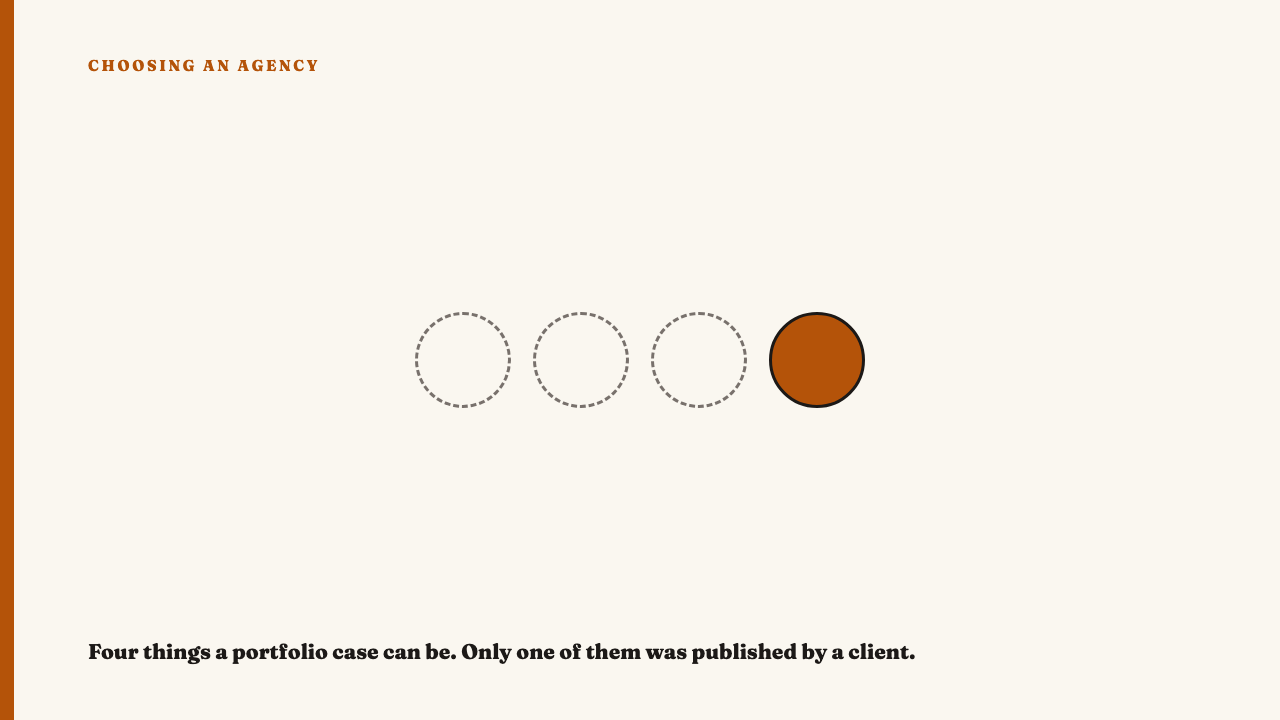
Shipped versus not shipped is a sharper filter than good versus bad, because it does not depend on your taste. Any case is one of four things, often unlabelled: a pitch comp for a lost brief, a self-initiated rebrand of a brand that never hired them, a concept a client killed, or work a client published.
Only the fourth survived anything. Concept work never passed an approval chain, a legal or compliance review, a budget ceiling, or a client with standing to say no. Craft made without those four constraints is weak evidence of craft made inside them, which is why it outranks your read on the work.
None of that is an accusation. Showing speculative work is normal and openly discussed in the creative trades. The failure is counting it as delivery evidence.
The words that signal concept work, and why silence signals nothing
Some vocabulary is effectively a disclosure.
- Plain labels. Concept, concept campaign, unsolicited redesign, spec, speculative, passion project, personal project, self-initiated, exploration, visual direction, just for fun.
- Softer constructions that do the same job. Reimagined, our take on, what a brand could look like.
- A case that never commits. An idea and an aesthetic, but no launch, no run date, no placement.
- The credit block. Delivered work usually credits a client and often names roles. Concept work credits only the agency or one designer.
An unlabelled case is not thereby a shipped case. A missing label is the reason to look, not permission to stop.
Go and find it on the brand’s own account
Take the brand named in the case, open its own account on the platform the work claims to have run on, and look for the specific asset. Not a mood, the artefact: the same photograph, the same headline, the same frame. Portfolios often show a variant that never ran.
Then check the date. A claimed campaign period with nothing findable inside it is the clearest single tell. If none is stated, look for a date on the posts.
Recognise a mockup. An asset in a phone frame, on a photographed billboard, or in a flat grid the agency built is a presentation of the work, not the work. Real platform chrome, a real caption and a real comment count are the work in the wild.
Widen before concluding. Check regional and sub-brand handles, other platforms, and placements you cannot browse, paid or stories. For anything deleted, the Wayback Machine takes a profile or post URL. A hit is evidence it existed. A miss proves nothing, since social pages archive unreliably.
The checks, and what each one is worth
| The tell | Where to look | What it proves |
|---|---|---|
| No client credited | Credit block, case footer | Suggestive, not conclusive. Some clients forbid credit. |
| No date or campaign window | Case header and body | Strongly suggestive. Delivered work has a run period. |
| Asset absent from the brand’s live account | Grid, reels tab, tagged posts | Conclusive only after widening. Alone, unverified. |
| Every visual is a render | Any real chrome, caption or comment count | Suggestive. |
| An idea and an aesthetic, never a placement or approval | What the prose commits to | Suggestive. |
| Explicit concept or spec language | Title, first paragraph | Conclusive, to the agency’s credit. |
When you cannot find it
Plenty of real work is not findable. The account was rebranded or archived. Posts were deleted after the campaign. It ran as paid social, only in stories, or on a regional handle. The audience was internal or B2B and never touched a public feed.
The rule is narrow. Absence moves a case to unverified, not fabricated, and unverified work carries no weight either way. Ask the agency. The answer is the evidence you lacked.
What to actually ask, and the answers that should worry you
Send this:
I liked the campaign in your third case study. Is there a link to where it ran live? Any platform is fine.
That asks for a link, not an accusation, and two answers resolve it: the link, or a statement that it was a concept plus a pointer to something that shipped.
Four answers should worry you: that public social work is confidential; a pivot to the idea rather than the placement; a screenshot instead of a link; a retreat to “that one was a concept for them” after the case implied otherwise. An agency that labels concept work unasked has shown you how it will report later.
Concept work is evidence of something, just not of that
Concept work evidences taste, range, a point of view, and the ability to have an idea. It cannot evidence working inside an approval chain, holding a line under legal review, sustaining quality across a run rather than one hero frame, or producing on someone else’s schedule.
So the weighting rule: labelled concept work plus a few findable shipped pieces beats a bigger portfolio where you cannot tell which is which. Apply what separates good social media work from average to the real ones. Run the check before you form an opinion, not after. It gets quick.
Selections, and how to put an agency forward
Selections here are editorial: nominated or scouted, we choose, and we say why. Start from the homepage, and if an agency’s work holds up, nominate an agency.
FAQ
Is it dishonest for an agency to show work a client never published?
No. Speculative work is a recognised practice in the design trades, with a defined meaning and a live public argument about whether it should exist. Judge the labelling, not the work’s existence.
What if the client will not let the agency name them?
That restriction is real and common. It changes what you can verify, it does not excuse the gap. An anonymised case can still carry a platform, a period, and a description of the constraint it worked inside. If it carries none of those three, treat it as unverified for your purposes.
How much shipped work should I expect to find?
There is no defensible number, and inventing one would be fake precision. Read it as a ratio against the agency’s claimed size and tenure, then ask: is anything findable at all?
Sources
- Speculative work, Wikipedia. Fetched 25 August 2026.
- Spec Work, no-spec. Fetched 25 August 2026.
- The Wayback Machine. Fetched 25 August 2026.