Judging a UGC Challenge: The Mechanic, Not the Best Posts
An agency shows you a hashtag challenge and the case study carries three submissions. They are good. One is genuinely funny. That is not the campaign, it is the campaign’s best output, chosen by the people who ran it. The rule that told strangers what to make is not on the page.
The mechanic is a separate decision from the content it produced
Two craft questions get collapsed here. The first is whether the ask was well designed: what people were invited to do, how hard it was, and why anyone would bother, all settled before any content existed. The second is whether a given submission is good. A wide pool produces outliers by arithmetic, which is the same reason one excellent campaign tells you almost nothing.
The reverse lands worse. A well designed mechanic can produce a stream of forgettable submissions and still be excellent work, because its job was to shape participation, not to guarantee any entry went anywhere. Evaluate the ask on its own terms first.
What a low friction ask actually looks like on screen
Friction is the distance between reading the ask and having something to post. A low friction ask is one clear action, completable in a single take, on the phone the person is already holding. Do the gesture your team does when a shift ends. No template to download, no editing software, no second person to hold the camera. The demanding version wants a split screen, a transition that only works if you can mask a frame, an audio layer you sync yourself. Each step filters the pool down to people who already make content and own the tools, which is an open call for creators, not a participation campaign.
The other extreme is more common. Post something and tag us imposes no friction because it imposes no form, and gives participants nothing to react against. That is not a mechanic. It is the absence of one, wearing a hashtag.
The creative constraint is what makes the mechanic worth judging
A real constraint is a structural rule visible in every entry. A prop or object that must appear. A transformation or reveal partway through, giving every entry the same skeleton of timing. A line that must be said, a sound cue, a gesture that must occur. The test is whether you could write the rule in one sentence and a stranger could tell whether a clip followed it.
What a constraint buys is recognisable variation. Everyone obeys the same rule and fills it with their own material, so the entries read as a family rather than a copy-paste job. It is also where the line sits between structure and imitation, read alongside where using a format ends and copying an idea begins.
The absence is obvious once you look. Scroll the tag itself rather than the case study. If the entries share no visual throughline, no repeated beat, no common object or phrase, and only the caption ties them to one campaign, there was no constraint.
Riding a trend format is not the same as designing a mechanic
Joining a circulating trend format is a single post choice, made on the brand’s own account, using a shape somebody else established. The craft there is timing and fit, covered in the difference between joining a trend and being late to one. Designing a mechanic happens earlier and points outward: a structural decision taken before any content exists, whose output is not a post but a rule outside participants repeat, unsupervised.
Borrowing the shell of a known trend format does not disqualify a mechanic from counting as design, if the agency added its own constraint and its own payoff on top. Re-hosting the trend unchanged under a branded tag does not count. Ask what the agency added. If the answer is a hashtag, you have your answer.
What counts as a real payoff for participating
Something has to sit on the other side of the effort, and the legitimate versions are narrow:
- A stated, genuine chance of being featured on the brand’s own channel, with clear criteria and evidence the brand actually did it.
- Recognition tied to the creative act itself, non monetary, where your version gets seen and named as yours.
- A small prize proportionate to the ask. A large one says the design could not motivate participation on its own.
The illegitimate version shows up in the terms rather than the headline. Follow the account, tag two friends, optionally post something with the tag. The creative step is an afterthought, and the real mechanic is a follower requirement in challenge costume.
Reading a portfolio for the spread of submissions, not the highlights
Notice how many submissions the agency is willing to show. Three strong entries and nothing else means you have seen its ceiling, not its floor, and the floor is where design quality lives. An agency confident in its mechanic shows the ordinary middle, because a good rule makes those entries watchable too. That omission belongs with what a portfolio leaves out.
Then put several submissions side by side and answer the constraint question yourself instead of taking the agency’s word for it. Do they look like variations on one clear rule you could state out loud after watching three, or do they share a tag and nothing more?
Judge the design before you scroll to the results
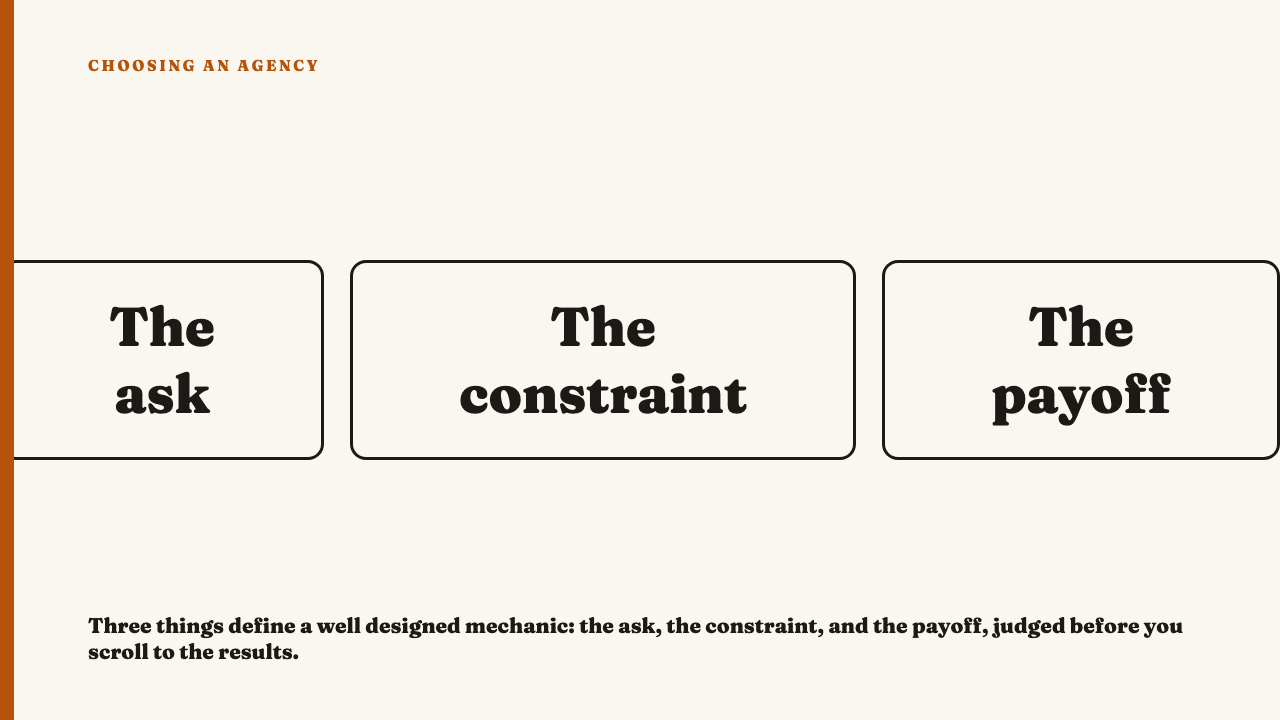
Look at the ask, the constraint, and the payoff first, and decide what you think before you see a single submission. Done that way, strong entries become evidence about a design you have already assessed.
Where to look next
The agencies we write about are selected editorially, and we say why in each entry. See this year’s selections to read these judgments applied to real work, or nominate an agency whose participation design deserves attention.
FAQ
Can a poorly designed hashtag challenge still produce a few great submissions?
Yes, and it routinely does. Assess the ask, the constraint, and the payoff, and treat the best two or three results as the least informative evidence on the page.
Does a hashtag challenge need a prize to be well designed?
No. The payoff can be non monetary, a genuine chance of being featured or recognition tied to the creative act itself. A prize does not repair a mechanic with no real constraint, it just buys entries, and a strong constraint often needs none at all.