Judging the Day After an Agency Goes Viral by Accident
An account posts something ordinary on a Tuesday and by Thursday it has an audience it never planned for. That part is luck, and it says almost nothing about the agency behind it. What matters is the week that follows: does the voice bend toward whatever made the post take off, does the account go quiet, or does it acknowledge the moment once and get back to work. That week is the real craft test, because it is the only part the agency controlled.
The Two Wrong Moves Look Like Opposite Instincts
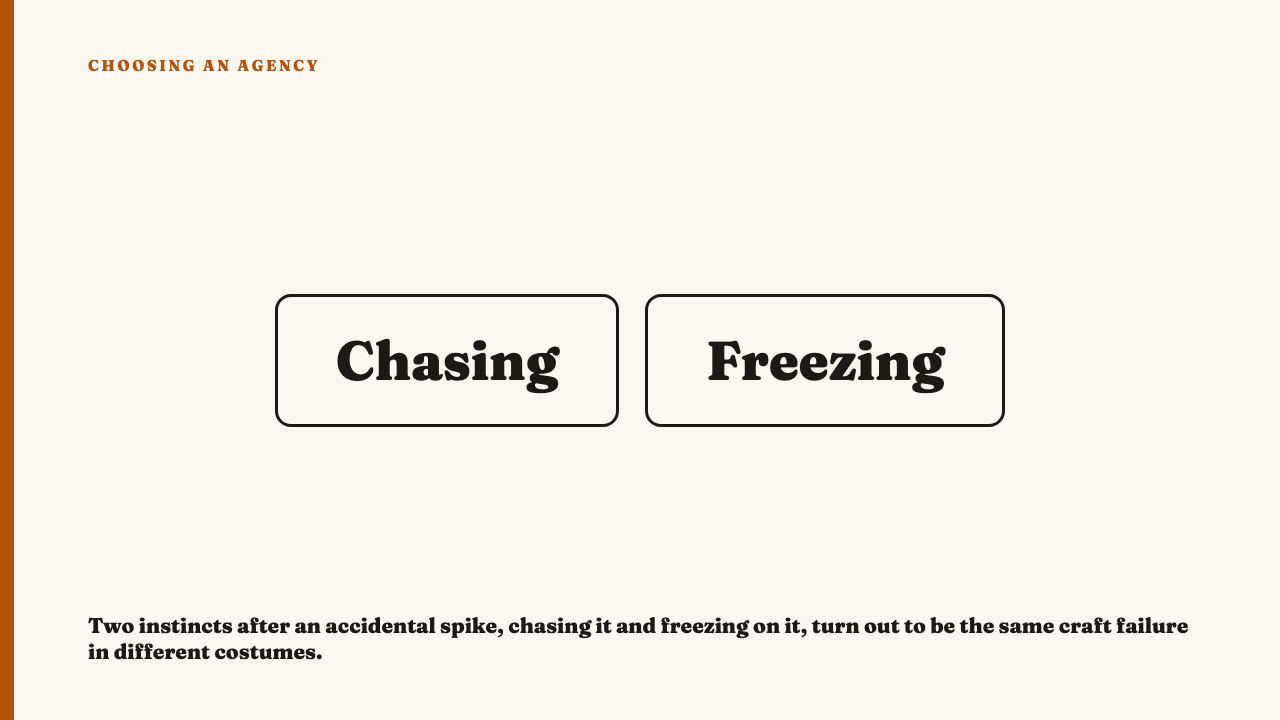
Chasing and freezing feel like different temperaments, one eager and one cautious, but they are the same mistake in two costumes. Both treat a single unrepeatable event as information about who the account should permanently become.
Chasing is easy to spot. The account’s tone shifts toward the viral post’s, posting frequency jumps for the week, and the joke or format that worked gets repeated, as if the account had found a formula rather than caught a break.
Freezing is quieter and just as costly. The account says nothing about the moment, or reverts so hard to the existing plan that the spike might as well not have happened, even as new comments and followers arrive on the same screen. That is not discipline. It is a missed chance to speak to the people who just showed up.
Both come from the same misreading: a fluke treated as a formula, or as a non-event. A single post going wide is data about the moment, not a referendum on identity.
What Steady Handling Actually Looks Like on Screen
Picture a composite, unnamed account with an ordinary posting rhythm that catches an unplanned wave. In the days after, the strongest version posts one thing acknowledging what happened, in its own normal voice rather than the viral post’s tone, a short line thanking new followers or a passing aside in the next scheduled post. The calendar continues as if that acknowledgment were just another entry in it, because it was.
What is more telling is what does not change: posting frequency, bio, pinned content, and the usual content mix all hold roughly where they were.
Now picture the chasing version, posting three or four variations on whatever worked that week, visibly trying to recreate the accident. An account with a legible identity starts to read as a tribute act to its own best week.
Why Overcorrection Is a Craft Failure, Not a Growth Strategy
Chasing can look like resourcefulness rather than waste. That gets the mechanism backward. An account’s value comes from a consistent voice built over months of ordinary posts, and one outlier, however large, is weak evidence about what that voice should become. The visible tell is a reset: positioning, subject matter, or tone shifts noticeably around the spike date and never fully returns, because nobody made the deliberate decision to go back.
The Quieter Failure: Freezing Out of Caution
The mirror-image mistake gets less attention because it looks like nothing happened. An agency committed to its plan can let a real audience moment pass with zero acknowledgment anywhere on the timeline, even as new followers and comments visibly arrive on the post itself.
A single, low-key acknowledgment is not chasing, and neither is replying more actively for a few days. Those cost almost nothing. Freezing is the absence of any of that, sustained past the point where it reads as intentional. Silence here is not caution. It is a missed opportunity that happened to be free.
How to Read the Timeline After the Spike
A reader can work through a short sequence of checks on any account’s history around a spike.
- Compare posting frequency in the week after against the account’s normal cadence. A sharp jump either way is the first signal.
- Check whether the viral post’s specific hook or format shows up again. Referenced once is fine. Repeated across several posts is chasing.
- Check whether the bio or pinned post changed to foreground the moment.
- Check how comments and new followers on the viral post were treated: in the account’s usual voice, or ignored.
None of this requires knowing why the post spiked, only what the account did afterward, which is public on the timeline.
The Restraint Test: When Doing Less Was the Right Call
Consider one more hypothetical, deliberately unglamorous. An account has a post take off by accident. Two days later it posts a single line acknowledging the attention, on voice and low effort, then resumes the plan already in motion. Nothing six weeks later would tell a stranger anything unusual occurred, except a slightly higher follower count.
That outcome is often the strongest response available, because it treats the spike as what it actually was, a nice thing that happened, not a pivot point. Judge the days after a spike by how little they disrupted the account’s actual identity, not by how much extra attention the agency tried to squeeze out of a moment that was never going to happen twice.
This is a different judgment call from joining a trend on purpose, which is planned rather than reactive, though it leans on the same case that restraint is its own craft skill. It sits next to a different kind of unplanned moment and shares its demand for composure with work made with no time to plan.
Put This to Use
The best way to test this is against real timelines, not descriptions of them. Browse the agencies in this year’s selections and look at how their accounts have handled unexpected attention over time. If you know an agency whose judgment holds up under this scrutiny, you can nominate an agency.
FAQ
How long after a viral post should you look before judging the response?
Look at roughly a week of posts, not just the next one. A single acknowledgment tells you little on its own. It is the pattern across several posts afterward that reveals chasing or restraint.
Is any change to the account after a viral moment automatically a bad sign?
No. A single acknowledgment, or a short period of more active replies to comments, is reasonable. The red flag is a sustained, repeated pivot in tone, format, or subject matter that continues well past the moment.
What if the account never mentions the viral post at all?
Total silence for an extended stretch, while new followers and comments keep arriving, reads as poor community management, not caution, and it is worse than a brief, low key acknowledgment would have been.