The Bio and the Link Are a Craft Test, Not an Afterthought
Most portfolio reviews start below the fold, straight to the grid, the motion, the captions. The line above gets a second of attention, which is a waste. The bio and the link under it are the only part of the account written under a hard constraint, with nowhere to hide.
The bio is a word economy test before it is anything else
Profile bios run to a short, fixed character limit on most major platforms, a couple of hundred characters at the outside. That constraint is the point: no warm-up sentence, no second idea, no hedging. Something has to be cut, and what survives tells you what the writer understood about the account.
The good version names something specific and checkable. Picture a bakery group whose bio names its cities and says the account posts the day’s bakes each morning. You know whether to follow, and what you are owed if you do. The weak version strings adjectives describing an intention rather than a fact, or lifts a mission statement fragment, a line you could paste onto any competitor without anyone noticing.
A third failure looks like effort rather than laziness. A bio written by committee keeps every stakeholder’s favourite phrase: sustainability, the founding year, the tagline someone in brand is attached to. Nothing was cut, because cutting meant telling someone no. The line reads as a list of approved words rather than a sentence with a point, which tells you the agency did not have, or did not use, the standing to edit its client.
What a good bio actually does in the space it has
Two jobs, worth separating. The first is orientation. A stranger should tell in one glance whether this account is relevant, and whether it is the one they meant rather than a lookalike with a near identical handle. Disambiguation is real work on a crowded platform, and a bio that fails it fails the easiest thing asked of it.
The second is setting an expectation the posts have to meet. A bio promises practical guidance, tips, answers, and the feed beneath it is pure brand entertainment: trend audio, reaction formats, nothing a reader could use. The contradiction is the finding. It means the front door and the house were decided by different people, and nobody reconciled them. It is the same gap as what a portfolio leaves out of a case study.
Reading the link the way you would read any other creative decision
The link slot beneath the bio is a prioritisation decision the agency either made or avoided. A single direct link commits: it names one destination as the thing a new visitor should reach, and it is easy to evaluate against what the account promises. A hub, one profile link opening a page of several destinations, trades that focus for reach, and every extra destination is a decision the visitor has to make.
Past roughly half a dozen destinations with no visual hierarchy between them, the hub has stopped routing anyone anywhere. A bad one is a flat stack of identical buttons, same colour and weight, ordered by whenever each was added: shop, newsletter, podcast, an old campaign page, careers. The visitor is doing the agency’s prioritisation for them. A hub that works ranks visibly, with one dominant destination at the top, larger or contrasting, carrying what the account wants a new visitor to do now, and the rest clearly secondary.
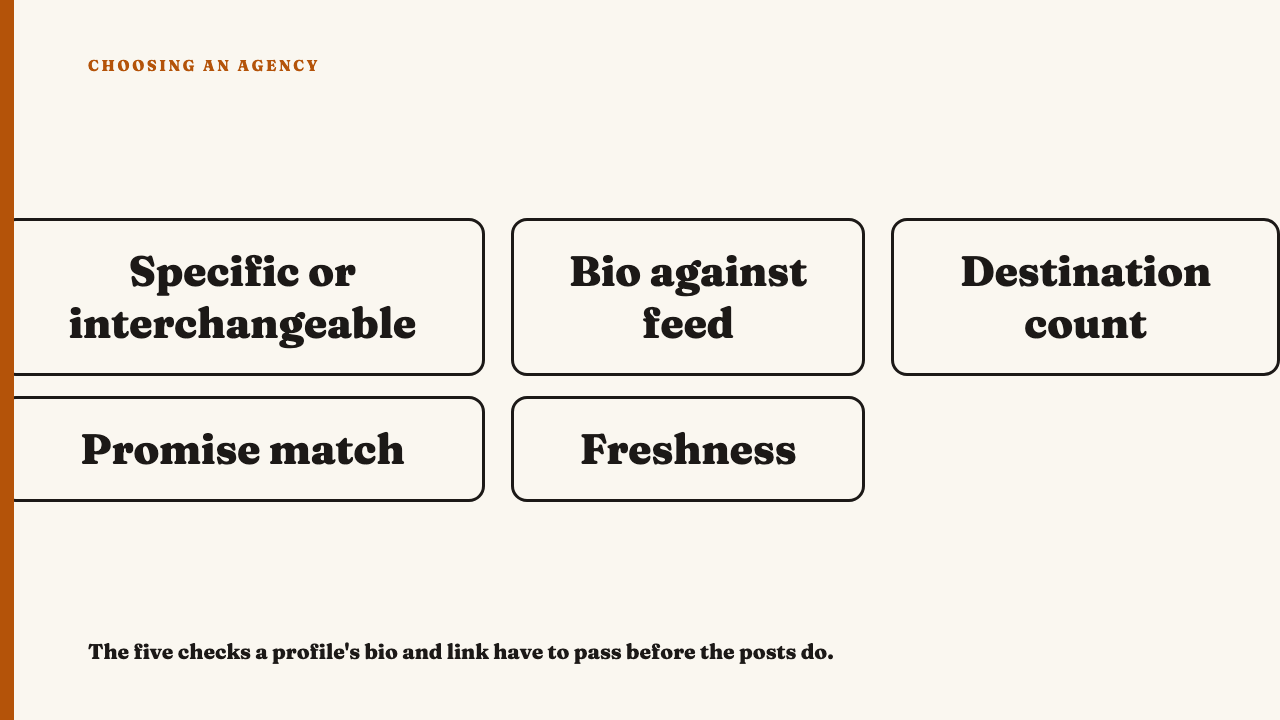
Signals in five minutes: bio and link checklist
- Specific or interchangeable. Does the bio name something checkable, or could it sit on a competitor’s profile unchanged?
- Bio against feed. Do the bio and the first two rows of posts agree on tone and purpose, or does one promise what the other never delivers?
- Destination count. How many places does the link route to, and are they ordered by priority or dumped in a flat list?
- Promise match. Does the destination deliver what the bio or pinned content says it will, or land somewhere unrelated?
- Freshness. Does anything in the bio or hub reference a campaign, offer, event or date that has plainly passed?
A stale bio is a maintenance failure, not a first-draft one
A bio that was never good is a judgment problem at setup. A bio that was good once and has gone stale is worse, because it proves the capability existed and then stopped being applied. A live reference to a collaboration that ended, a countdown to a past date, a hub button for a closed offer: someone wrote that with intent, and nobody came back.
An agency maintaining an account properly treats the bio and link as living copy, revisited whenever what is being promoted changes, not a setup task from the first week. Read it as evidence of process rather than taste, the way you would when reading strategy from public output. The bio is a copy problem under a harsher constraint than a caption, covered in judging caption and copy craft.
Where to take this next
For this close reading applied across a set of agencies, see this year’s selections. If you know an agency whose work holds up under it, you can nominate an agency.
FAQ
Does the bio actually matter if most visitors scroll straight to the posts?
Not every visitor reads it. But the people deciding whether to follow or click through often do, and it is one of the few pieces of the profile the agency controls completely, with no ranking system between the writing and the reader. It is a compressed test of judgment, not a traffic driver.
Is a single direct link always better than a link hub?
It depends what the account needs to route people to. A single link is easier to evaluate and forces a real choice about priority. A hub is defensible when several live things are worth surfacing, but only when it is ordered with visible intent, one clear primary destination and the rest ranked beneath it. A hub used as a dumping ground is not a reach decision, it is the absence of one.
How often should an agency update the bio and link?
There is no correct interval. The front door should change when what the account is promoting or promising changes, so the cadence follows the work, not a calendar. What is worth naming in a review is not a missed frequency but a visibly stale reference: an ended campaign, a passed date, a closed offer still in the link. That is evidence nobody owns the surface.