Judging Craft When One Account Serves Two Audiences
You are looking at an agency’s work for a client whose followers are plainly two different crowds, and every post is captioned as if it were for everyone. You cannot tell whether the agency handled the split with craft or wrote for one group and waved at the other.
The failure is quiet, and it hides behind the caption
A split audience, defined narrowly, is two groups who would not share a vocabulary, a reason to follow, or a tolerance for the same post. Picture a hospital system followed by practising clinicians and local families. Two demographics of the same buyer do not count.
Serving both is a legitimate brief. The craft failure is a post that claims both and serves one. So the core test is plain: ask who the post was built for, not who it says hello to. A caption that opens “Whether you’re a specialist or just curious” is a claim, not evidence.
This is a different problem from judging B2B social work, where one audience is served well or badly. Nor is it a tone question: one voice cannot cover both sides, which is where when a brand voice is distinct and when it is only loud runs out. Here the question is which side is shortchanged.
Read the post before the caption
Captions are the easiest part to make sound inclusive, so start with the asset. Look for assumed vocabulary, an acronym left unexplained, a first frame or first carousel slide that needs prior knowledge, and visual shorthand such as a chart that takes for granted you know what the axes mean.
Two passes. First, view the post with the caption hidden and write down who it seems made for. Second, read the caption and note whether it widens that audience or contradicts it.
The common tell is the post built for the specialist and captioned for the public: a dense chart or jargon-heavy visual with a friendly, generic line stuck on top. The mirror tell is a warm, broad, emotive visual with a single technical term dropped into the caption to signal credibility to the expert. Each was built for one and dressed for the other.
What a post that genuinely threads both looks like
- Layered captions. The first line lands for the general reader without a glossary, and a later line carries the detail the specialist came for. Mashed together, the opening sentence is half plain and half technical, and both readers trip. On most platforms the opening of a caption is what shows before a tap, so that line must work alone. See what separates a written caption from a filled in one.
- Dual visual cues. An image or first slide that works at a glance for one group, with a second layer, a labelled detail or a later carousel slide, for the group who looks closer.
- Terms explained in passing. Once, in a clause that neither slows the expert nor talks down to the newcomer.
- The screenshot test. Each audience could screenshot the post and feel it was for them, and neither would feel handed the other’s leftovers.
Two accounts, described as types
Both accounts below are illustrative composites, not real cases, with no numbers or outcomes attached.
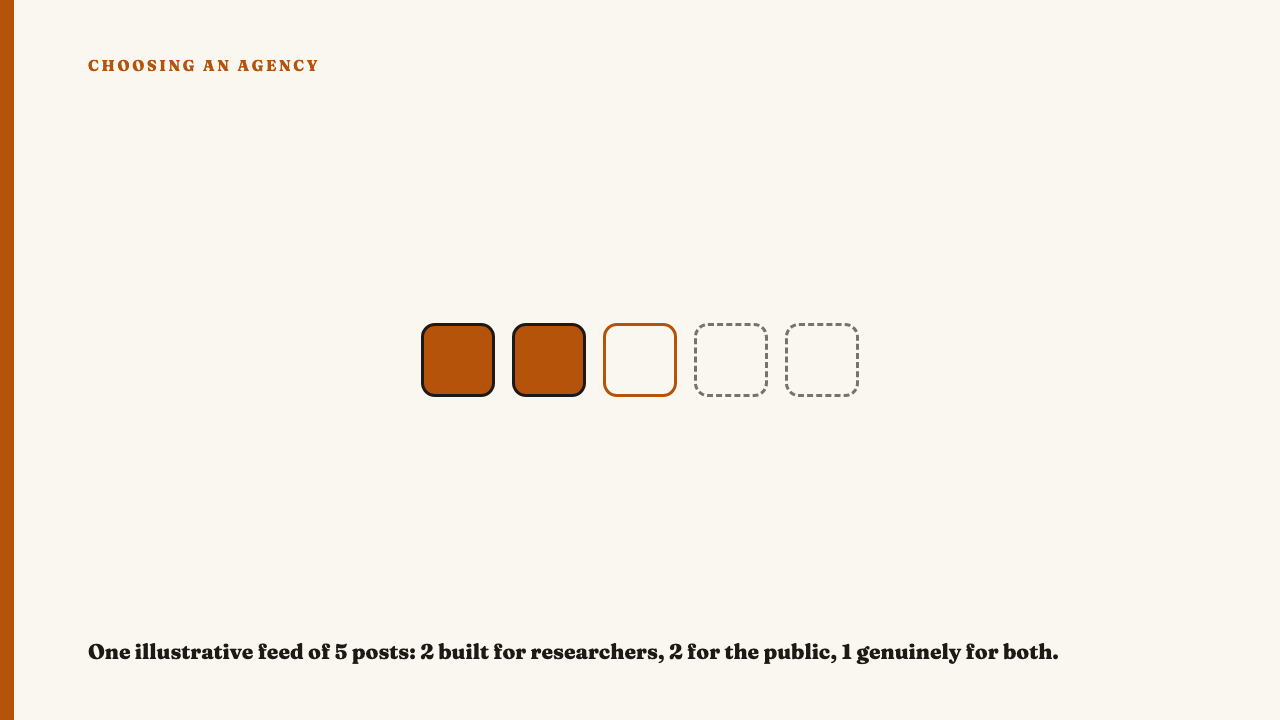
The first is a university research office followed by the public and by fellow researchers. Post one is a dense results figure with a technical caption. Post two is a student’s lab tour clip, one warm sentence. Post three is a carousel: a striking image and a plain question, then a labelled method diagram behind it. Post four is a methods note for peers. Post five is a campus event photo for locals. The alternation is a pattern: some posts for one side, some for the other, a few genuinely both.
The second is a supplier followed by specialist buyers and hobbyists. Post one is a spec sheet crop with a chirpy caption. Post two is a product on a workbench under “Precision engineering for everyone!” Post three is a technical cutaway thanking “all our amazing followers.” Post four is a lifestyle shot with one term, “tolerance stack,” dropped into the caption. Post five is a diagram with a smiley. The caption tone stays evenly welcoming while the visuals drift toward the specialist. Nearly every post is a compromise that satisfies neither.
Count the feed, not the post
One post can be beautifully threaded while the account leans hard one way, so look at a run. Go through recent posts yourself and mark each as built for A, built for B, or genuinely both.
An uneven split is not automatically a fault, since a brief may weight one audience. The fault is a split that contradicts what the account says about itself, or a side that never gets a post built for it. The shortchanged side shows in what is missing: no explained terms for the newcomer, or no depth for the expert. It is the skill of reading a grid as one composed layout, applied to audience.
Questions to ask when you see a portfolio piece
- Which audience does the agency say the piece was for, and does the asset agree? Treat the explanation as information about the post, not proof of it.
- Where are the posts for the less glamorous audience? A portfolio tends to show the side that photographs well.
- Can the agency point to a moment it chose one audience over the other on purpose, and say why?
When the split is deliberate and when it is a dodge
Covering two audiences is a real craft problem. Sometimes the honest response to a brief that cannot be threaded is to make some posts plainly for one side and some for the other.
The dodge is a feed of medium-warm, medium-technical posts that no one is unhappy with and no one loves.
To see work we think handles its audience with craft, See this year’s selections. If you know an agency whose split-audience work deserves a look, nominate an agency.
FAQ
Can one post really speak to two audiences?
Yes, when it is layered: a plain first line and an image that works at a glance for the general reader, then a second layer such as a labelled detail or a later slide that rewards the specialist. Most posts will lean one way, which is fine across a feed.
How do I tell which audience a post was built for?
Read the asset with the caption hidden, note the vocabulary and prior knowledge the first frame assumes, then compare that against who the caption claims to address.