The One Tell That Gives Away Ghostwritten Founder Content
You are scrolling an executive’s feed, trying to work out whether the agency behind it is capturing that person or producing interchangeable thought leadership with their face on it. The posts read well and the hooks land. And you still cannot tell.
What agency-run founder content usually gets right
When an agency takes over a founder’s account, a specific set of things improves fast. Posting becomes regular. The first line becomes a hook, a short declarative sentence that earns the click. Grammar tightens. Paragraphs break every sentence or two instead of arriving as a wall.
All of that is real craft, and none of it tells you whose voice it is. A competent writer can produce every one of those improvements for any client. Read polish as authenticity and you have handed your judgment to the part of the work that is easiest to fake.
The tell is specificity, not polish
The signal is whether a post contains one detail only that person could plausibly know. Not a detail that sounds insider, one that required access.
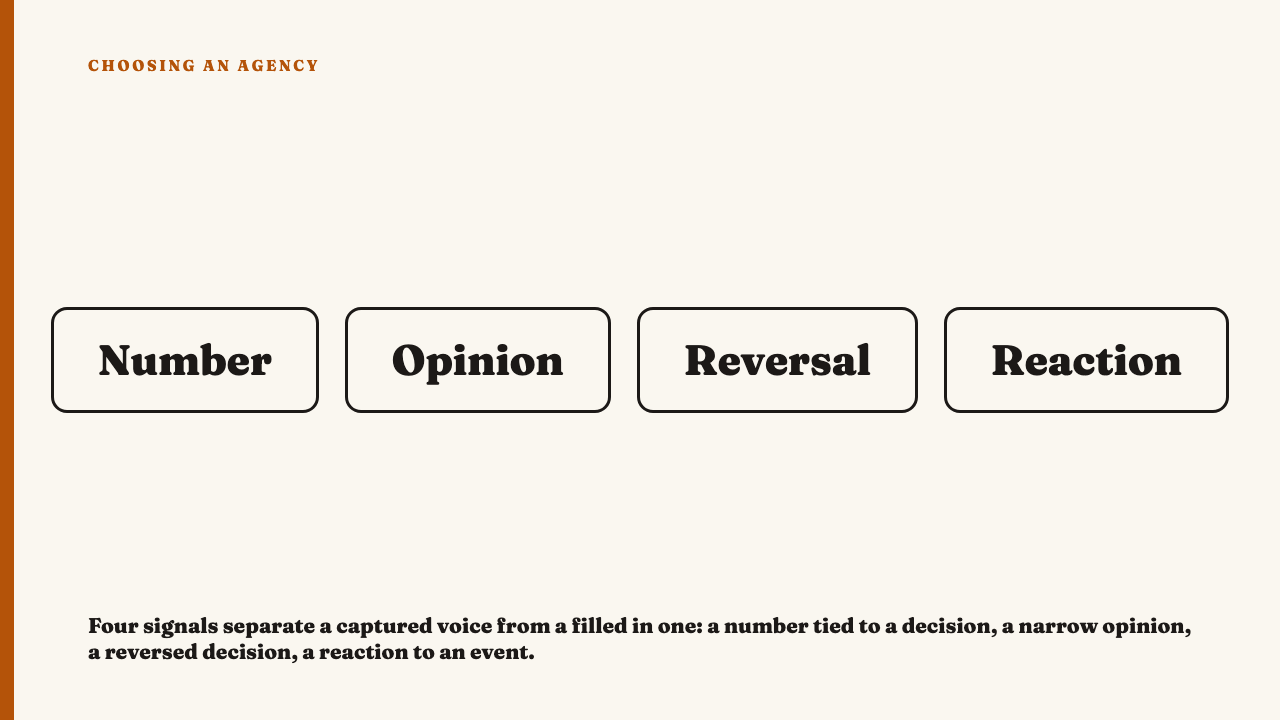
Four shapes recur. A number or timeframe tied to an internal decision: not “we grew fast” but “we ran the pilot for eleven weeks and killed it in the twelfth”. A narrow opinion rather than a safe stance: not “hiring is hard” but why one particular interview stage is theatre. A decision the person reversed and what changed their mind. And a reaction to a specific event rather than a lesson extracted from it, which dates the post to a week.
Set that against the generic register: broad claims about leadership, culture, growth. Ask whether you could swap in any other founder in the category without changing a word. If you could, it carries no information about the person named on it.
How bad ghostwriting flattens a voice even as production improves
The mechanism is throughput, not malice. Volume on someone else’s behalf pushes a writer toward the safest register, because safe is fast and passes review. Syntax variance gets smoothed, so the long rambling sentence and the four word one both regress toward the middle. Domain vocabulary gets swapped for business language that reads professional to everyone and native to no one. The sum is a person erased.
Here is a constructed illustration, not a documented case and not a quote from anyone real. Picture the founder of a mid sized logistics company. Flattened: “Efficiency gains come from empowering your team to make decisions closer to the work.” Specific: “We let dispatchers override the routing software without asking. Took about six weeks before the arguments stopped.” The first fits anyone running anything. The second could only come from someone who watched dispatchers argue. Flattening took out the role, the tool and the timeframe, leaving better prose and worse evidence.
What good ghostwriting actually does
Good ghostwriting starts upstream, in extraction. Someone interviews the person for real opinions and real anecdotes, then does it again next month. What comes out has edges: an opinion they would defend, an anecdote with a role and a number, a thing they got wrong.
Good ghostwriting cleans structure and adds voice back in: a verbal habit the person has, a real disagreement with their industry, a real number from a real decision. Bad ghostwriting cleans structure and loses those, because they are the part that reads as rough. The same distinction is what separates written copy from filled-in copy.
Specific voice versus flattened voice, side by side
| Signal | Specific voice | Flattened voice |
|---|---|---|
| Numbers and timeframes | Unrounded, tied to a decision: eleven weeks, three of seven | Round and directional: significant growth, over time |
| Opinions | Narrow, contestable, naming what is disagreed with | Broad, agreeable, nobody would argue against it |
| Anecdotes | A role, a complication, an unflattering middle | A moral, pre-resolved, could happen to anyone |
| Vocabulary | Trade words, used casually rather than explained | Alignment, empowerment, leverage, journey |
| Swap test | Breaks if you change the name | Survives the swap unedited |
A five-minute check for a founder’s feed
- Count how many of the last ten posts contain a number or timeframe tied to an internal decision. Marketing numbers do not count. Decision numbers do.
- Find one post that disagrees with something specific. Restating consensus in a confident tone is not disagreement.
- Look for what an outsider could not know: a tool they use, an internal debate, a role rather than a name.
- Check whether tone varies. Real people post tired, irritated and distracted. A feed at one even temperature was produced on a schedule.
- Run the swap test on the three most recent posts. If all three survive it, the extraction never happened, and a voice that is distinct from being loud never survives it.
When a flattened voice isn’t the agency’s fault
Some genericness is imposed rather than chosen. A regulated company runs every post through legal, which strips the number, the timeframe and the tool by policy. A founder in a competitive market will not name the internal system that gives them an edge. Some people are guarded in every context, not just online.
The checklist still separates a constrained voice from an absent one, because a constrained founder disagrees specifically even when they cannot share specifics. They will refuse to name the number and still tell you the standard approach in their category is wrong, and why. A feed with no extraction behind it cannot do that. The broader question is how much of the work the agency actually did.
Where to see this applied
We look for this kind of specificity in the agencies we cover. You can see this year’s selections, or nominate an agency whose founder voice work holds up under the swap test.
FAQ
Is ghostwritten founder content automatically a bad sign?
No. Executive ghostwriting is a legitimate service line that agencies offer openly, and this is not an argument against the practice. The question is never whether a third party was involved, it is whether specificity survived the process.
Can you tell from writing style alone whether a founder writes their own posts?
Not reliably. Sentence length, punctuation habits and emoji use are weak signals, because they are easy to imitate. Specificity is stronger because it cannot be imitated. It requires access to the person’s real decisions, which means someone did the interview work.