Work Can Perform Well and Still Be Bad Work
Someone shows you a post you think is lazy. A stitched-together trend video, a caption that could sit under any account in the category. Then they tell you it did several times the account’s usual reach, and the room goes quiet, because nobody wants to argue with a number. So you back off. You did not have to.
Two different questions are getting collapsed into one
“Did it perform” is about what happened after the work went out. It is answered later, by a platform or by a client’s own reporting. “Is it good work” is about the piece itself: the idea underneath it, the quality of the execution, whether anything in it is specific to this brand rather than generic to the category. Reading a yes to the first as proof of the second is a category error, not a difference in taste.
This post takes any reported result at face value: if someone says a piece hit a number, assume it did. Whether a metric can be trusted is a separate question that belongs elsewhere. Even an accurate number answers a question you did not ask. For the baseline on the other one, start with what actually separates good social work from average.
How work performs without being good
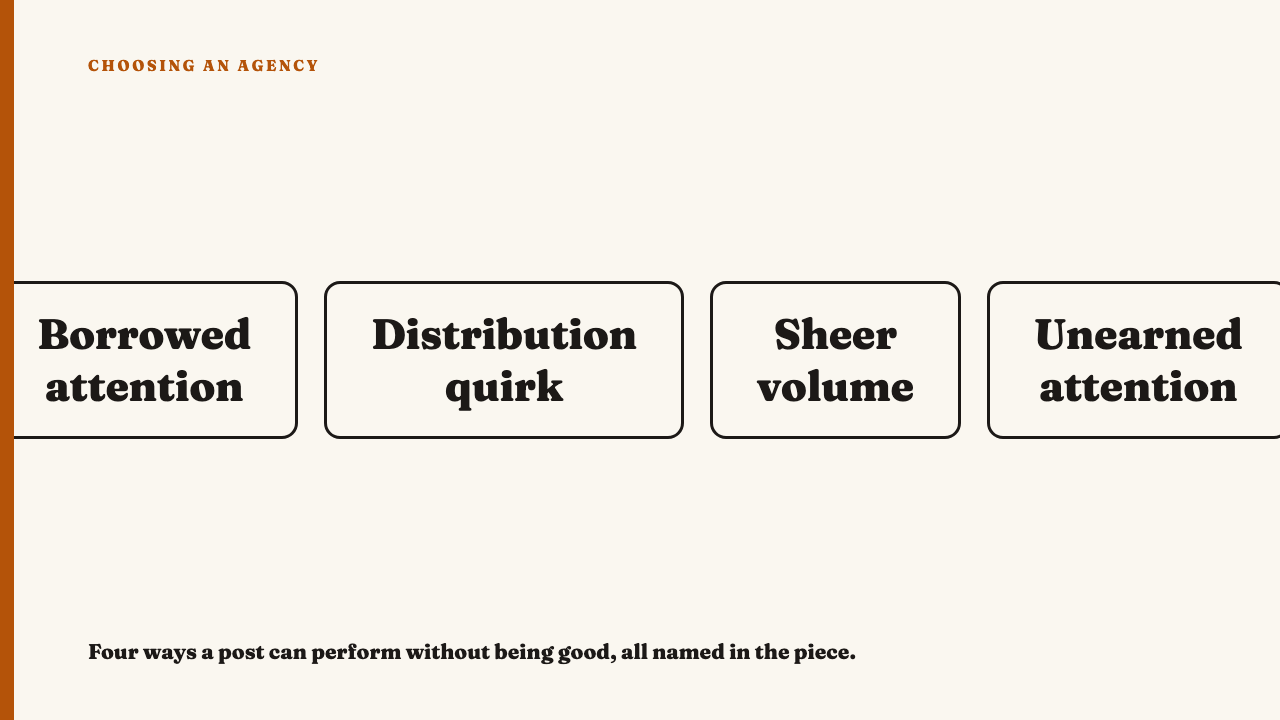
When a crude piece racks up numbers there is a mechanism, and you can usually name it from the piece alone.
- Borrowed attention. The piece rides a sound, format or meme already moving before the brand touched it. Strip that layer out and nothing is left anyone would have stopped for. The reach belongs to the trend.
- A distribution quirk. Platforms push particular formats at particular moments, and a posting pattern can happen to suit the current mechanics. What got rewarded is format and timing, not the thinking inside the piece.
- Sheer volume. Post often enough and a few pieces land on statistics alone. The one held up to you survived a batch, and what worked was the schedule. Ask how many near-identical pieces went out that month.
- Attention the post did not generate. A new account gets a novelty window, and an audience primed by something the brand did offline arrives already interested. The post stands in front of a crowd it did not gather.
A crude example, walked through
Picture a regional gym chain. The piece is fifteen seconds: a trending audio clip, three cuts of people on treadmills that could have come from any facility anywhere, text in the platform’s default font chosen purely for speed, a caption that is a category cliché with an emoji on the end. Nothing tells you which gym this is.
It performed. The format was circulating that week, so it arrived pre-loaded with attention, and it cost so little that eleven variations went out over five days and this one caught.
Now ask what the brand does with it on Monday. It cannot extend the idea, because there is no idea, only a format on loan. It cannot build a series, because the second instalment lands after the sound has moved on. It cannot offer it as evidence of a voice, because the same fifteen seconds with a different logo would serve a competitor down the road. That is reading the strategy behind a piece from its public output, and it comes back empty. It performed, and it is disposable.
How good work fails to perform, and why that isn’t a verdict on the work
The reverse deserves equal weight. A well-made piece can go nowhere for reasons unrelated to its quality: it posted into a saturated feed on a loud day, it is a format the platform is not currently favouring, or distribution mechanics shifted the week it went live.
Refuse to let that become a blanket excuse. Plenty of work underperforms because it deserved to: unclear, self-indulgent, an in-joke needing context the viewer will not chase. The test is whether the piece reads clearly to a stranger. If someone who has never heard of the brand can say what it is about and what it wanted, and it still went nowhere, the week was bad. If they shrug, it failed on its own terms.
What actually compounds, and what doesn’t
A specific idea can be extended. A distinct visual or verbal voice carries into a second piece, then a tenth. A format built for one brand becomes a template that improves each time it runs, because the audience starts recognising it.
Borrowed attention has none of that. You cannot run the trend again, so the next piece starts from zero and needs a fresh one to borrow. Grade a body of work by which posts performed and you reward whoever posted most often or got luckiest with timing, over whoever built something reusable in a quiet quarter. It is also why one excellent campaign tells you almost nothing.
Why the industry treats these as separate categories
This is not an idiosyncratic position. Cannes Lions lists Creative Effectiveness as its own entry type, described on the awards site as celebrating the measurable impact of creative work, and asking entrants to show how a strategy met its business objectives. Separate from it sit Film Craft, Digital Craft and Industry Craft, whose descriptions are about artistry, technical skill and execution.
The IPA does the same at the level of a discipline. Its Effectiveness section is a standing resource area with its own research, an archive of case studies, publications, an accreditation scheme and qualifications, all organised around whether communications activity paid back. When an industry builds two sets of institutions, it is measuring two things.
How to hold your read when someone hands you a number
Do not dispute the number. Concede it, then ask the second question out loud: that performed, and what did it give the brand that we can build on next month. Either someone names an idea, a voice or a format that survives the trend, or the silence answers. “This performed and it is still not good work” is not a contradiction. It names two things that were both true at once.
Take a look at the work
This site’s method is editorial selection: work gets read closely and we say what we saw and why, not sorted by what travelled furthest. You can see the current selections and the reasoning, or nominate an agency whose work holds up to this reading.
FAQ
If a piece of work performed, doesn’t that prove it was good?
No. It proves the piece reached people. That reach may have come from a trend already moving, a format the platform was favouring, or posting often enough that something had to land. None of those is the piece’s own craft. Performing tells you it travelled, not that it was well made.
What’s the clearest sign a piece of work is disposable rather than reusable?
Ask whether a competitor could run the identical piece with a logo swap. If the idea, voice or format is specific enough that the swap would break it, there is something to extend. If any account in the category could have posted it without anyone noticing, it is disposable, however far it travelled.
Sources
- Cannes Lions, The Lions (award entry types), fetched 6 September 2026.
- IPA, Effectiveness, fetched 6 September 2026.