Judging Craft When a Platform Stops Favoring a Format
You scroll back through an account you are evaluating and something snaps. Eight months of one kind of post, then, inside two weeks, a completely different kind. No rebrand, no new product, no visible reason. The question is not whether the account should have changed, but whether the agency carried anything across the change.
What you’re actually noticing
The signal is abruptness, not difference. Feeds periodically shift what they push, and every account feels it at once. The tells are specific: static to video, long form to short, art directed to deliberately raw; a cadence that doubles or collapses; a format the account had never used appearing four times in a fortnight. They cluster in one window rather than arriving one at a time.
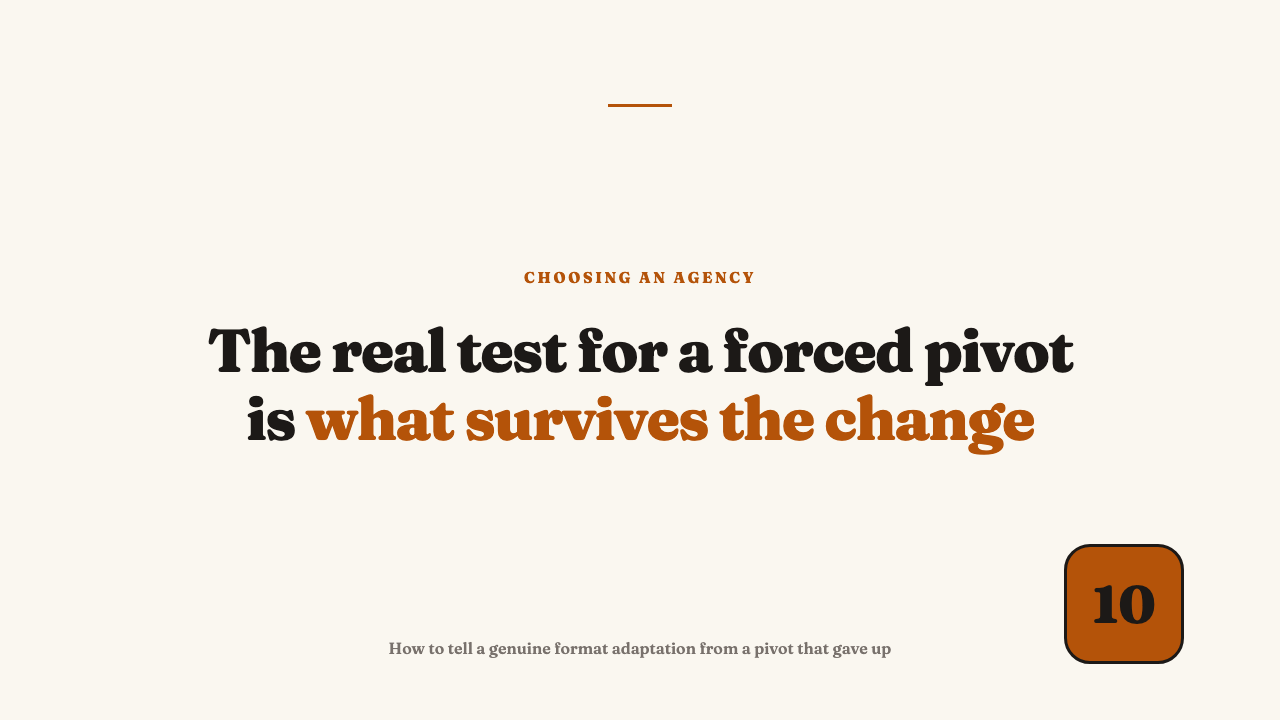
Creative evolution does not look like that. It looks like refinement: a caption voice getting drier over half a year, a recurring segment losing three seconds because it plays better that way. Evolution keeps the idea and sharpens it. A forced pivot leaves no line to trace, which is close to the question behind telling platform-native work from a crossposted asset.
What a genuine adaptation looks like
First, name what was being adapted. Strengths mean concrete things: a recurring visual signature, a specific tone in the copy, a running bit or a recurring on-camera person, a pacing style you could identify with the sound off. A real adaptation re-expresses at least one of those inside the new format instead of starting over.
Picture an account known for dry, understated captions. Flat sentences, no exclamation marks, the joke buried in the last four words. It moves to short-form video. The version that shows craft keeps the understatement: a deadpan voiceover, on-screen text landing the same flat punchline, an edit that refuses to cut on the beat because that voice never oversells. The version that shows nothing switches to a bright, high-energy read, because that is what performs now.
Genuine adaptation also costs the agency something. Making a written voice work as a spoken one takes longer than dropping the product into a template, and you can often see that friction as roughness resolving over three or four posts. Smoothness from post one usually means nothing was attempted.
The tells of a pivot that gave up
Individually some of these are forgivable. Three or four in the same fortnight are not.
- Trending audio with no relationship to the brand’s voice. Not the audio itself, which is often correct, but audio that would sit identically under any other account. This is where using a format ends and copying an idea begins.
- On-screen text templates that belong to nobody. Default typeface, default position, default three-beat structure.
- A recurring bit, character, or motif that simply disappears. No replacement, no attempt to bring it across, nothing in the space it left.
- Caption style that goes generic overnight. A written voice replaced by a question, an emoji, and a call to comment.
The giveaway is one question. Would a follower who knew this account well still recognise it with the handle hidden? If the only continuous thread is the logo, the identity did not move formats. It was abandoned.
Why one post won’t tell you anything
A clumsy post in a new format can be clumsy because it is a first attempt, not because the thinking is thin, and a polished one can be a bought template. Decisions only become visible across a run of posts.
So find where the format visibly changes, pull the ten posts immediately before and the ten after, and list what recurs across the first ten: the voice, the motifs, the running bits, the recurring people. Then count how many survive into the second set in any form. Six or seven of ten is a translation. One or two is a replacement.
A worked comparison
Take a hypothetical hardware company whose account is built around one in-house character, the warehouse manager, who narrates product updates in flat deadpan while holding the item slightly too close to the camera. He is always unimpressed. Then the feed shifts toward short vertical video and reach on stills falls away.
The strong adaptation puts him on camera. Same flatness, same too-close framing, now used deliberately as a video device. The edit runs slower than the format’s default because his timing needs the pauses, and someone decided the pauses mattered more than the pace.
The version that gave up drops him. Product on a turntable, a trending track, three lines of white sans-serif, an upbeat voiceover from someone we have never heard. It is competent and indistinguishable from four other accounts in the category, and on the recognisability test it fails outright. The first version is stronger craft because someone asked what was worth keeping.
When it isn’t really the agency’s call
An agency told to get the numbers back up, three weeks into a reach drop, is not being asked for a considered adaptation. It is being asked to stop the bleeding, usually without added budget or client appetite for anything unfamiliar. That is a permission problem, not necessarily a craft failure, and scoring the two alike will make you wrong about good teams. The same calibration problem shows up in the difference between joining a trend and being late to one.
You can usually tell them apart. A permission-constrained pivot looks inconsistent within the new format, some posts still carrying the old voice and others clearly not. A fully abandoned identity looks uniform, every post equally generic. Unevenness is evidence of an argument. Uniform blandness is evidence there was none.
Where to see this applied
The agencies we write about are chosen editorially, with the reasoning published alongside each selection. To see this standard applied to real work, see this year’s selections. If you know an agency whose work holds up under this reading, nominate an agency.
FAQ
What if I don’t know the account well enough to tell what its strengths were before the change?
You do not need prior familiarity. Read the ten posts before the shift and look for internal consistency: visual choices that repeat, a tone that holds, a bit or a person who keeps coming back. If there is no distinct signature to begin with, that is a finding in itself, because nothing was there to abandon.
Does a format change that clearly performs better mean the agency made the right call?
Performance and craft are separate questions, and this piece answers only the craft one. Whether the new format did better in reported terms sits outside what we assess here. Work can be well made and land poorly, or be generic and travel widely.