Why One Excellent Campaign Tells You Almost Nothing
You watched the campaign and it was genuinely good, good enough that you want to see what else this agency has done. But the piece sits at the top of the portfolio for a reason, and the reason is not that it represents the work. It is the least typical week in the entire account.
The reel is a highlight, not a sample
A launch campaign is made under conditions the rest of the account never sees. It gets a production runway, weeks where a timeline exists and someone is protecting it. It gets senior creative and strategy attention assigned to it specifically, the leadership-page names in the room rather than reviewing at the end. And it gets a budget ring-fenced before anyone wrote the brief, so the idea was allowed to cost something.
None of that is a criticism, it is how good campaign work gets made. But it makes the hero piece the least representative artifact in the portfolio rather than the most, precisely because those conditions do not repeat.
Why the other fifty weeks look different
Consider the ordinary week. The weekly post goes out whether or not anyone had a good idea that Tuesday. The reactive moment has to be caught within hours or it stops being reactive. The routine product update ships because someone needs it live by Friday. Work made on that clock passes through fewer hands and gets less senior oversight, because no normal production cycle gives a two-line caption a creative director’s afternoon.
Here is the reasoning error worth naming, because naming it is how you stop making it. A single exceptional data point does not establish a pattern, it establishes a ceiling. It shows what the agency does at full stretch, not on an average Wednesday.
What to look at instead of the hero piece
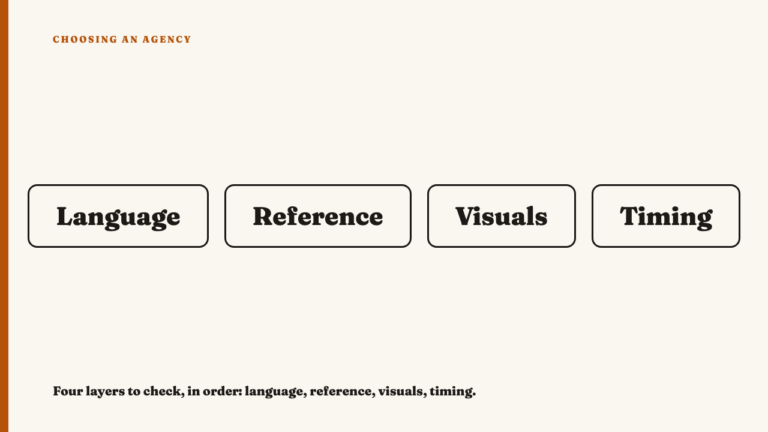
Those weeks are usually public. Find where the hero campaign landed on the account’s timeline, then look away from it and read the ten to fifteen posts before and after. Four things become visible:
- Whether captions still show effort on a dead news day. With nothing to react to, a caption either does something, a real observation, a line that could only be about this product, or it fills space with a rhetorical question and three emoji.
- Whether the replies are specific. Open twenty. If most answer the actual comment in the brand’s voice, someone competent is working. If four phrases rotate with different names attached, replies are being cleared, not written.
- Whether a routine post is native or an obvious crosspost. Vertical video with the caption inside the safe zone reads differently from a landscape asset letterboxed under a hashtag block. Telling platform native work from a crossposted asset takes seconds.
- Whether the second and third best pieces sit near the best. Rank the account’s strongest work. If two and three are close to one, the standard is real. If there is a cliff, the hero piece was an event, not a level.
A worked example
Nothing below is a real agency, campaign, or number. It is a method applied to an imagined case, not a case study.
Picture a portfolio opening with a ninety second brand film for a kitchenware company. Beautifully shot, a voiceover written rather than assembled, real sound design. Now read the four weeks of ordinary posts around its launch. In one version they hold: stills composed by the same eye, captions carrying the voiceover’s dry register, reactive posts quick but not careless.
In the other, the film is surrounded by flat product shots on a gradient, captions that read like whoever had the login wrote them, and a reply section on autopilot. Same film, opposite conclusion. The film shows what the agency makes with a runway and a budget; the weeks around it show what happens without one.
Questions to ask before you let the hero piece count
Two questions do most of the work, and both are about resourcing, not taste.
- When was it made, relative to everything else? Check the date against the rest of the portfolio. A piece landing on a rebrand, an anniversary, or a quarter when the agency was pitching for new business was made in a moment of extra resource. Not disqualifying, but it lowers the weight the piece carries.
- Do the same team and format appear again? If the campaign used a director, a motion style, or a shooting format that shows up nowhere else, it was a one-off assembled for the occasion, a cousin of separating concept work from work that actually shipped. If elements recur in cheaper form in the ordinary weeks, the thinking survived a normal budget.
The reel is optimized to do this, and that is not dishonest
A sizzle reel exists to compress an agency’s strongest fragments into a few minutes, and a credentials deck does it across slides. That is a reasonable thing to build, not a sign of hiding anything. Nobody assembles a showreel from their median work.
But the reel was never designed to represent the median week, so do not read it as if it were. Your job is not to penalize an agency for having a good reel, it is to notice the reel answers a different question than yours, then go find the median week yourself. The same discipline covers what a portfolio leaves out, and it rests on what actually separates good social media work from average.
Try it on a real account
You can see this year’s selections, or nominate an agency whose ordinary weeks hold up as well as its best one.
FAQ
Is it unfair to discount an agency’s best work?
No. The piece is not being devalued: a brilliant campaign stays brilliant and its craft is real. What changes is only its weight as evidence about typical output.
How much ordinary work should I look at before I trust my impression?
Enough consecutive ordinary weeks to span more than one campaign cycle, so you can see what happens when nothing is riding on a post and whether it happens again. No researched threshold exists. The practical test is whether you have stopped being surprised by what you see. One weak week proves as little as one strong one, so look for the pattern.
Sources
- What a Social Agency Portfolio Leaves Out, fetched 2026-09-05.
- What Actually Separates Good Social Media Work from Average, fetched 2026-09-05.
- How to Tell Concept Work From Work That Actually Shipped, fetched 2026-09-05.
- Telling platform native work from a crossposted asset, fetched 2026-09-05.