How to tell a lazy cutdown from a considered one
You are four clips into an agency’s reel and one of them nags at you. It played, nothing was obviously wrong, and yet it sat badly. That feeling is usually a cutdown: a clip lifted out of something longer and exported at a new aspect ratio without the rework that would have made it belong.
The moment you can’t tell
A portfolio clip arrives with no history, so read the edit for evidence of a second act of work. The signs are small. A shot opens mid-sentence, the first words carrying the tail of a thought you never heard. A static frame holds a beat and a half longer than the clip has patience for. A subject sits in the left third with the right side empty, framed for a wider canvas that is no longer there.
Almost nobody watching clocks any of this as a fault. They register a vague slump in attention and scroll on. Your job is to name what an ordinary viewer only feels, the same discipline as separating platform-native work from a crossposted asset.
Repurposing is a rebuild, not a resize
None of this argues against repurposing. Long-form footage gets cut down constantly. The judgment is about the cutdown, not the decision to make one.
Turning three minutes into thirty seconds is a separate craft from making the three minutes. Someone has to retime the rhythm, recompose shots for a frame with different proportions and obstructions, write an opening that assumes no prior context, and rebuild the audio around cut points that did not exist before. Skip all four and you have exported the same edit at a new size.
Marker one: pacing that was retimed, not inherited
Picture a three second static shot of a workshop bench. Four minutes into a longer film it reads as a breath after a dense stretch of talking. Put the same shot three seconds into a thirty second vertical clip and it is dead weight, because nothing has happened yet that needs relieving.
A considered cutdown treats the new runtime as a new brief: holds shortened, dead air trimmed, shots reordered so the most legible image lands first rather than where the original narrative put it. A lazy one keeps every hold intact, breathing at a pace calibrated for a piece you are not watching.
Marker two: the hook was rewritten, not just trimmed
A borrowed hook gives itself away by answering something. The first line responds, cold, to a question the viewer never heard asked, and you are already behind. Or the opening frame catches a hand mid-gesture, a head already turning, continuing a motion that started before the cut. The clip begins in the middle of itself.
A rewritten hook states its point in the first frame and assumes nothing. A new line recorded, a later sentence pulled to the front, the setup carried on a title card: the same decision each time, that the clip has to work for someone who has seen nothing. The tell is not that the opening is exciting. It is that it is self-sufficient.
Marker three: reframed, not just cropped
A straight crop shows up visually. Look for:
- A head, hand or gesture clipped by the frame edge.
- Graphics or on-screen text sliced off, or shrunk past legibility at the size the clip plays.
- Captions sitting underneath the platform’s own interface, the buttons and handle that overlay part of every vertical player.
A reframe looks different. The subject is repositioned into the part of the frame that stays visible. Graphics are redrawn at the new dimensions rather than scaled, so type is set for a phone. Captions sit inside the band the interface leaves clear, which requires knowing where that band is.
Marker four: the sound was redesigned for the new length
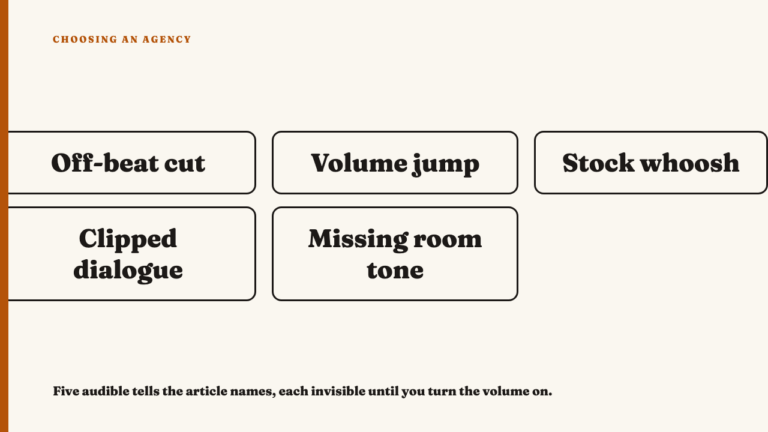
Audio is where a rushed cutdown is least able to hide, because music has structure and structure is hard to fake. Pull the original bed through and its swells land where they landed originally, nowhere near anything now. The build that used to crest on a reveal crests on a cutaway. A transition that used to carry a whoosh is silent. The reworked version has music re-cut so its accents fall on the new hard cuts, an effect on the transitions the shorter edit actually has, and a bed trimmed to fit this length.
Reading a portfolio clip for the rework
Watching for all four at once is unrealistic. Run a short pass instead:
- Do the first two seconds work with no setup from footage you have not seen?
- Do captions and graphics sit fully inside the visible frame, clear of the interface?
- Do the cuts land on beats that make sense at this length?
- Does the audio feel built for this runtime, or trimmed at an arbitrary point?
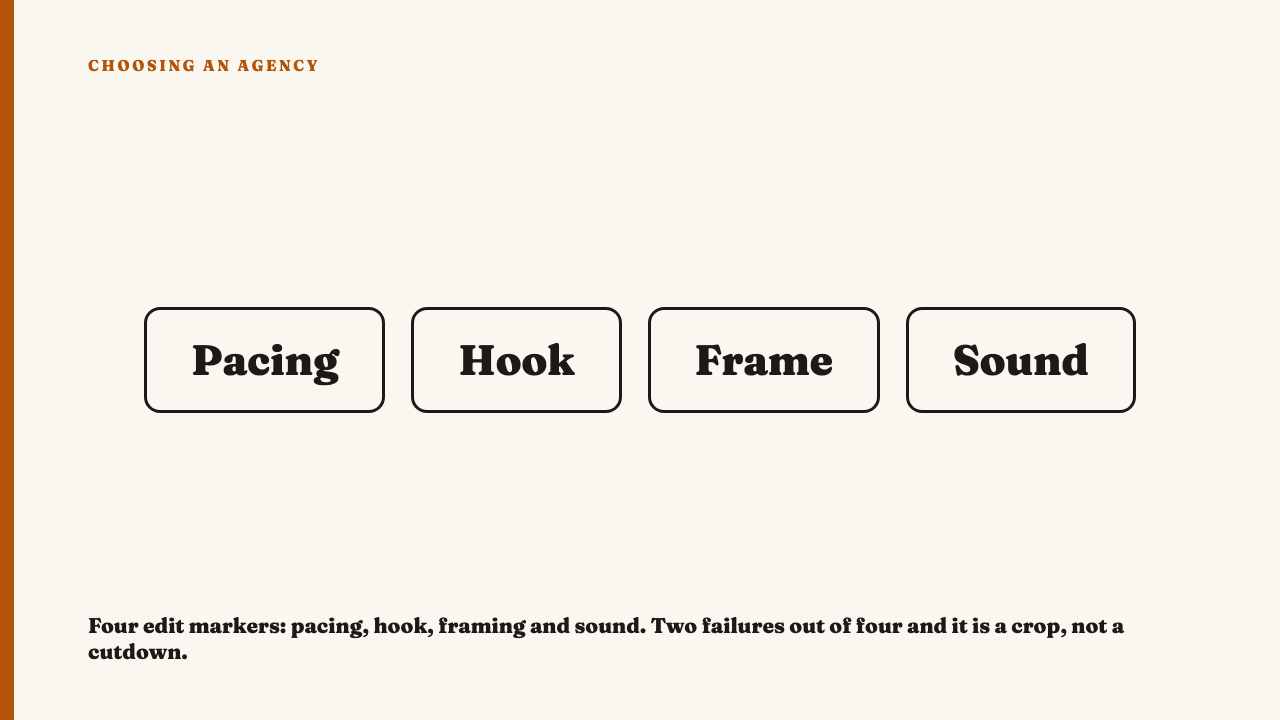
Two failures out of four and you are looking at a crop. Same scepticism you bring to what a portfolio leaves out, or to telling concept work from work that actually shipped.
Why this is worth noticing at all
An agency that reworks a cutdown properly is doing careful, invisible labour no viewer will consciously credit. Nobody comments that the hook was rewritten. They just watch it. That is exactly why it deserves credit from whoever is assessing the work, because the alternative is rewarding only what announces itself. A portfolio full of well-reworked cutdowns shows what a run of purely native pieces cannot: that this team can take material made for one context and rebuild it honestly for another, repeatedly, without letting the seams show.
Where to look next
To see this kind of reading applied across a range of work, see this year’s selections. If you know a team whose cutdowns hold up under it, nominate an agency.
FAQ
Is repurposed content always worse than something made native to the platform?
No. Craft decides this, not origin. A cutdown that has been genuinely retimed, reframed, rehooked and rescored can be stronger than something shot native, because it draws on material with a bigger production behind it. A lazy crop gives itself away in the first two seconds regardless of how good the source was. Origin tells you where a clip came from, not whether it is any good.
Does a cutdown need new footage to count as well made?
No. Everything assessed here is an edit decision: retimed pacing, reframed shots, a rewritten opening, redesigned sound. All of it is achievable with frames that already exist. New footage sometimes helps a hook, but its absence is not a mark against the cut.