The Disclosure Label Is a Design Decision, Not a Checkbox
You are looking at a sponsored post, trying to work out whether the agency behind it is any good. The concept is what you were meant to judge. Look instead at the line nobody was excited to write: the disclosure. It is mandatory, unglamorous, and no brief ever asked it to be beautiful. That makes it the better test.
The label as an afterthought
Disclosure reads as an add-on because in production terms it usually is one. A writer drafts the caption, a designer builds the frame, the work goes to whoever handles ad ops or legal sign-off, and comes back with a requirement attached. Someone pastes in a sentence. Nobody reopens the layout. It ends up the only part of the post made by someone who was not in the room for the other decisions.
It is easy to recognise once you have seen it twice. A caption with a distinct voice, specific and a little strange, ending in a flat line like “this is a paid partnership with our friends at the brand.” A badge dropped into a corner with no regard for what is under it, sitting half over a hand or the edge of a plate.
What an integrated disclosure actually looks like
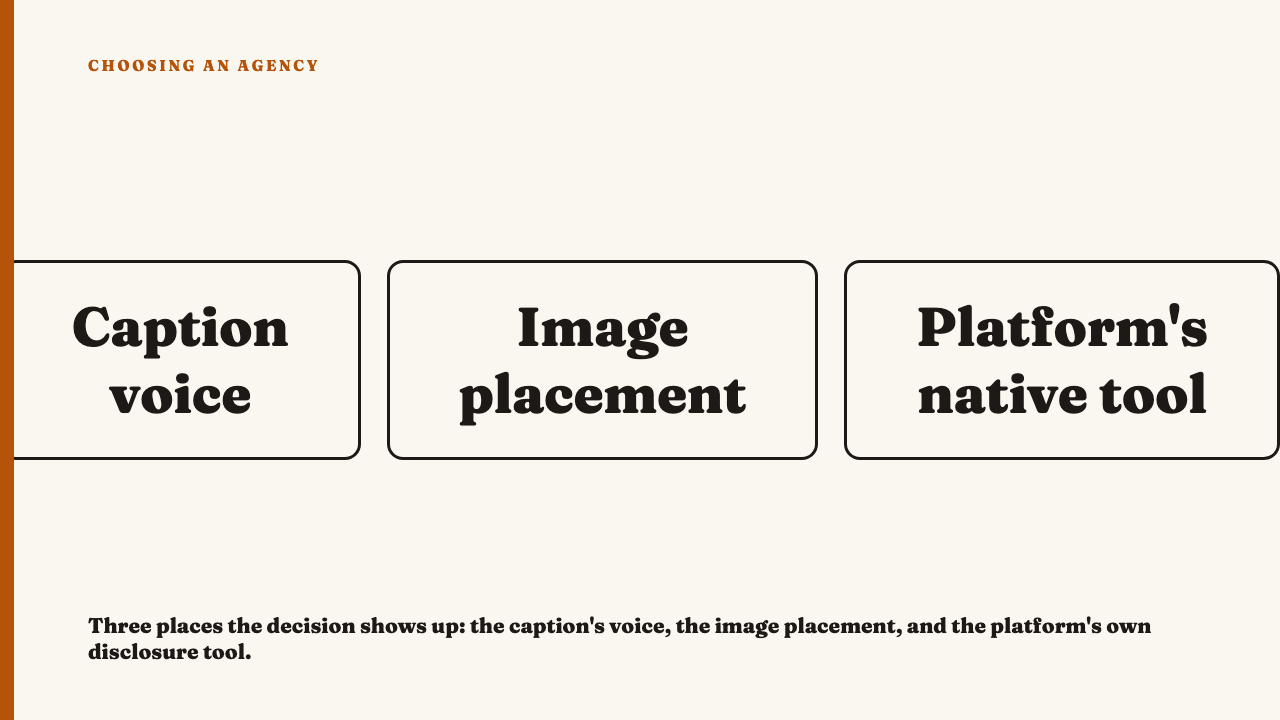
Picture a kitchenware caption that opens with a complaint about how nobody owns a pan that survives a house move. The afterthought version closes with a bolt-on line in a register the account never uses. The integrated version folds it into that opening: the brand paid for the pan, and the writer says so in the same tone as the joke. The reader learns the commercial relationship before deciding whether to read on.
Placement works the same way. A designed in-image tag sits in a part of the frame that was already empty, a wall, a tabletop, the flat sky the photographer left room for, at a size and weight matching the rest of the type. An undesigned one lands wherever the template puts it. One looks framed for, the other placed on top.
The third pattern is structural. Platforms provide a built-in disclosure mechanism rather than leaving it to the caption. YouTube’s help documentation tells creators to declare paid product placements, sponsorships and endorsements by selecting the paid promotion box in the video details, separately from the description. Good work treats that native mechanism as the primary disclosure and writes caption language to complement it. Weak work ignores the tool, or duplicates it word for word.
Reading the caption for the seam
The most reliable tell in a caption is a seam. The writing is loose, funny or specific, and then, usually mid-sentence, it goes flat. The line could belong to any brand on any platform. That shift is visible even to a reader who has never thought about disclosure, because voice is what people notice without knowing it. It marks what separates a written caption from a filled-in one, and shows when a brand voice is distinct and when it is only loud.
Placement failures worth naming
- An overlay across the subject’s face or the image’s focal point. Composition and compliance are fighting, and nobody adjudicated it.
- Label text set small enough, or at low enough contrast, to be functionally invisible on a phone. The UK Advertising Standards Authority’s advice on recognising ads says a label must be prominent enough that people easily notice it, and names poor colour contrast as one way of getting that wrong.
- A video with no on-screen or spoken disclosure at all, the only mention living in caption text below the fold. The US Federal Trade Commission’s guidance for influencers says disclosures are likely to be missed behind a More click, and that one in a video belongs in the video. When a platform offers a native tag built for this case and the work uses neither, the omission was a choice.
Why this is a craft signal and not a compliance one
Voice-matched disclosure copy costs deliberate effort every time, because the sentence it has to sit inside is different in every post. One that got that attention is evidence the same care went into the parts of the work you cannot audit from outside. A pasted one shows where corners get cut when nobody is expected to look closely. Disclosures almost never make a portfolio. They belong to what a portfolio leaves out.
What this does not tell you
None of this is a compliance assessment. Whether a disclosure satisfies a platform’s policy, or any advertising regulation, is answered by that platform’s published rules and the applicable regulator, not by how the label looks. A beautifully integrated disclosure can be inadequate and an ugly one sufficient. Whether a native tag on its own is enough is a policy question this piece does not answer; it varies by platform and would need checking against that platform’s current published rules. Judging craft means asking whether a decision was made, not whether it was correct under a rule.
Where to take this next
Run this test on the last three sponsored posts from an agency you are assessing. Then see this year’s selections, and nominate an agency whose work holds up.
FAQ
Does a well-integrated disclosure mean the post is legally compliant?
No. Craft and compliance are different questions with different sources. Whether a post satisfies a requirement is answered by the relevant platform’s published policy and the advertising regulator in the market where it ran. What we assess is design quality, and a disclosure can be elegantly integrated and still fall short of a rule.
Why do some sponsored posts still feel authentic despite carrying a disclosure label?
Because the disclosure was written in the same voice as everything else on the account rather than in a borrowed legal register. Readers are not put off by knowing a post is paid for. They are put off by the tonal jolt of a sentence that came from somewhere else.
Is a platform’s native paid partnership tag enough on its own?
That is a policy question rather than a craft one, it varies by platform, and this piece does not resolve it. How an agency uses the tag is a design decision you can assess on sight. Whether the tag alone is sufficient has to be checked against that platform’s current published documentation.
Sources
- YouTube Help, Add paid product placements, sponsorships and endorsements, fetched 2026-09-06.
- US Federal Trade Commission, Disclosures 101 for Social Media Influencers, fetched 2026-09-06.
- Advertising Standards Authority, Recognising ads: Social media and influencer marketing, fetched 2026-09-06.