What an agency pins says as much as anything it posts that week
You open an agency’s profile for the first time. Before you have read a caption or scrolled a row, one item sits above everything else, held there deliberately. Whether the account deserves another ten minutes turns on reading that item correctly, and most people read it as just another post.
The pin is a re-selection, not a post
Everything else on the account was chosen once. Somebody made it, it went out, the feed carried it downward. A pinned item did all that and then got chosen again. It is not the newest thing on the account, it is what the agency held in place past the point where the timeline would otherwise have buried it.
That second decision is continuous. Unpinning takes four seconds, so a pin that has not moved in eight months is not an absence of attention. It is eight months of concluding, repeatedly, that this is still the right thing to lead with. You are judging a standing statement, not an old post.
What a first-time visitor actually sees
Run the sequence in the order a real person meets it. Profile photo at thumbnail size. Handle and display name. The bio, skimmed. Then, before the grid or feed proper, the pinned or featured tile.
For a prospective client moving fast, that tile is frequently the only content from the account they engage with beyond the bio. Not the best piece. The only one. It is the same reading problem as what a portfolio leaves out: judge the choice, not the artefact.
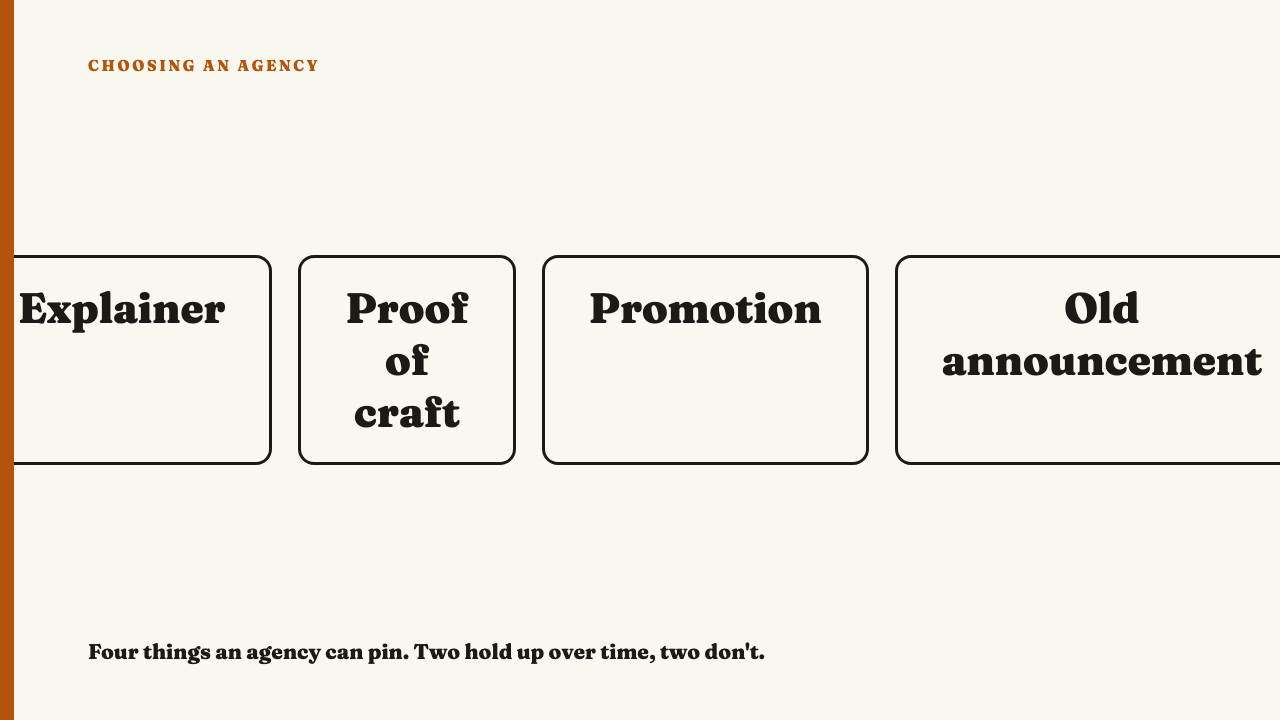
What gets pinned, and what that choice says
- An explainer of what this account actually is. Who we are, what we make, who it is for. Reads as self-aware: somebody pictured a stranger arriving cold and built for them.
- A proof-of-craft piece. The agency’s most demanding output. Reads as confidence, and it is testable: is the work as good as the placement implies?
- A running promotion or competition entry. Defensible while it is live, because it points at something happening now. The risk is expiry.
- An old announcement nobody has revisited. A rebrand, a new hire, an office move. Reads as neglect however strong the current output is. An excellent feed does not rescue it, it makes the mismatch louder.
The mechanics differ by platform
The number of slots a surface gives is what makes the pin a judgment call. One slot forces a single bet: which piece can carry the whole profile in front of a stranger. Room for several moves the tell from choice to ordering.
LinkedIn’s featured section sits at that end. Its help documentation describes a section you can add an unlimited number of items to, of which 400 are displayed, holding posts you wrote or reshared, LinkedIn articles, external links, and uploaded images, documents, presentations and videos. New items appear first by default and can be reordered by hand. That is a shelf, not a pin, and eleven unrelated items in reverse chronological order is not curation, it is a second feed.
Instagram’s, TikTok’s and X’s current limits could not be confirmed against those platforms’ own help pages at the time of writing, so this piece states none of them. Check them on the platform, because they change. What matters is not the number of slots but whether the account treated them as a decision.
Staleness is its own signal
The tells are visible without leaving the profile. The link behind the pin, or the bio link it depends on, no longer resolves or lands on a closed offer. A date or seasonal reference in the creative has visibly passed. The counters on the pin look frozen against the recent feed, useful purely as a dating signal, not as a judgment of the work.
None of that is the same as age. An anchor piece can sit at the top of a profile for years and still be right. The test is the surrounding context: does the bio still describe the agency the pin shows, and does recent work look like it came from the same outfit? When pin and context agree, longevity reads as conviction. When they disagree, it reads as an unattended shop window.
Two pins, two different messages
Picture two agency profiles with strong recent work behind them. Both are illustrative composites, not real accounts or real agencies.
The first pins a fifteen second piece that opens on the exact thing the account is good at. If the specialty is fast product cutdowns, the first two seconds are a cut you could not do casually. No title card, the work explains itself. Watch only that and you know what the agency does.
The second pins a static graphic announcing a new office and a leadership hire, in the house template. Nothing about it is bad, and it is also indistinguishable from the equivalent post at any other agency in any year. Same craft standard underneath, opposite outcomes, decided at re-selection.
Take it further
If the pin passes, ask whether the account holds together over time: judging whether an agency built a system or just one good post, built on what actually separates good social media work from average. If a pin stopped you cold, nominate an agency.
FAQ
How many posts can an agency pin on Instagram?
Instagram’s help documentation could not be read at the time of writing, so this piece states no number. The limit has changed before, and a remembered figure is worth less than a look at the platform. What matters more than the count is whether whatever fills those slots was chosen for a stranger.
Is the LinkedIn featured section the same thing as a pinned post?
No. LinkedIn’s documentation describes a section that accepts an unlimited number of items, of which 400 are displayed, across posts, articles, links and uploaded media. That is a shelf, not a single slot: on one slot you read a choice, on a shelf you read whether anyone imposed an order.
Does an old pinned post always mean an agency has gotten sloppy?
No, and treating age as the verdict misreads good accounts. Check whether the bio and recent posts still support what the pin claims. A years-old anchor that still describes the agency accurately is conviction. The failure case is mismatch: a dead link, a passed date, or a version of the agency the feed no longer resembles.
Sources
- LinkedIn Help, Featured section on your profile FAQs, fetched 7 September 2026
- LinkedIn Help, Manage featured samples of your work on your LinkedIn profile, fetched 7 September 2026