How to Tell a Custom Shoot From Treated Stock Footage
You are three shots into a brand film and something snags. A cutaway of a bright open office, someone laughing at a laptop. Pleasant, and also, you suspect, a shot you have seen before. You cannot prove it. Reels do not come with production records, and no agency annotates which frames it licensed. You are left judging with your eyes.
The question is not whether stock footage was used
Licensed footage is a normal part of professional production, including at agencies that own cameras and run full shoot days. The purity test is the wrong test. The failure is not sourcing the shot, it is using it undifferentiated, the way its thousands of other buyers used it. Footage like that was left in rental condition, and that shows on screen whether or not you ever learn where the file came from.
What gives away untreated stock on screen
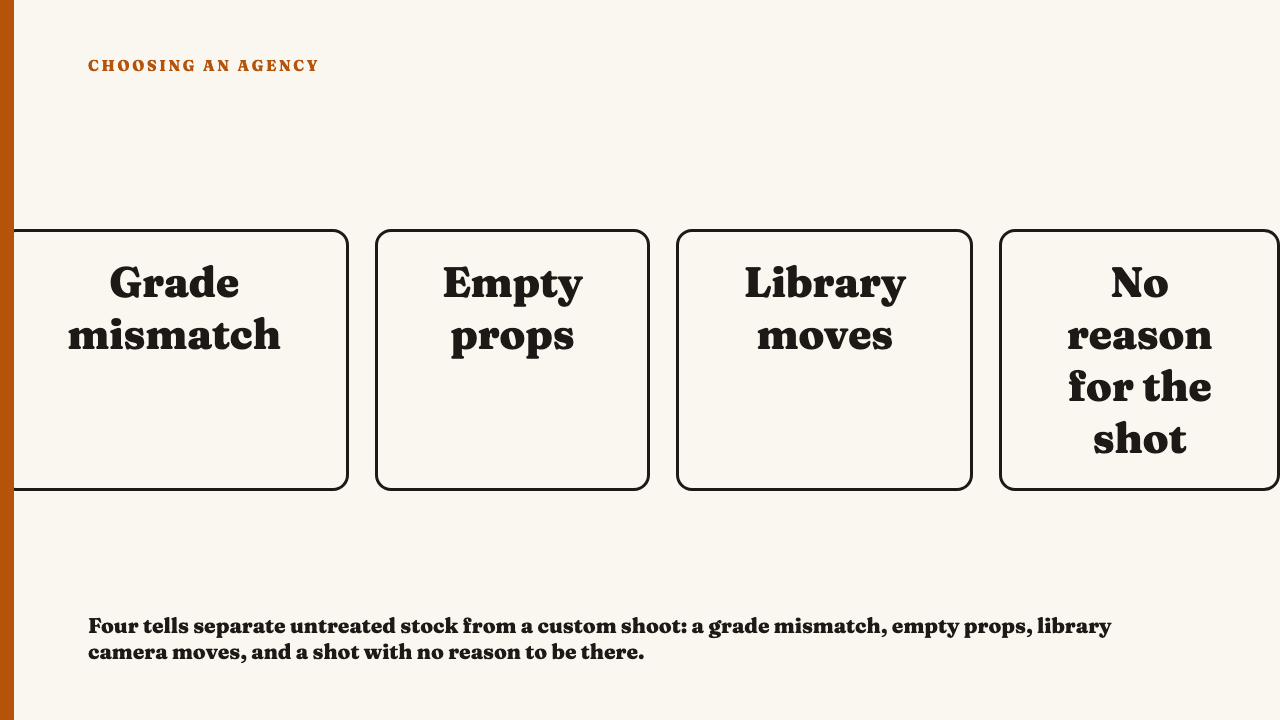
- The grade does not match its neighbours. Untreated stock reads warmer or flatter than the shots around it, with a different contrast curve: blacks sitting milky where the custom footage has real shadow. Depth of field shifts too, from an interview shot wide open with a soft background to a cutaway that is sharp all the way to the back wall.
- Nothing in frame belongs to anyone. The laptop screen is blank, or angled so that no operating system or app chrome shows. Signage is blurred or turned away from camera. No logo on a wall, no product on a desk. A room that could be any company in the category was sold to exactly that.
- The camera moves like a library. Gimbal pushes with no operator weight in them. A drone rising over a skyline that has nothing to do with where this brand operates. Slow motion lifestyle beats, hair in wind, coffee poured, that you have seen carrying completely unrelated messages.
- The shot has no reason to be there. Ask what the piece would lose if you cut it. If the answer is two seconds of runtime, it is filling a gap rather than making a point. This is the most reliable tell, because it is about the argument of the film rather than the pixels.
How a dressed-up clip tries to hide the seam
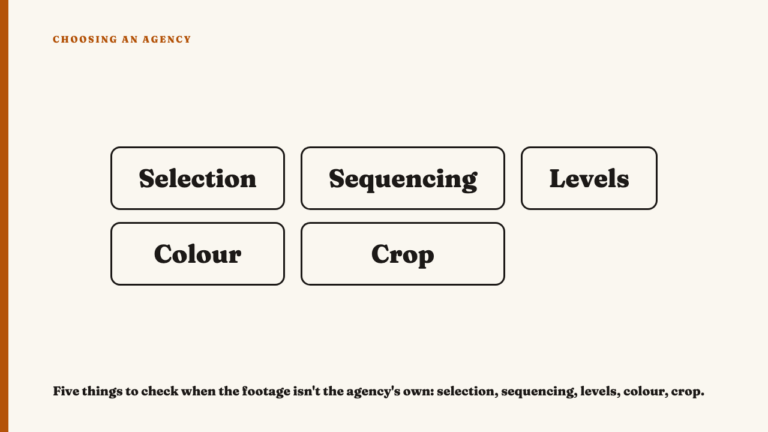
The disguises are finite. A matching grade pulls the clip toward the palette of the custom footage, which narrows the gap but cannot fix lighting direction or lens character. No colour work moves the sun from camera right back to camera left. A crop hides the background detail that would have located the shot somewhere specific. An overlay, a lower third or a kinetic caption, pulls your eye off the image beneath. And brevity does the rest, because six frames gives you no time to register a mismatch.
A short example of reading a single shot
Picture a two minute film for a hypothetical logistics software company. At forty seconds, a close up of hands typing on a keyboard, held a second and a half, cut between a founder talking to camera and a wide of a warehouse floor.
Does the lighting match what surrounds it? The founder is soft and slightly cool, the warehouse flat and fluorescent green, the hands lit hard from upper left with a warm rim on the knuckles, belonging to neither. Flag, not verdict. Does anything in frame connect to this brand? The screen is out of focus behind an anonymous glow, and no detail matches the warehouse we just saw. Stronger flag, because a shoot on that floor had a real screen available. Was the framing chosen for this story or because it existed? The film is about routing decisions made under time pressure, and a tight crop on knuckles says only that work is happening.
Where custom footage still gets this wrong
Do not treat custom as automatically better. A shoot commissioned without a clear brief produces the same generic language a library does: the open plan office, the laptop, the employee smiling toward the light. The tell here is continuity and access. Real shoots carry small unrepeatable details, signage with real wording, a specific product, a recognisable doorway, that a reviewer can cross reference against the brand’s own channels. Genericness proves only that nobody decided what the shot was for, a failure also visible in the editing decisions that separate good social video from filler.
Why this matters for judging the work, not just the footage
Stock footage is not a mark against an agency’s craft. The mark against it is undifferentiated footage used as though it were bespoke, with no matching and no work done to make it specific to this brand rather than the category. The strongest agencies mix sources deliberately, a licensed aerial establishing a city cut against interiors that could only be one building. Notice the seams, do not assume every seam is a failure. That runs parallel to the argument that whether AI made it is the wrong question to ask of the work.
Take this to a reel
Next time you sit with an agency’s video work, run the grade check and the specificity check on every cutaway. It pairs with knowing what a social agency portfolio leaves out. You can see this year’s selections to practise on, or nominate an agency whose footage holds up.
FAQ
Is it a red flag if an agency uses stock footage at all?
No. Licensed footage is an ordinary production tool used by agencies entirely capable of shooting custom, and its presence alone tells you nothing about craft. The question is how it was chosen and treated. A clip picked to do a specific job and matched to what surrounds it is good work, and the same clip dropped in raw to fill two seconds is not.
What is the fastest visual tell that a shot is stock footage?
A grade and lighting mismatch against the shots on either side of it, usually visible before you can say why: a warmer cast, flatter blacks, a key from the wrong side. After that, an environment and props with no identity, a blank screen, a blurred sign, a desk holding nothing that names the company or the place.
Can custom footage look just as generic as stock footage?
Yes. A shoot run without a clear point of view produces the same anonymous offices, laptops and smiling staff a library would sell you. The differentiator is specificity, whether the footage carries detail that could only belong to this brand.