Judging a Recurring Bit That Only Loyal Followers Will Get
You are four posts into an agency’s portfolio when one stops making sense. The caption lands on a phrase as if it has been said before, the first frame opens on a character you are supposed to recognise, and the comments are warm and knowing without explaining. You have a review sheet and no context.
The confusion this creates in a portfolio review
Two easy reactions, both wrong. Marking it down because it left you outside punishes the agency for the hardest thing to build, an audience with a memory. Marking it up because the comments are affectionate rewards the existence of an in-joke rather than its quality, and a private joke can be doing no work.
So stop asking one question. Legibility to a stranger and value to a regular are two separate measurements, and one score cannot hold both: a post can be perfectly clear and entirely disposable, or rich and impossible to enter.
Why the stranger is the normal case, not the edge case
Cold viewing is not a condition you invented by opening a portfolio. YouTube’s own description of its recommendation system says a logged in homepage mixes personalised recommendations with subscriptions, and that Up Next suggests other videos it thinks a viewer may be interested in. Neither surface is limited to the accounts a person chose, so a feed routinely carries work its viewer has no history with.
Your confusion reproduces a real viewing situation the agency should have anticipated. That raises the bar for legibility without making every recurring bit a mistake: a post can be legible without being fully explained, and the good version lives in that gap.
What legible while still inside actually looks like
Four moves let a bit read cold without flattening it for regulars. Each has a failed twin.
- A one line reintroduction. The character is named and given a role in the first seconds or first sentence, which a regular reads as a gag and a newcomer reads as information. Failed: a character with no name and no job.
- An establishing frame. The setup is shown, not assumed: the place, the task, the thing about to go wrong. Failed: it opens on the punchline, setup cut for pace, a reaction to nothing.
- A caption carrying the premise. The visual does the callback while the caption states the situation plainly. Failed: a caption that is only the catchphrase.
- A pinned or top comment. The missing history sits under the post, put there by the account. Failed: the explanation is in the thread, left to the audience to supply, which is what the replies reveal.
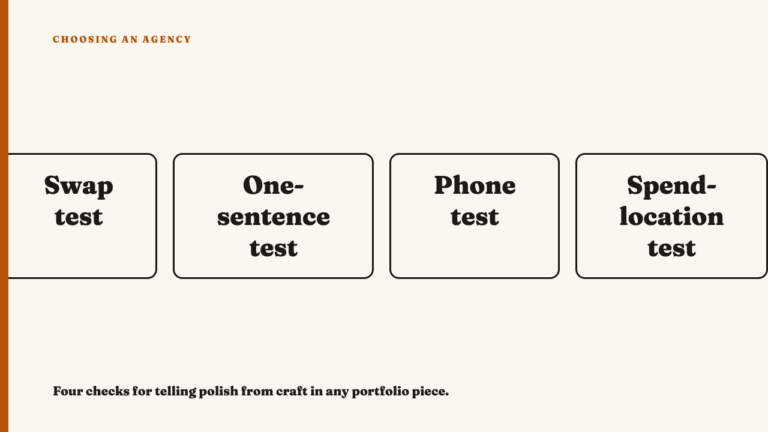
The test is one sentence: could a stranger describe what happened here, even if they cannot say why it is funny.
The second question: is the bit building anything
A bit that builds changes across appearances. The character picks up a trait and keeps it. The format earns a variation, so a later outing bends a rule the first one set. The joke gets inverted rather than restated. A bit that only signals reruns the same beat on a new backdrop.
That is checkable. Put three or four appearances in order and say what is different about the last one. If you cannot, the bit is a habit rather than a build, which is the discipline behind one post is not the body of work.
Caring about the returning viewer is not sentiment: a regular is the harder audience, having seen the shape once, and their failure mode is boredom, which is easier to hide than confusion. If the bit rests on a persona, the account level version is a brand account built around a persona.
Crossing the two questions into four verdicts
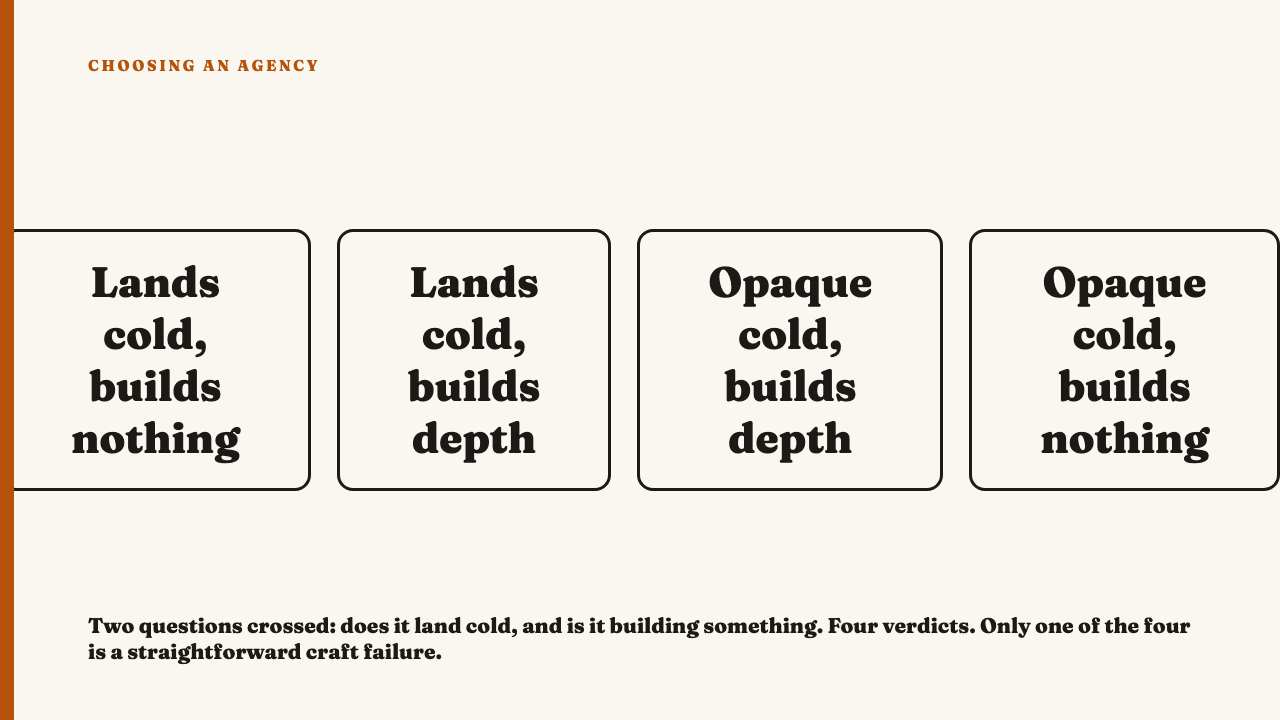
Two questions with two answers produce four combinations. The count is arithmetic, not a claim about how work is distributed, and nothing here says how often any cell turns up.
| Lands cold? | Building? | Verdict | Reason |
|---|---|---|---|
| Yes | Yes | Best case, credit the difficulty | Reads cold, still pays a regular. |
| Yes | No | Competent and disposable | Clear, professional, forgettable. |
| No | Yes | Contested, and often misread | Depth your sample did not contain. |
| No | No | The only straightforward craft failure | Opaque to a newcomer, stale to a regular. |
For the contested cell, read the series in order before writing anything down. If the earlier posts supply the setup you were missing, the gap is in your sample, not in the work.
Working an example without naming anyone
Take an invented account, a generic retailer. Every few weeks a stock room character reappears, aggrieved, mishandling a delivery. In the post you opened, the character walks in already annoyed and the caption is only the catchphrase. Lands cold: no. Building: yes, once you read backwards, because earlier appearances gave the character a grievance and the recent ones invert it. Contested cell, and the fault was in your sample.
On the same account, a cold open on a product. No history, no character, set up in the first frame and closed in the last. Lands cold: yes. Building: no, and not trying to. Competent and disposable, not punished for lacking depth it never claimed. If you cannot see a bit’s earlier appearances, mark the verdict provisional. Turning a gap in your sample into a mark against the craft is your error, not theirs.
What this changes about how you write the note
A usable note names which question the post failed, on what evidence, and what a fixed version would have contained. Not “this confused me”, which reports your state, but “a newcomer cannot say what happened, because the character is unnamed and the setup frame is missing, and one line of introduction would have fixed it”.
Resist the opposite reflex. Demanding that every post explain itself grades every account down to its most casual viewer. If you have seen an agency doing the harder version well, nominate an agency for editorial consideration.
FAQ
Does a post always have to work for someone seeing the account for the first time?
No, but it has to be describable by them. Understanding what happened is the requirement: a stranger who cannot narrate the post has been handed nothing. Getting why it is funny is the reward, and reserving some of that for regulars is legitimate.
How many earlier posts should I look at before scoring a recurring bit?
Enough to see the bit at least twice more, so you can say what changed between appearances. That is the instruction rather than a fixed number. A verdict from one post is provisional.
Sources
- Recommendations, How YouTube Works, fetched 2026-09-08.