Format Choice Is a Craft Decision, Not Just a Performance Bet
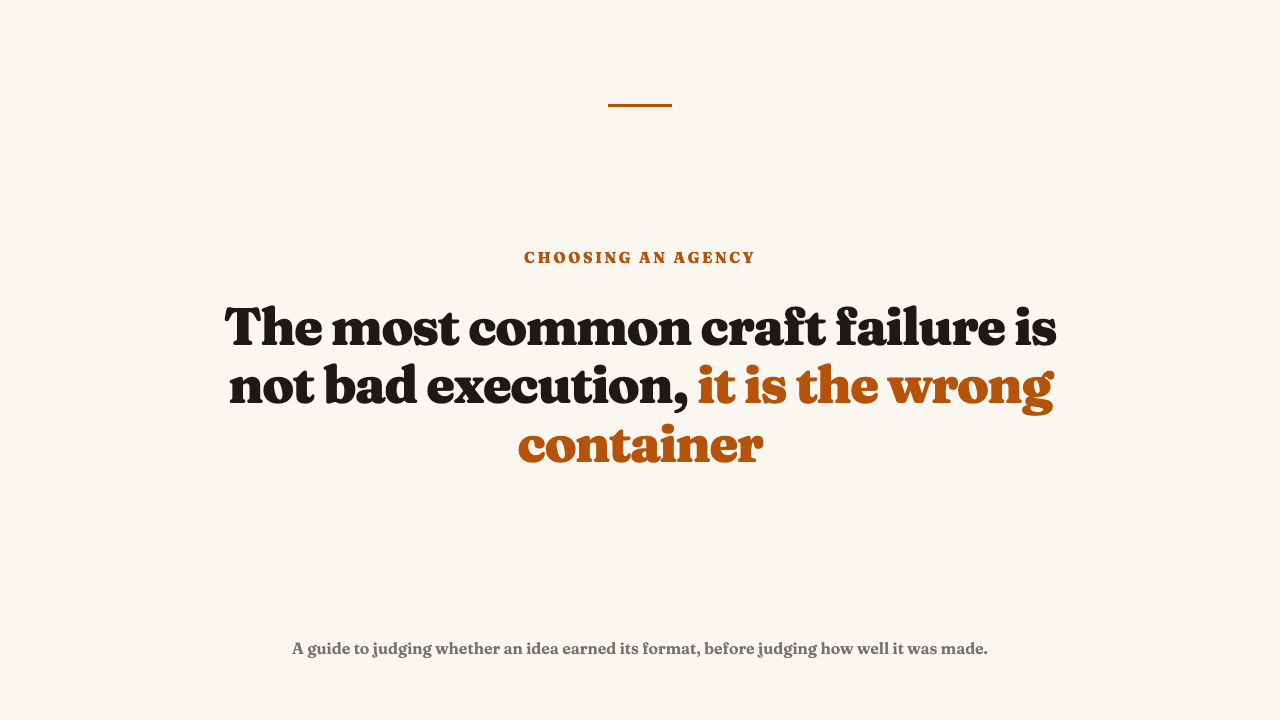
You are looking at a carousel that is well designed, cleanly typeset, on brand, and still feels like slides too many. Or a Reel that is shot and edited well and still drags. The instinct is to blame the execution, but the execution might be fine. The problem can sit one level earlier, in the decision about which format the idea was ever put into.
Two questions, and social criticism usually only asks one
Most commentary on a Reel versus a carousel is a performance argument dressed as a craft one: which format gets more reach, which holds attention longer, which saves better. Reach, saves, and completion rate are distribution questions. They tell you how a post travelled, not whether the idea inside it belonged in that container.
That is the question this piece asks instead. Given what a specific post had to say, was nine slides the right vehicle, or six seconds of video, or one static image. You can answer that without knowing how the post performed, and before judging how well the format was executed. Execution is a separate question, answered after this one.
What a mismatch actually looks like
Picture a process explanation, the three steps a team takes before a project starts. That is one sequential idea, stretched into a silent, captioned Reel where the on screen text repeats, slide by slide, what a voiceover would have said in a third of the time. The mismatch is structural: a sequence that wanted to be heard in one pass was given a runtime it did not need.
Picture a single fact, sayable in one sentence, given a ten slide carousel where slides two through nine restate the same point in different phrasing because the deck needed to reach a slide count. Now picture a story with a real turn in it, undercut by what happens next, flattened into a single static graphic that states the outcome with no setup. The reversal cannot land because the format gave the reader nothing to be surprised out of. In each case something the idea needed structurally, a beat, a single point, a sequence, met a container that forced a different shape onto it: extra runtime, extra slides, or a missing setup.
The tell: watch where the padding lives
You do not need to guess at intent to spot this. In a carousel, look for the slide that could be deleted without losing information, the one that only rephrases the slide before it. If removing a slide leaves nothing missing, that slide was there to hit a count.
In a Reel or video, look for an intro that delays the one idea the post has, or an idea that would have worked as a caption over a single still frame but was given motion it did not need. In a static post, the tell runs the other direction: a caption doing work the image cannot do, explaining a sequence or a change over time that a still cannot show. When the caption carries the structure the visual should carry, the format was too small for the idea.
Why format mismatch is easy to miss and easy to fix
The mechanism is ordinary and does not need a statistic to be believable. A content calendar or format quota decides what gets posted on a given day, often before the idea for that day exists. Tuesday is the carousel day, Thursday is the Reel day, and whatever idea shows up gets retrofitted into whichever slot is on the calendar.
This is why format mismatch is a craft failure, not a strategy failure. A strategist can choose the right themes, cadence, and audience, and every call can be sound, while the decision of which container a given idea goes into is still made badly. Strategy sets the plan. Format choice is a craft judgment made post by post, and it can go wrong even when everything upstream went right.
How this is different from judging whether a post is native to the platform
A post can be fully native, built with no template and no crosspost, shot for the platform it appears on, and still be the wrong format for the idea inside it. Native execution and correct format choice are different judgments made at different points. One asks whether the asset was rebuilt for the platform it lives on. The other, the one this piece is about, asks whether the container matched the shape of the idea, regardless of how carefully it was built. Two adjacent questions are worth naming without answering them here: whether an asset was rebuilt for the platform it appears on rather than dumped there from somewhere else, and whether a template did the designer’s thinking before the designer got involved. Both are real judgments. Neither is this one.
What to do next
None of this requires taking anyone’s word for what counts as good. See this year’s selections and read a few with the questions above in mind, or if you think an agency’s work holds up under this kind of scrutiny, nominate an agency.
A short checklist for judging format choice
- State what the idea is in one sentence, before looking at how it was executed.
- Ask what the shortest format is that sentence could survive in.
- Compare that to the format actually used, and name the gap if there is one.
- Check whether the gap repeats across the account. One mismatched post is a misstep. A pattern is a house habit.
What this does not tell you
This is not advice on which format to choose for your own next post, a decision for the person making the work, not a judgment of published work. Nor does it replace judging the execution inside the format once the format is settled. A post can have exactly the right container and still be poorly made inside it. Getting the format right is necessary, not a substitute for the rest of the craft.
FAQ
Isn’t format choice a strategy decision, not a craft one?
Both are true at once. The strategist decides content pillars and posting cadence. But which container a specific idea goes into, made post by post, is a craft judgment, and it shows up in the finished work the same way a bad edit or a flat caption does.
Can a post be well executed and still fail this test?
Yes, directly. Clean design, good motion, and a competent edit can all be present while the container is still wrong for the idea inside it. That is what makes this failure easy to miss.