Judging Social Content Made to Recruit, Not to Sell
You are looking at a portfolio piece labelled employer branding, a culture video or a day in the life cut vertical. Your instinct is to grade it gently because it was made for candidates, not customers. The brief changed. The standard did not.
The bar drops the moment the brief says hiring
Listen to the excuses as people phrase them: internal work, a hiring thing rather than a campaign, shot on a phone by the team. Each explains the footage, none the edit: why the cut is limp, why the audio jumps between speakers, why nobody chose an order for the shots.
Look harder, not softer: someone researching an employer opens the account on purpose and watches in sequence, and attentive viewers notice construction. A different brief means different criteria, not fewer, as this site argues in judging work against its own brief rather than a borrowed one.
The brief is different, so read the brief before the frames
Consumer work asks a stranger for a moment of attention. Recruiting work asks one person to imagine themselves in a room, and imagining needs material. Nobody pictures a place they were only told is vibrant.
So the demand is legibility about the job: what the day contains, how big the team is, how fast it moves, who talks to whom. Atmosphere about workplaces in general fails the task. Could a viewer describe one real thing about working there, and if not, what was it for?
What a real day looks like on screen, and what a performed one looks like
The performed version has a house style. Someone walks in with a coffee. A laptop opens onto a screen nobody looks at. A whiteboard covered in shapes, not words. A meeting where everyone nods and nobody interrupts. A desk with nothing on it. None of it untrue, none of it information.
The real version reads differently. Someone is mid-task rather than starting one. A screen is legible and what is on it is boring. The room sounds like a room. An interruption survives the cut. A shot runs long enough to show something nobody staged.
Take one scene twice. A designer sits down, opens a laptop, smiles at a colleague, two seconds. Or the designer is hours into a file, says a version number out loud while hunting for it, and someone off camera asks whether the client saw the other option. The second cost a producer who stayed for that sentence and an editor who kept three unflattering seconds.
Then the tells that the b-roll was gathered afterwards, not during the day it documents: an office empty in the wides while the voice over describes a busy team, a workspace lit but unused, daylight that changes between two shots of one afternoon. Reconstruction is allowed once the edit stops pretending.
Who is speaking, and whether anyone directed them
Employees on camera are non-professional talent, so the question is not whether they performed well, but whether anyone cast and directed them.
Two failure modes share a cause. One employee reads a script written in marketing language, so a warehouse supervisor talks about empowering journeys. Another was handed nothing, and the cut keeps the part where they run out. Good direction shows from outside: answers that begin mid-thought, details too small to invent, a cut that protects the speaker. Casting asks whether these are the people who do the advertised job or the three most comfortable presenters again.
A post aimed at candidates is a different assignment from a customer-facing takeover: the viewer is deciding about their own working life, so the risk is a promise about one team, not brand voice. Where such content also sells the product, disclosure becomes a design problem. The FTC’s endorsement guidance treats an employment relationship as a connection that should be disclosed clearly and conspicuously, and its guidance on placement keeps the disclosure inside the video rather than only in the description. Ask too how much of the work the agency actually did.
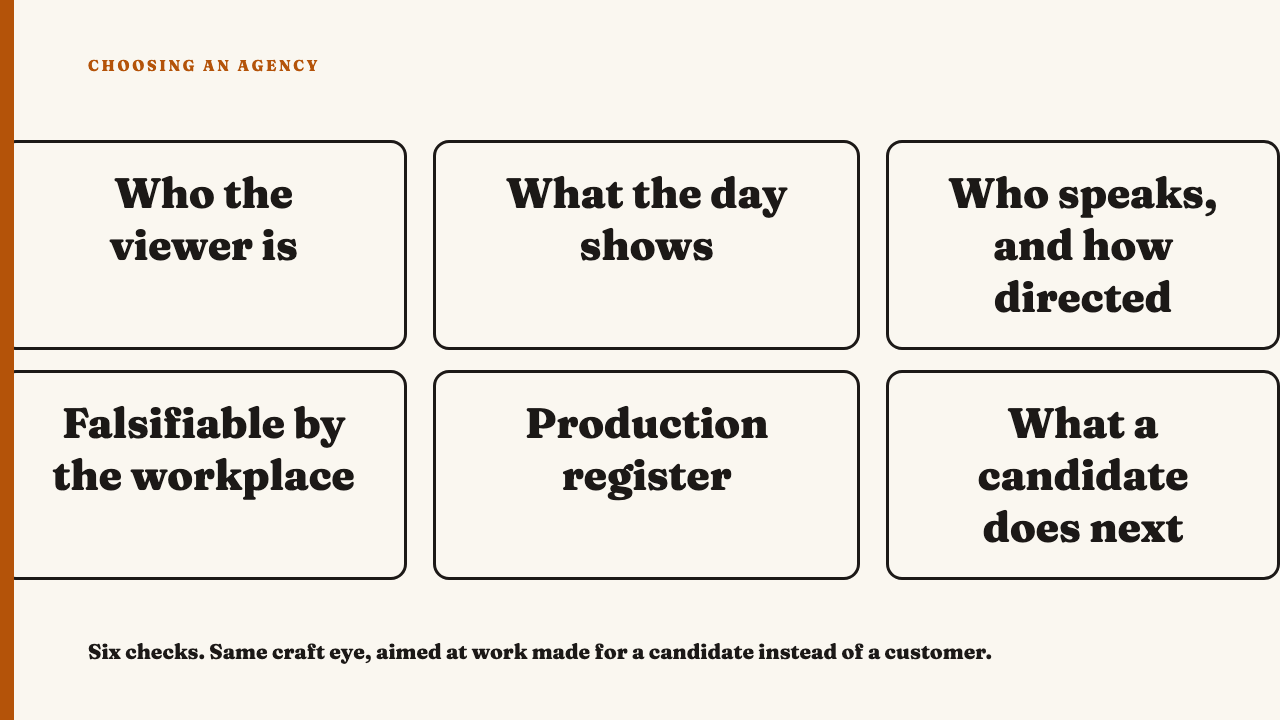
Six checks to run on a recruiting portfolio piece
- Who the viewer is. A candidate for a named kind of role, or nobody in particular?
- What the day shows. One concrete detail a viewer could repeat afterwards, or a mood?
- Who speaks. Did the direction do the hard part, or was the employee left carrying it?
- Falsifiable by the workplace. Something a new joiner could check in week one?
- Production register. Does the polish match the room shown, or overshoot it?
- What it asks next. Was the ask designed in, or bolted on?
The polish problem, and the ending
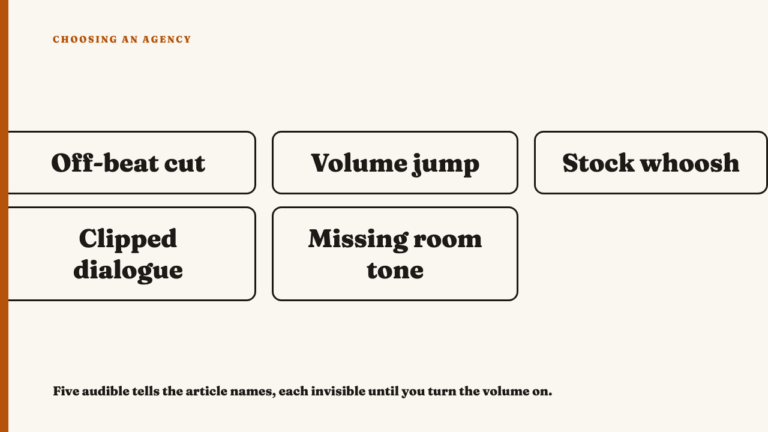
Register is where this work breaks its own promise. A cinematic grade, a drone shot over the car park and a licensed anthem, over a workplace of three rooms and a kitchen, promises what the building cannot keep, and the candidate who arrives was mis-sold by the craft rather than the copy. Deliberately rough is a choice only when consistent: shaky footage cut to a beat with clean sound design is a decision, clipped audio in two clips of six is an accident. That is when a voice is distinct and when it is only loud, in production.
Then the ending, usually where attention ran out. Is the ask legible without pausing, and do the on-screen text and the caption agree? A card saying we are hiring, a caption pointing at a careers page and a profile link pointing elsewhere are three people finishing separately. Constrained work deserves the fair reading in craft on an account with almost no room to move. Either way it sits in the same portfolio as the consumer campaigns, read the same way.
Where to look next
For the work put forward this year, see this year’s selections, chosen editorially, with the reasoning published. If an agency’s recruiting work survives those six checks, nominate an agency.
FAQ
Does a low production budget excuse weak culture content?
Budget explains the finish, not the decisions. Framing, sound, casting, direction and shot order come at any price, and those are what you grade. Rough on purpose is a choice, rough in patches is an accident.
How do you tell a staged day in the life from a documented one?
Readable screens rather than glowing ones, interruptions that survived the cut, and continuity of daylight and wardrobe across one claimed day. Continuity is easiest to check and hardest to fake later, since a reconstruction rarely matches itself.
Sources
- FTC, Endorsement Guides FAQ, fetched 2026-09-08.
- FTC, Disclosures 101, fetched 2026-09-08.