What Actually Separates Good Social Media Work from Average
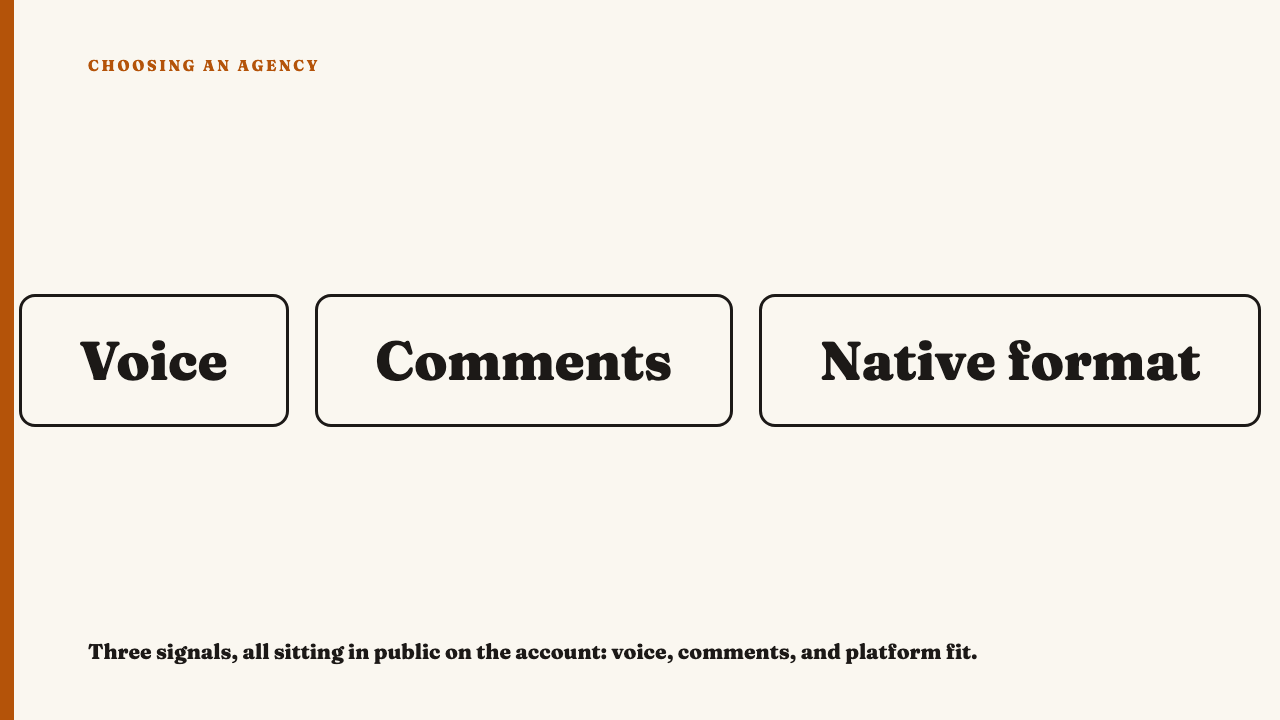
Most agencies pitch you with the same three things: strategy, creativity, results. None of that tells you whether their actual output is any good. What you can judge, from the outside, before you sign anything, is craft. Craft shows up in the small, unglamorous places: whether a brand sounds like itself on a Tuesday afternoon reply, whether a comment section gets ignored, whether a video was clearly shot for TikTok or just resized from something else. These signals are visible in five minutes on a brand’s page, and they tell you more about an agency than any deck will.
Voice consistency is the first tell
A brand’s voice should survive contact with a bad day. Pull up an agency’s client accounts and scroll back three months. Does the caption tone hold steady, or does it swing between “witty internet native” and “corporate press release” depending on who apparently wrote it that week? Inconsistency is the fingerprint of a rotating cast of freelancers with no shared brief, or an account team that never built one in the first place.
Picture a regional coffee chain whose captions are sharp and self-aware for a stretch, then suddenly read like a menu insert for two weeks, then snap back. That’s not a brand with range. That’s a brand that lost its writer and patched the gap with whoever was available. Good agencies protect voice the way a copy desk protects style. You should be able to read five captions with the handles blacked out and still guess the brand.
How they handle comments says more than how they handle posts
Anyone can write a good caption with unlimited time and no audience watching. Comments are where craft gets tested live, in public, with no do-overs. This is the section most buyers skip, and it’s the one worth the most attention.
- Good: replies that sound like a person who read the specific comment, sometimes with a little personality, sometimes just useful. A complaint gets acknowledged and moved to DMs instead of left hanging. A good joke in the comments gets a reply, not silence.
- Bad: copy-pasted “Thanks for reaching out! 😊” on everything, including comments that were clearly complaints. Or worse, nothing at all. Hundreds of comments, zero replies from the brand, on every post going back months.
- Bad, differently: replies that are technically present but generic enough to have been written by nobody in particular. This is what an agency does when community management is billed but not actually staffed.
An agency that’s genuinely good at this treats the comment section as part of the content, not an afterthought bolted onto a posting calendar. If you want to know whether an agency actually cares about the account or is just filling a schedule, this is where you look.
Does the work look native, or does it look repurposed
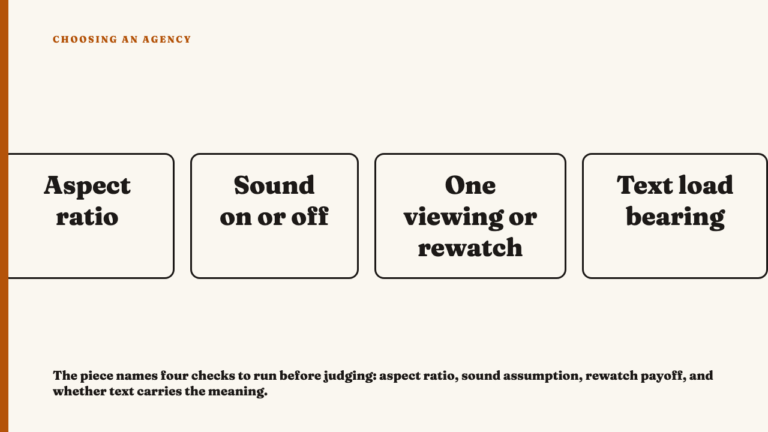
The fastest way to spot a mediocre agency is to look for the seams. A vertical video with black bars because it was shot horizontal and never reframed. A TikTok that’s obviously a Reel with the watermark cropped, or an Instagram carousel that’s obviously a slide deck exported to PNGs. Text sized for a desktop screen, crammed into a phone frame. These aren’t small errors. They’re evidence that the work was made once and pushed everywhere, rather than made for the platform it’s landing on.
Native work looks different in ways that are easy to spot once you know to look. Pacing matches how people actually scroll that platform, not a generic “social video” pace. Captions on video are burned in and readable with sound off, because the agency assumes, correctly, that most people are watching muted on a train. The hook happens in the first second, not after a logo animation. On LinkedIn, the same brand might post something closer to a written thought than a polished asset, because that’s what performs there and a good agency knows the difference.
Consider two furniture brands running near-identical product lines. One posts the same 15-second clip across every platform with the same crop, same music, same caption style. The other posts a stitched-together trend format on TikTok, a tightly edited how-to on Instagram, and a plainer, more conversational post about the same product on LinkedIn or X. Nothing about the underlying product changed. What changed is that someone treated each platform as having its own audience and its own grammar, instead of treating platforms as identical distribution pipes.
What good actually looks like, put plainly
Good social work has a rhythm you can feel before you can articulate it. Posts land like they were made by people who use the platform, not people who studied it. Replies sound like a person, not a macro. The account has a point of view strong enough that you could tell, blind, which competitor it isn’t. And crucially, the quality doesn’t dip on the unglamorous days, the Wednesday afternoon post that isn’t a campaign, just a normal update. That consistency under low scrutiny is a better indicator than any hero video, because hero videos get every resource thrown at them. Ordinary Tuesdays reveal what the agency does without anyone watching closely.
The bad version is easy to describe by contrast. Voice that drifts. Comments that go unanswered or get form replies. Content that’s clearly built once and pasted everywhere with different aspect ratios slapped on. None of these require inside access to diagnose. They’re all sitting in public, on the account, right now.
Where to look next
We built The Social Agency Awards because most “best agency” lists are pay-to-play or based on self-reported case studies nobody can verify. Ours is editorial: we look at the actual public output, the same things described above, before an agency makes the list. See this year’s selections, or if you work with an agency you think holds up under this kind of scrutiny, nominate an agency.
FAQ
Can I judge an agency’s quality without seeing their contract or pricing?
Yes, largely. Voice consistency, comment response quality, and platform-native formatting are all visible on the public account itself, with no access to the agency’s internal process required. Pricing and contracts tell you what you’ll pay, not whether the work is good.
What if an agency’s client accounts look great but the agency itself won’t share who they work with?
Treat that as a caution flag, not a disqualifier. Some client relationships include confidentiality requirements that are legitimate and common. But an agency that won’t point to any public work at all, confidential or not, is asking you to trust a claim you can’t check, which is exactly the position case-study-only pitches try to put you in.