The Sound Choices That Give Away a Rushed Edit
You have watched the same reel three times and formed opinions about the pacing and the type treatment. You still have no idea what it sounds like, because the volume was never on. That is the normal way to review social video, and a whole layer of the editing went past unexamined.
Why most reviews miss half the craft
The habit comes from the feed. Video autoplays silently, you scroll muted in a meeting or on a train, and that default follows you into work, including when you sit down deliberately to judge whether an agency’s craft is real.
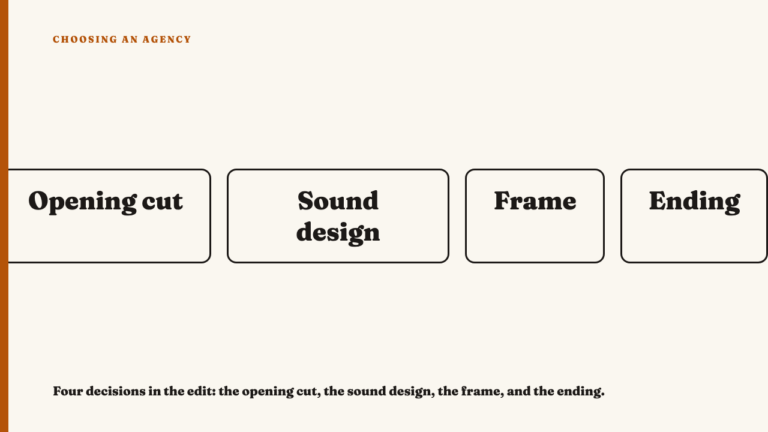
What that costs is specific. Where a cut falls against the track, whether the voiceover stays on top of the music, which audio was chosen at all: three deliberate decisions, none of which leaves a visible trace. A muted watch tells you nothing about whether anyone was paying attention.
What a cut timed to sound actually looks like
Picture a thirty second piece for a bakery. The track has a clear pulse, and every visual change, a new shot, a text card, a wipe, lands on it. The price card snaps in on the stressed syllable the voiceover leans on. Halfway through the track adds a layer, and the edit widens from tight product shots to the room. You register that it feels tight.
Now the rushed version of the same footage. Shots change every two seconds because two seconds felt right, not because the audio asked for it. An obvious accent goes by, a snare, the moment the vocal comes in, and the picture does not move. Then a cut lands four frames after the beat, enough to feel wrong, like a handshake offered a moment late. Any sound with structure gives an editor points to hit, and you can hear from outside whether they were hit.
Mixing: the balance nobody notices when it’s right
A competent mix is defined by absence. The voiceover stays intelligible even though music runs underneath, a sound effect sits beside the track rather than on top of it, and when the edit moves from an interview clip to B roll carrying its own ambience, the level does not lurch, it moves. Nobody ever compliments a mix.
The failures are loud once you listen for them. Music at a volume where it competes with the voice. A whoosh dropped in at a level unrelated to anything else. Two clips stitched together where the second is audibly louder because nobody levelled them. The technique separating the two is ducking, the music dropping under the voice as it speaks and returning when it stops. You do not need to know how it is done, only whether someone bothered.
Audio choice: fit versus mismatch
Timing and mixing can both be clean and the audio can still be wrong. A mismatch announces itself immediately: a hard, percussive, high energy track under footage of something quiet or careful, or a slow melancholy cue under content that wants to feel light. The signature is that it feels borrowed, picked for being in circulation rather than for fitting the footage.
A fit is harder to see, because it disappears into the work. The mood, pace, and texture of the audio push the direction the picture is already pushing, so the piece reads as one decision, not two things stacked. It is the same test as when a brand voice is distinct and when it is only loud, applied to sound instead of copy, and a fast way of telling platform native work from a crossposted asset, since an asset built elsewhere arrives with audio chosen for somewhere else.
The signs of a rushed sound job
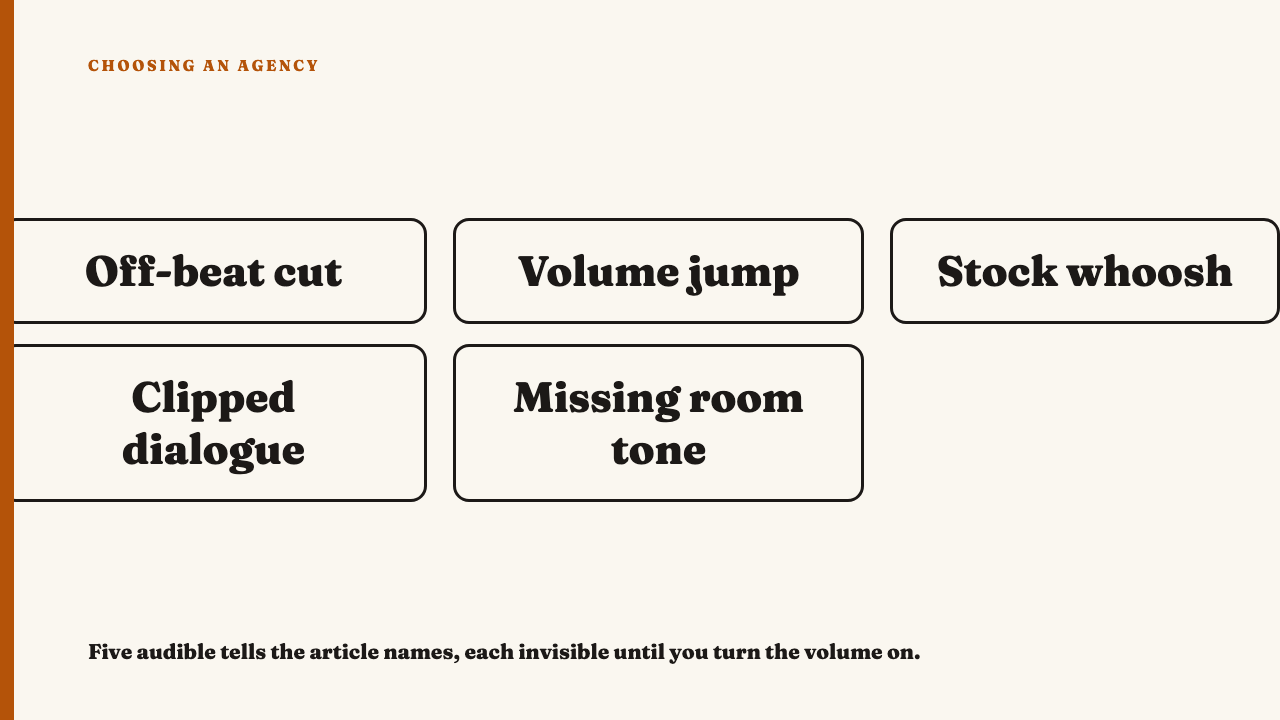
On a second pass with the volume up, listen for these:
- A cut that ignores an obvious beat or accent, so track and picture run on separate clocks.
- An abrupt volume jump between two clips that were never levelled against each other.
- A stock transition sound, a whoosh, a swipe, a click, dropped over a change that does not warrant it.
- A line of dialogue or voiceover clipped mid word at the head or tail of a cut.
- Silence where a natural sound belongs, footsteps, room tone, a door, reading as oversight rather than choice.
Why this belongs in a portfolio review, not a production note
The question is not whether you could do it better. It is whether the team that made this was attending to it at all, which makes this a reviewing skill rather than a production one. Sound is one more surface where a reel can be dressed up or left thin, and it is the surface a reviewer is least likely to check, which makes it honest evidence, one more entry in what a portfolio leaves out.
Where to take this next
To see this reading applied, see this year’s selections, chosen editorially with our reasoning attached. If a team’s work holds up with the volume on, nominate an agency.
FAQ
Do I need to be a sound engineer to judge this?
No. Every tell here is audible on a second watch with the volume up. Does the cut land with the track or beside it. Is one clip louder than the next. Does the music belong to this footage. None of it requires technical vocabulary to notice.
Isn’t sound just a production detail, not a real craft signal?
It is a craft signal of the same order as any visual one. Deciding where a cut falls against a beat is a judgment about rhythm. Choosing audio that fits the moment is a judgment about tone. Both take attention and taste, and both are skipped first when a team works faster than the work deserves.
What if the reel has no music, just ambient or dialogue audio?
The same standard applies. Whether the room tone is clean, whether a line survives the cut intact, whether the ambience carries across a scene change or drops out at it, all of that was decided by someone. An edit with no music has fewer places to hide, because nothing is laid over the top to cover a careless pass.
Should sound be checked on every reel, or only some?
A first pass on mute is fine for reading pacing and framing without the audio flattering the cut. But no judgment of an edit is finished until you have watched it once with the volume on. Skip it and you are assessing half the work, and the half most likely to have been left thin.