Judging Work That Was Never Made for You
Two minutes into an agency’s reel, nothing is happening to you. The cuts land, a voice says something you assume is a joke, and you feel nothing. The question is not whether you liked it. It is whether that flatness is about the work or about you.
Your reaction is data, but not the data you think it is
Picture someone in their mid thirties who works in marketing, watching a reel built for fifteen year olds. The pacing is faster than feels comfortable, the references are unfamiliar, the tone is louder than feels necessary. The verdict forms fast: thin, gimmicky, not serious. It runs the other way too. Hand the same viewer a series made for structural engineers and the flatness arrives for the opposite reason. Nothing is loud, nothing is charming anyone, and it assumes you know the vocabulary.
Two explanations fit both cases. Either the work is weak, or it is doing its job for people who are not you. Most evaluations skip that fork, because a flat reaction arrives with the certainty of a craft judgment and none of the evidence.
What still counts as craft, no matter who is watching
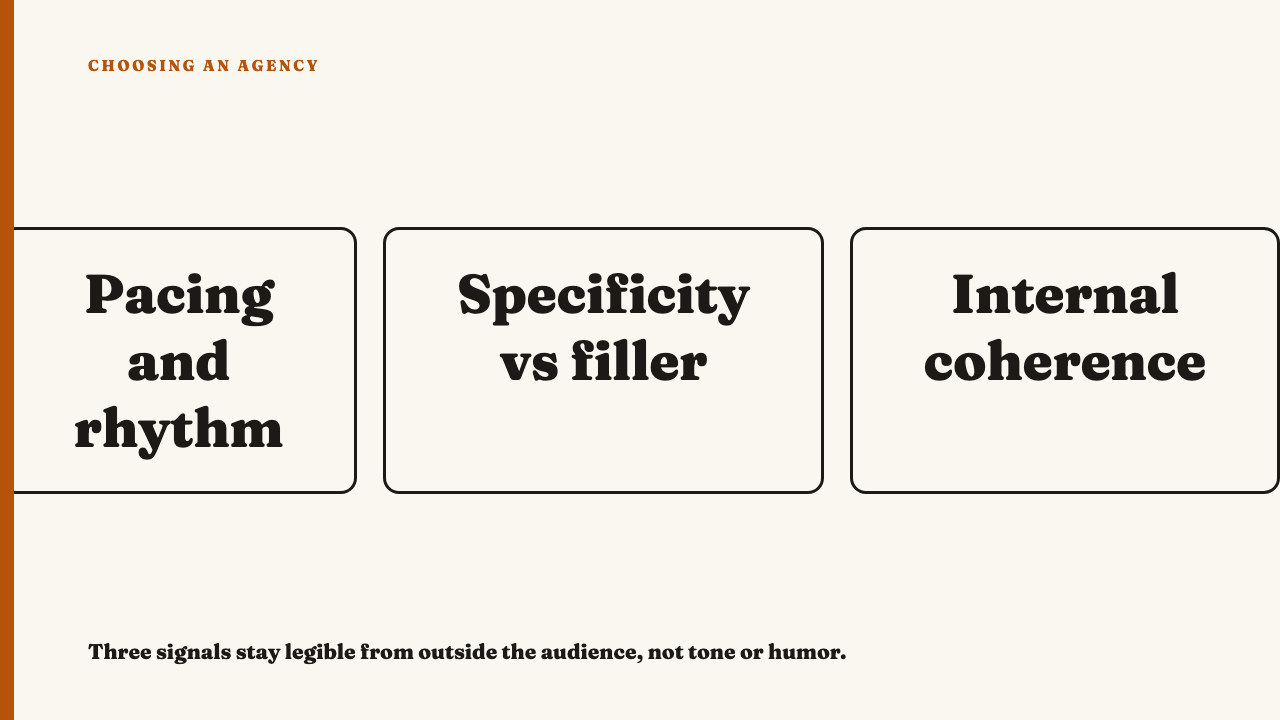
Three things stay legible even when you are structurally outside the intended group. None require getting the joke.
- Pacing and rhythm. A cut either lands on the beat or it does not. Watch for a punchline arriving half a second after the shot gave it away, or a hold that runs two beats past its purpose. Drag is arithmetic.
- Specificity versus filler. Ask whether any line, prop or piece of art direction could be swapped into another brand’s work unchanged. A caption saying the team is passionate about quality is filler. A caption naming the exact moment on a Tuesday shift when the thing goes wrong is not. You are checking for absence, not asking to be charmed.
- Internal coherence. Good work sets rules and keeps them: a recurring framing, a running bit that pays off, a visual grammar meaning the same thing on post nine as on post two. You can track that without recognising a single reference.
What your reaction can’t tell you when you’re outside the audience
Now the unreliable half. A joke or a reference that does not land for you is close to worthless as evidence, because both run on shared context and shared context is what you lack. Your blank face is not the response failing, it is that response addressed to somebody else.
Tone works the same way. What reads as try hard or cringe from outside often sits precisely on the norm inside the group it was made for. Your discomfort reads a boundary, not a fault in the execution. Same distinction as when a brand voice is distinct and when it is only loud.
A worked example: judging across a real audience gap
Take content made for an older audience. The checkable norms: longer captions that explain rather than imply, calls to action stated plainly instead of gestured at, and trust building that leans on testimonial style reassurance. A twenty year old would call that unsubtle. Inside the intended audience it works as respect: the offer is clear, nothing needs decoding.
Now a niche trade audience. The norms invert. Field specific terms arrive at high density with no gloss, and prior knowledge is assumed rather than built. Outside the trade that reads as inaccessible. Inside, using the vocabulary correctly is how you show you have done the work. Same logic as judging B2B social work without borrowing consumer standards.
These are examples of how genre norms differ, not claims about how any group behaves.
Find the person the work is actually for
Stop being the test subject. Build a specific person in your head, specific enough to be inconvenient: not a younger audience but a nineteen year old who has seen this format four hundred times. Ask whether this piece would hold that person, and whether the setup earns its payoff for someone who already knows the shape.
Then look outward. Comments on the account itself, read directly rather than through agency reporting, are a weak but real proxy. Weak because attention can be bought. Real because the shape of the responses shows whether people are quoting lines back, arguing, tagging friends, or saying nothing. It pairs with reading strategy from public output alone.
Where ‘you’re just not the audience’ becomes an excuse
That line should open a check, not close one. Two tells separate the honest use from the defensive one.
- The work never establishes its own premise. Hand it to someone who does have the context, and they still cannot say what it is or what it wants. A piece can sit entirely inside a subculture and be incoherent within it.
- It wears the surface without the reasoning. The slang is present, the format copied, the visual style approximately right, and nothing underneath shows why those choices work. Catch it at the seams: slang half a step off its meaning, a format borrowed with its structural joke removed, an aesthetic applied to material it does not fit. Costume, not fluency.
Take it further
Our editorial picks come with the reasoning behind each one. See this year’s selections, or nominate an agency whose work holds up under this scrutiny.
FAQ
If I’m not the target audience, should I trust my gut reaction at all?
Partially. Pacing, specificity and internal coherence stay legible from outside, so a reaction grounded in those is worth keeping. One driven by humour register, aesthetic taste, or unfamiliar references is not reliable evidence from outside the group.
Does an agency get a free pass just by saying ‘you’re not the audience’?
No. Treat it as a prompt to check, not the end of the conversation. The question it triggers: would this piece function for a real member of the audience it claims to serve, or does it fail on its own terms too?
What if I have no way to reach anyone from the actual target audience?
Use observable proxies. Read the comments and reactions on the account itself, never the agency’s own reporting of numbers. Then compare the piece against other accounts genuinely serving that same audience: if its captions, pacing and register sit far outside those norms with no visible reason, that gap is worth asking about.