Judge the Script of a Talking Head Video, Not the Presenter
You have two talking head samples from the same agency. One is sharp, and you could repeat its point afterwards. The other feels like a LinkedIn post being read at the camera. Both presenters seem competent, so the face cannot explain the gap, and you lack the words for what differs. Those words are about the script.
The face takes the credit and the blame
A talking head video puts one person in the middle of the frame, so every impression attaches to them. That shortcut is often wrong.
Run a thought experiment. Hand the flat video’s lines to the sharp video’s presenter. Then reverse it: keep the sharp presenter and give them the flat lines. In our reading, the second swap changes the video far more. A good presenter can lift weak lines a little, but a weak script has a shape problem, and no face fixes shape. The face tells you little here, because it is the one constant while you watch.
Performance and direction are a different question, and eye line, energy and charisma are not judged here. For the on-page cousin of this craft, see what separates a written caption from a filled in one. This piece is only about the words.
Written to be said versus written to be read
A caption read aloud tends to carry long subordinate clauses, a parenthetical aside, a list of three adjectives, and a sentence you would have to re-read. On a page, the reader can double back. The ear cannot. It loses the thread, and the presenter’s pace tends to speed up to cope.
Lines written to be said do different work. A person can finish a sentence in one breath, with subject and verb early. There are contractions, a fragment used as a beat, and a short line after a long one.
An illustrative pair, invented for this article and quoted from no one:
On the page: “Our approach, which prioritises authenticity, consistency and measurable engagement, ensures that brands, regardless of size, can build lasting relationships with their communities.”
Said aloud: “Most brands post a lot. Few say anything. Here’s the difference.”
The second can be heard one piece at a time. To test any line, say it out loud at normal pace without looking at a screen. Where you stumble or run out of air, it was written for the page.
The first line is where filler shows up
Throat-clearing comes in a few shapes: greeting the audience, announcing the topic, announcing that the video will explain it, and a rhetorical warm-up question that never gets answered. Each costs the viewer seconds spent being told content is coming.
A hook is a claim, a tension or a concrete detail. Filler announces that something is coming, while a hook is already the something.
If a sample opens with filler, keep watching. A script that recovers tells you the agency can write a weak first line and a strong rest, which is information about its process. The sound-off piece says to judge it that way first when captions and visuals carry the work. This piece is about the spoken script.
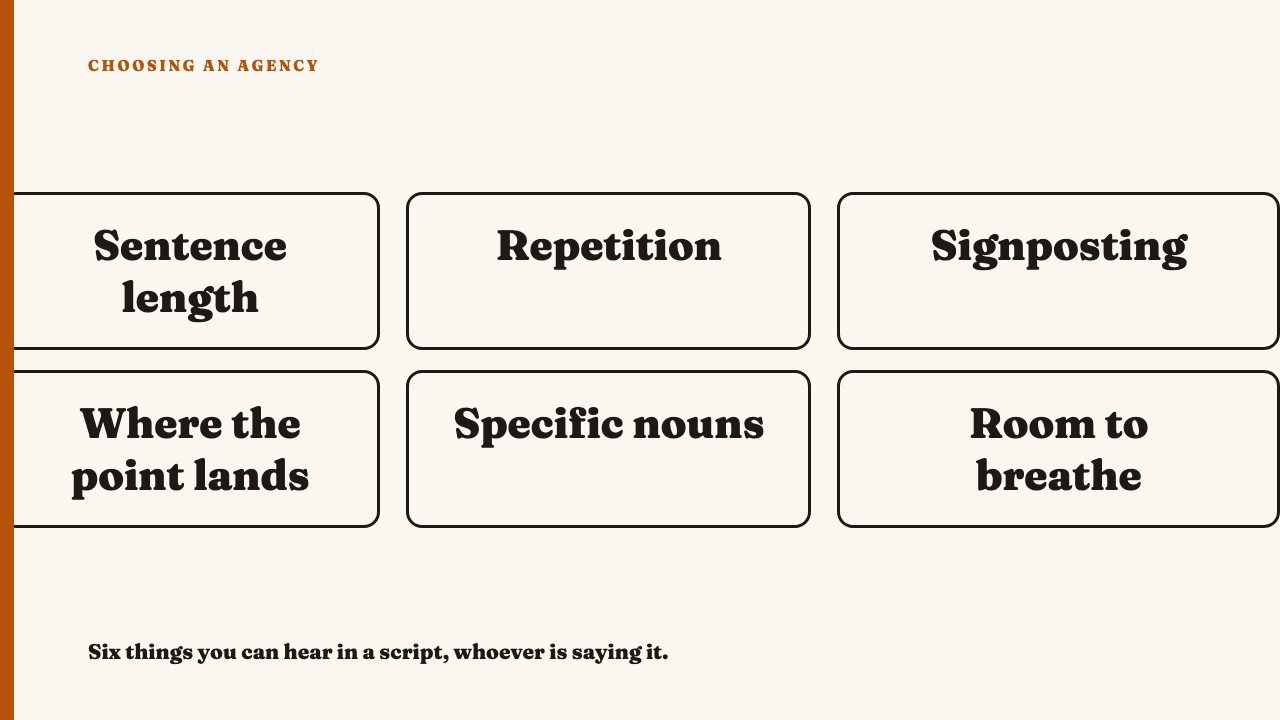
A field guide to the spoken script, in six things you can hear
- Sentence length as heard. Varied rhythm sounds like thinking. Uniform length sounds like reading.
- Repetition on purpose. A phrase returned to so the ear can hold the structure is craft. The same idea said three ways to fill time is padding.
- Signposting. The ear needs to know where it is. A good script says so in a few words, such as “second thing”, not a paragraph of setup.
- Where the point lands. Early, middle or last line can all work. Ask whether the placement felt chosen.
- Specific nouns. Can you picture what is named? A concrete object or moment beats “engagement” or “community”.
- Room to breathe. Does the script leave space for pauses, or is every second packed so the presenter must rush?
The missing turn
The turn is the line where the video says “but”, “except”, or “here is the part people get wrong”. It moves the idea forward rather than repeating it.
A script with no turn sounds like three or four sentences that could be reordered without changing anything, ending on a restatement of the opening. A script with a turn fails that reorder test, because later lines depend on earlier ones.
To check, pause at the halfway point and say what the video has told you so far. Then watch to the end. If your two summaries match, there was no turn.
Putting it to work on an agency’s samples
Watch once normally. Listen again with the picture covered, so only the words reach you. If a transcript or captions exist, read them cold and ask whether they still hold up.
Picture an imagined sample. The opening is “Hey everyone, today we’re talking about content,” which is filler. Midway you could summarise it as “content should be consistent.” The end says the same, so there is no turn. The one line worth keeping is a concrete detail about a single Tuesday post.
Then compare two samples from the same agency. A habit that follows the writer from presenter to presenter belongs to the agency. One that stays with a face belongs to the performer. To keep cuts separate from words, read the editing decisions that separate good social video from filler.
Do not over-read. A script written for a founder’s voice may be deliberately loose, and the question is whether the looseness is chosen. Our piece on ghostwritten founder content covers that case.
What this does not tell you
From outside, you rarely know how much of a script came from the agency, the client or the presenter. A strong script does not make a whole video good, and a weak one can sometimes be rescued by cutting. This is one lens among several.
Keep looking
For work to practise on, See this year’s selections, or nominate an agency whose spoken work deserves a look.
FAQ
Can a great presenter rescue a weak script?
Partly. Energy can cover clumsy phrasing, but structural problems such as a missing turn or a buried point stay audible. Reading the transcript cold shows what the presenter is masking.
Is it a flaw if a script sounds conversational and loose?
No, looseness can be a deliberate choice. The test is whether the loose lines still have a shape: an early point, a turn, a landing. Loose and shapeless are different things.