When one idea is reformatted per platform, judge the fit
You are looking at one campaign running on a brand’s Instagram, its TikTok and its LinkedIn, and the versions share a single idea. The question is not whether the agency reused the idea. Of course it did. The question is whether each version was built for the place it runs, or the same asset resized until it fit the frame.
The case that sits between native and crossposted
There are two clean extremes, and neither is what you are usually looking at. At one end is the identical crosspost: the same file dropped everywhere. At the other is the genuinely native build, where each platform gets its own idea from scratch. Most campaigns live in the middle, where one idea is reshaped for each platform on purpose. The extremes are easy to grade. The middle is harder precisely because the adaptation is real. Something did change, so the question is never whether the agency adapted the idea. It is how far. You are judging degree, not presence. This piece assumes you understand the difference between native work and a crossposted asset, and treats the graded middle ground between them.
What actually changed, beyond the frame
Separate what changed on the surface from what changed underneath.
- Surface-only tells. The aspect ratio was swapped to fit the slot. The caption was trimmed for one place and padded for another. The same hook opens every version and the same beats land in the same order, inside a different container. The content itself does not know where it is.
- Substantive tells. The opening is built for how that platform is actually watched, not just re-cropped. The pacing matches how quickly attention moves in that feed. There is a reference or format choice that only makes sense in that one place.
- The one question to run. If you removed the logo and any watermark, could you still tell which platform this version was made for from the content alone? If yes, someone made real decisions. If every version is indistinguishable once you strip the frame, the frame is all that changed.
This is also the distinction between where using a format ends and copying begins: a version can wear a platform’s format without using anything it does.
Reading each version on its own platform’s terms
Take a single idea and picture it rendered well for three kinds of place, without inventing a brand or a number. In a fast feed scrolled with the sound off, a good version front-loads the point into the first frame and carries meaning without audio: text on screen, a legible visual beat, a payoff that survives on mute. In a place built for reading, the same idea slows down and leans on the argument, and the opening line does the work a moving hook would do elsewhere. In a place built for sound, it treats audio as load-bearing and assumes a viewer who is listening.
A good version is not merely compliant with a platform’s spec. The right dimensions and length are the floor, not the craft. A version earns its platform when it uses something that platform does that the others do not. That reach is an editing decision, and the same editing decisions that separate good social video from filler make one opening land muted and another land only with sound. Feeds are watched differently enough that a single edit rarely serves all of them equally, though the muted-viewing claim is not one I can source to a platform’s own page here [EVIDENCE NEEDED: a platform’s own guidance that feed video is watched muted by default].
The token-gesture patterns to watch for
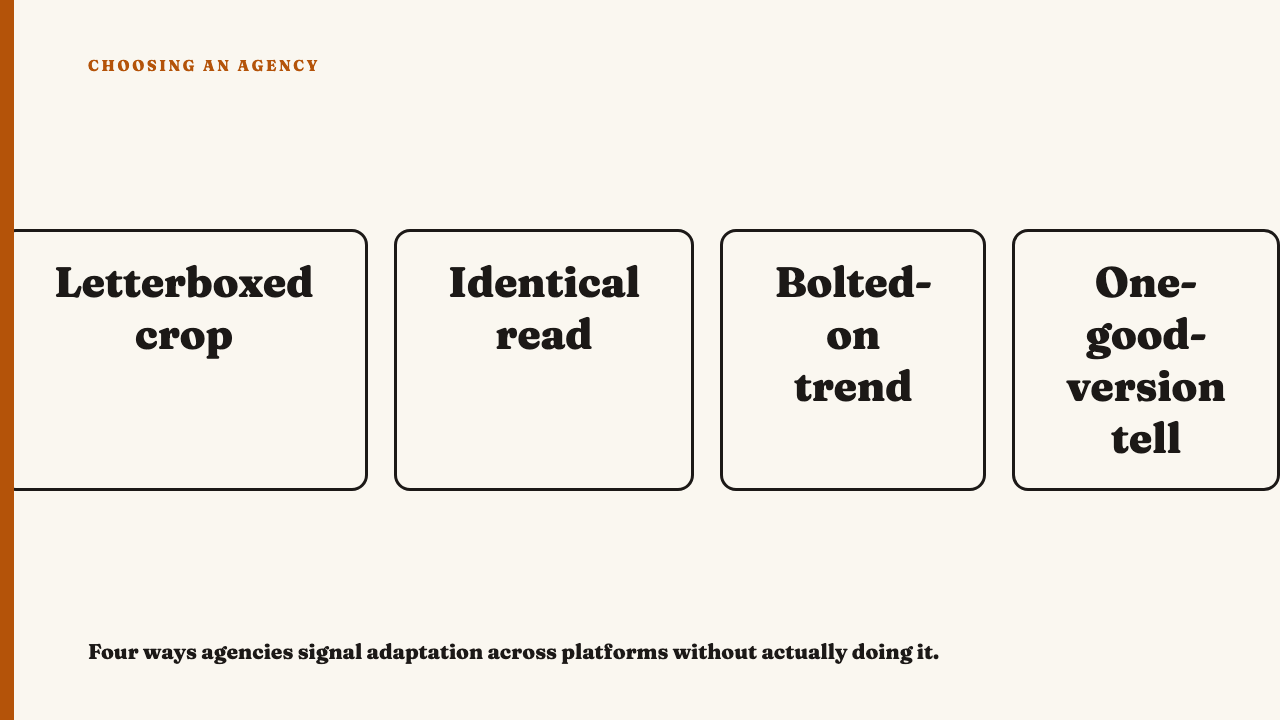
Some agencies signal adaptation without doing it. Once you can name these, they are hard to unsee.
- The letterboxed crop. A horizontal edit dropped into a vertical slot, dead space top and bottom filled by a colour block or a blurred stretch of the same frame. The content never became vertical.
- The identical read. The same script at the same pace across every platform, with only the caption reworded. Nothing about the timing or the opening acknowledges that one audience is reading and another is watching.
- The bolted-on trend. A hashtag, sound or format reference stuck onto one version as the single platform-specific element, while the content is untouched. It is a sticker, not an adaptation.
- The one-good-version tell. The hardest to catch. Real effort goes into one platform, and every other version is that same work copied down to fit. It reads as adaptation until you line the versions up and notice only one was ever made.
When same-everywhere is the right call
Uniformity is not automatically a failure. Some ideas are self-contained enough that near-identical treatment is defensible, and some brands are consistent enough that varying the execution per platform would cost more than it returns. The distinction that matters is whether the sameness looks decided or defaulted into. A decided version shows that someone weighed the alternatives and held the line for a reason: the idea works on mute and with sound, and the pacing already suits more than one place. A defaulted version never asked.
See the work for yourself
To see how this craft judgement plays out across the agencies we cover, you can nominate an agency whose cross-platform work you think earns each place it runs.
FAQ
Is reformatting one idea for every platform lazy?
No, not automatically. Reshaping one idea for each platform is the normal, and often the right, way to run a campaign. The question is not whether the idea was reused, it is whether each version earns the platform it lands on. A reused idea that was genuinely rethought is good work. A reused idea that was only resized is the thing to worry about.
What is the single fastest tell of a token adaptation?
Look for the version where only the container changed. Same hook, same pacing, same content, different aspect ratio. When the sole difference between platforms is the shape of the frame, the work was resized, not rethought.
Should every platform version look different?
Not necessarily. Near-identical treatment can be a defensible decision when the idea or the brand supports it, so difference is not the only proof of craft. The test is whether the sameness looks chosen rather than defaulted into: a treatment held on purpose because it holds up everywhere, versus one that never asked whether each place needed something of its own.
Sources
- Native work versus a crossposted asset (fetched 2026-09-11).
- Using a format versus copying an idea (fetched 2026-09-11).
- Editing craft in social video (fetched 2026-09-11).