Judge Social Work as If You Were Seeing It a Year From Now
You are looking at an agency’s older post and it feels embarrassing, and you cannot tell whose fault that is. Most people wince and mark it down.
Looking dated is not the same as being weak
A post can look old for two reasons. It was weak when it went out, with a muddled idea, default framing and copy that said nothing. Or it was strong for a window, built tightly around what everyone was watching that week, and the window closed. On first glance the two look identical, and most people judge them identically. Only one says anything bad about the people who made it.
So judge the work as if you were seeing it a year from now. That asks what is left once the moment is removed. Joining a trend well in the week is its own skill, covered in joining a trend well in the moment.
The rewatch test
- Watch it cold. Skip the caption. Note what you understand, what lands, and where you feel lost.
- Strip it down. Mentally remove the sound, the on screen text and the format. Ask what idea remains. Can you say in one sentence what the post is about?
- Imagine the outsider. Would a viewer with no memory of that season still get the point and the joke? This is a judgment, not a measurement.
A pass looks like this on screen: the idea survives with the trend removed, the hook still lands, and the product or the point is still clear. A fail is a post that is a reference to something that no longer exists and nothing else.
If the portfolio lets you hide the date, do. Note your own reaction before you look at when it was posted.
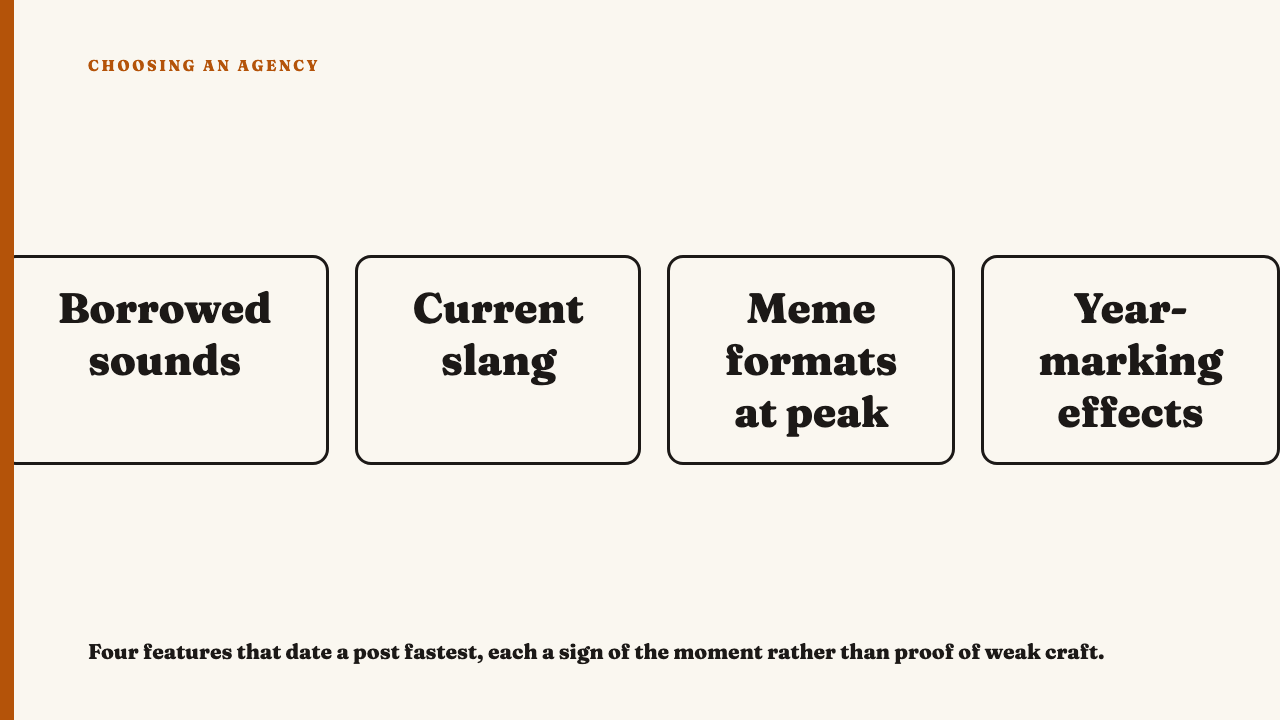
The four features that date a post fastest
Borrowed sounds. What it looks like: the joke or rhythm is carried by a popular audio clip, and the cuts land on beats that only make sense because everyone knew the clip. When the clip stops circulating, the edit loses its timing logic. What ages better: a sound chosen to serve the edit, where cuts follow the picture and the audio could be swapped without the post collapsing. As the piece on a trending sound pick is a timing call argues, that call has a date on it.
Current slang. What it looks like: a caption whose whole voice rests on a phrase at the peak of its use. What ages better: copy that is dry, specific and about the subject, naming the actual thing in plain words.
Meme formats at peak. What it looks like: a template used at the height of its circulation, where the format does the work and the brand just fills in the blanks. What ages better: a format adapted to carry a point of the brand’s own, so only the structure is borrowed.
Effects that signal their year. What it looks like: filters, transitions, colour treatments and overlay styles that anyone can place in a season at a glance, used as the entire concept. What ages better: the same effect as seasoning, a light touch on an idea that stands without it.
Dated by the moment, or dated by the choices
| Question | If the moment dated it | If weak craft dated it |
|---|---|---|
| Does the idea survive with the trend stripped out? | Partly. A recognisable idea sits underneath, thinner without its context. | No. There was never an idea beneath the trend. |
| Was the trend element seasoning or the whole concept? | Often the whole concept, but executed tightly for exactly that purpose. | Bolted on. The post does not commit to the trend or to anything else. |
| Do framing, pacing and copy show deliberate decisions underneath? | Yes. Shots are held or cut for a reason, and the copy has a point of view. | No. Framing is default, pacing drifts, and the copy could sit under any post. |
The key distinction: a post can fail the rewatch and still have been well made for its window, while a weak post stays weak at any date. The rewatch test measures shelf life, not quality at the time. Shelf life is worth weighing, but it is not proof of weak craft.
Reading a whole portfolio for shelf life
Picture two portfolios. In the first, every strong piece leans on a reference that has since gone. The older you scroll, the less there is to see. In the second, older pieces still read cleanly. The idea sits in the subject, the writing or a visual decision, so even worn posts make sense cold.
Be fair about it. A mix is normal, since riding a moment is a legitimate choice. The question is whether the agency has anything besides moments. Whether it built a coherent look is a separate question, covered in whether an agency built a system or just one good post. Curated reels may also drop exactly the older work that would show shelf life, as what a portfolio leaves out explains.
Ask what the agency would keep and what it would retire from its own older work. A considered answer, one that separates pieces built for a week from pieces built to last, is a good sign.
What the test cannot tell you
An old post that reads cleanly is not automatically good, only durable. Quality still needs judging on idea, craft and execution. You also cannot fully un-know the moment, so expect some residual bias and discount for it rather than pretend it away.
Keep one habit. Before marking a piece down for looking old, ask whether you would have marked it up in its week, and what is left that you would still defend.
See the work for yourself
See this year’s selections, or nominate an agency whose older work still holds up.
FAQ
Is trend-based work bad work?
No. Riding a moment is a legitimate choice and can be well made. The point is shelf life: judge it for what it was and note that it only worked inside its window. The concern is a portfolio with nothing else.
How long should I wait before judging whether work has aged well?
There is no fixed duration. The test is a thought exercise: imagine the viewer a year on, or rewatch older work in the portfolio with the trend stripped out. Older work is the natural place to run it.