The launch arc: judging teaser, reveal and the weeks after
You are looking at an agency’s launch case study and the reveal is beautiful. Usually that tells you about one post. A launch is a sequence, and the sequence is where the craft either shows up or does not.
Why the reveal post flatters everyone
The reveal is the most polished, most budgeted and most screenshotted moment of a launch, so case studies lead with it and readers over-credit it. A reveal post can be excellent even when the surrounding launch was thin, because it is one asset and the arc is a sequence of them.
What a case study usually shows is the reveal, perhaps a montage. What it usually omits is the first teaser and the post from three weeks later. That is how portfolios work, as we say in what a portfolio leaves out, but it means the missing pieces are the ones to ask for.
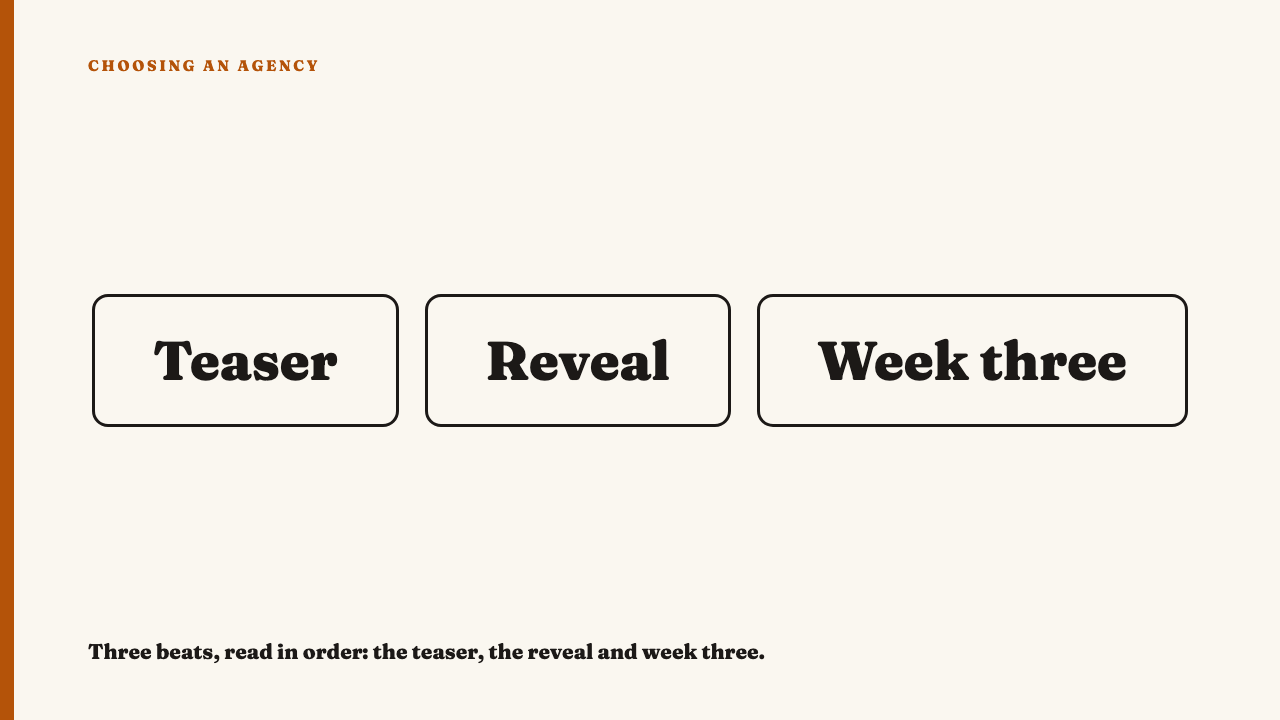
The method is simple. Read the launch as three beats in order: teaser, reveal, week three. For each, ask what job it was doing and whether the work did that job. This is a promotional sequence with a payoff, which makes it different from judging a rebrand rollout or reading a story told one post at a time.
Beat one: what the teaser withholds
A good teaser withholds one particular thing, perhaps the product, perhaps what it does, perhaps its name, and gives the viewer something concrete to hold: a texture, a sound, a shape, a line of copy that only makes sense later.
A weak teaser withholds everything. A countdown, a blurred image, “something is coming” over a dark frame. Nothing is asked because nothing has been given.
Run this test: after the teaser, could you say what you are waiting to find out? “What makes that sound?” is a question. “Something new, I guess” means the teaser withheld without framing one. If there are several teasers, check that they escalate, each showing a little more. Three posts saying the same nothing in different colours are repetition.
Beat two: whether the reveal pays off the teaser
Judge the reveal against the teaser, not in isolation. Look for the callback to the teaser’s motif, the first clear view of what the product does, and whether the viewer is asked to do anything.
| What to look for | Pays off the teaser | Ignores the teaser |
|---|---|---|
| The motif | The withheld texture, sound or line returns, now with its meaning clear | A generic hero shot that could follow any teaser |
| First clear view | The product is seen doing something almost at once | The product rotates on a plain backdrop, looking expensive |
| The ask | A specific reason to look closer | Nothing, or a vague “available now” |
A visually stunning reveal with no link to the teaser is polish, not sequencing.
Beat three: what keeps the product alive in week three
The sustain period is where most launches go quiet, so what the account posts after attention moves on is the most honest evidence of how the launch was thought through. This is the same logic as the first 90 days on social.
Good sustain work finds new angles: a use, a detail, a reaction, an answer to a question people clearly asked. Each post stands on its own while still belonging to the launch. Weak sustain work is the reveal re-posted in new crops, a thank-you post, or silence followed by a return to normal content.
Ask for the posts from the second and third weeks and the account’s grid for that stretch. An agency reluctant to show them is giving you information. This beat is judged on the public record of the posts, not on any reported figures.
Reading a case study against the three beats
- Can you state, in a sentence, what the first teaser made you want to find out? Did later teasers narrow it?
- Does the teaser’s motif return in the reveal, and is the product shown doing something?
- What was posted in week two and three, and does each post work alone?
- Do the beats share a visual and verbal thread, so the launch reads as one piece of work rather than three assets?
- If only the reveal is shown, treat it as one strong post and ask for the rest before forming a view.
A launch where the arc works, and one where it does not
Both are invented illustrations, not real campaigns.
Works. The teaser is a few seconds of a hand tracing a ridged surface, a soft click, and one line: “Feel for the second click.” No product, no name, but a texture, a sound and a question. The reveal opens on the same hand and ridges, pulls back, and shows the product doing the thing, with the second click landing as the payoff. In week three come a close look at the mechanism and a reply to a question people kept asking, both with the same hand, the same line and the same sound.
Does not. The teaser is a dark frame, a countdown and “Something is coming.” The reveal is gorgeous, a hero shot that would suit almost anything. Then ten quiet days, then ordinary content. A reader should conclude the agency can make a striking asset, and that the case study offers no evidence it can build a launch.
When the launch brief limits the arc
A single drop date can compress the teaser, a surprise release can skip it, and a small budget can shrink the sustain beat. Allow for that, but note that even a compressed arc shows a decision about each beat, such as a one-line teaser that plants a motif. Separate a constraint the agency worked within from a gap the agency left. You will rarely see the brief, so hold conclusions loosely, without letting that excuse absent thinking.
Looking at launch work with us
See this year’s selections, or nominate an agency whose launch work holds up across all three beats.
FAQ
What makes a good teaser on social media?
It withholds one specific thing and gives the viewer a concrete detail and a clear question to be answered later. Vague mystery or a bare countdown is not craft.
Should a reveal post be judged on its own?
Not only. Judge it against the teaser: does it pay off the question the teaser set up, and does it show what the product does? A beautiful reveal with no link to what came before is polish, not sequencing.
Sources
- What a portfolio leaves out, fetched 2026-10-09 (HTTP 200)