Whether AI made it is the wrong question to ask of the work
Four screens into an agency’s portfolio, a carousel stops you. The lighting is too even, the model’s hand is doing something a hand would not do, and the caption reads smoothly while committing to nothing. Your first thought is that a machine made it. Your second is that this counts against the agency. The second thought is the one worth pulling apart.
The detection habit doesn’t fit this job
Most reviewers have absorbed some of the circulating advice on spotting generated material. On the text side, the standard frame is statistical regularity: flat, uniform sentence rhythm and a generic tone read as signals. On the image side, the tells are rendering failures, hands with the wrong number of fingers, background text collapsing into letterforms that almost spell something.
Notice what that guidance was built for. It grew out of contexts where someone is passing off generated material as something it is not: academic submissions, hoaxes, synthetic media used to deceive. Those are honesty questions, and whether a piece of social work is any good is a different one. This piece takes no position on how accurate any detection method is, since asserting a number would be a claim we cannot support.
A fingerprint is not a quality score
Even perfect provenance would teach you nothing about craft. A signed, tamper evident record attached at creation and carried through editing answers the authorship question well, and still does not grade the work.
Entirely handmade and entirely empty is a common combination. A product shot on a real camera that looks like every other shot in the category: warm wood, soft window light, one sprig of something green. A caption you could drop under any competitor’s post unchanged. A grid with a palette and no argument.
The reverse holds too. Work assembled with generative tools can still carry a specific, informed decision, because the decision lives in what the piece says and leaves out, not in what rendered the pixels. Neither fact is evidence on its own.
Two pieces of work, one question
An illustrative comparison, invented for this article. No real case, no results or companies attached.
Picture a regional bakery. The first post is a slightly too glossy overhead of a sourdough loaf, the kind of frame that makes you suspicious. The caption reads: “Nothing beats the smell of fresh bread in the morning. What’s your favourite loaf?” Whatever made that image, the caption is the problem. It could run under any bakery account anywhere, unchanged.
The second is a plain phone photograph of a tray of burnt loaves. The caption says the bakery is discontinuing the cinnamon swirl, that a vocal part of the audience will be furious, and that the burnt tray is the same batch they posted on their first day. All of that required knowing this business: its history, its running joke with its own customers, a position that guarantees hostile replies. No generic version arrives there, and no stylistic tell would separate the two.
What actually predicts whether work is good
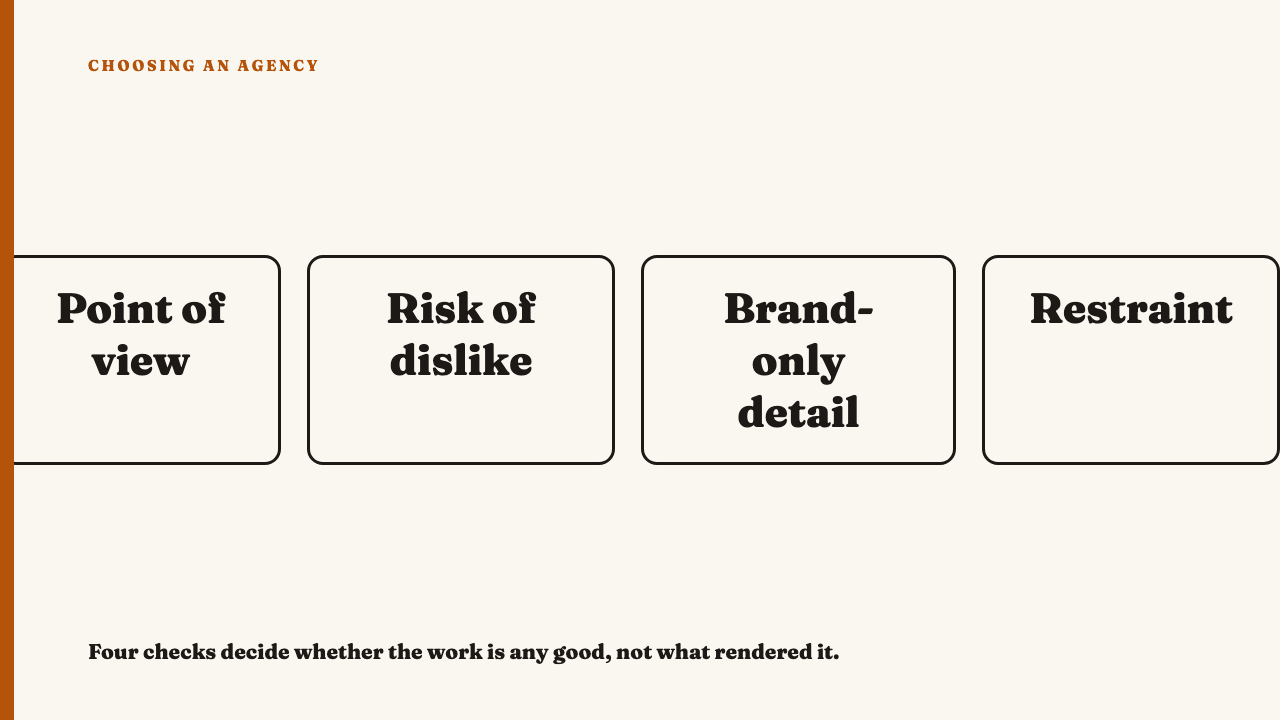
Each of these is visible in the post itself, without knowing anything about how the agency operates.
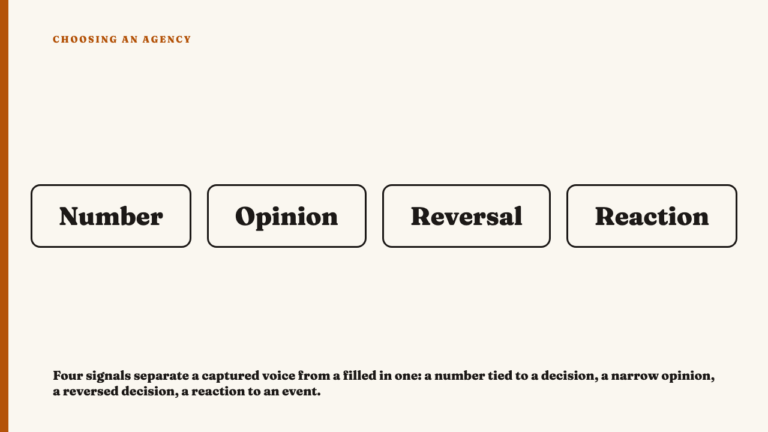
- A point of view stated flat out. The post says something that could be argued with, without hedging it back into safety by the end of the paragraph.
- A choice that risked being disliked. Something in there will annoy a definable part of the audience. If nothing could offend anyone, nobody decided anything.
- A detail only this brand could supply. Its own past, a joke its followers already understand, a customer habit that would read as nonsense to an outsider.
- Restraint. Something a default version would have kept is missing: the explanatory second sentence, the logo in the corner, the reassuring call to action.
Why the suspicion is pointed at the wrong thing
Back to the carousel that stopped you. Suppose you are right and it was generated. All you have established is that a tool rendered it, not whether anyone decided anything. Meanwhile the post two rows down passes every handmade check you could apply and may be just as empty, and your instinct waved it through.
Run the decision test on both instead. It uses only what is on screen, a narrow version of what strategy looks like from the outside, and it pairs with how much of the work the agency actually did and what a portfolio leaves out.
What this isn’t about
Whether an agency should tell you it used generative tools, and how it bills when it does, are real questions about process and conduct. This piece does not address them. What is in front of you is finished work, and it can be judged on its own.
Before you close the tab
Run the decision test on the last three posts you looked at and count how many survive. If an agency’s work does, you can nominate an agency and say which piece made you look twice.
FAQ
Is it fair to judge a piece of work differently once you suspect AI was involved in making it?
No, because tool involvement is not the variable that predicts quality. A decision made with a tool’s help and one made without it can both be sharp, and both can be empty. The test is what the piece decided, not what rendered it.
How do I tell if a caption or image was AI generated?
This piece deliberately does not answer that, because reliable detection is a separate and unresolved problem. Ask instead whether the piece carries a specific, brand informed decision, or language generic enough to belong to any account in the category.
Does using AI tools mean an agency did less work?
Not necessarily, and this piece takes no position on it. That is a question about agency process and disclosure, which is separate from judging the finished piece.
Are AI detection tools accurate enough to rely on when reviewing an agency’s portfolio?
We assert no accuracy rate for any detection method. When the question you care about is craft, the more useful move is to stop relying on detection and test the work for a decision.
Sources
- GPTZero, on the patterns text detectors look for. Fetched 2026-09-05.
- Wikipedia, AI slop, on rendering artifacts including incorrect fingers and garbled text. Fetched 2026-09-05.
- Wikipedia, Synthetic media, on detection arising from deceptive uses. Fetched 2026-09-05.
- Content Authenticity Initiative, How it works, on signed, tamper evident provenance records. Fetched 2026-09-05.