An Agency’s Own Account Is Weak Evidence of Its Work
An agency’s own grid looks art directed by someone with taste, and you want to know how much that counts. Or the reverse: the case studies look fine, the account has been quiet since spring. Both treat the feed as a work sample. It samples something, but not what you would buy.
The advice you have almost certainly read
The agency-facing version is blunt. SocialPilot’s guide for agencies says social media is your industry, so your own channels should be your best case study.
Buyers get the same claim from the other side. upGrowth’s red flag list includes an agency whose own social media is dead or generic, and makes opening its profiles step one of vetting.
It is not unanimous. Killerspots tells the same buyers the best agency is not the one with the slickest portfolio or the biggest following of its own, since agencies are not their own best customer.
Part of that is right. A feed untouched for months tells you how the agency allocates attention when client work gets loud. The dispute is narrower: whether it is evidence about the work.
Four constraints that are missing from an agency’s own feed
- No client. Nobody outside the building has to be persuaded the idea is worth making, and that persuasion is half the difficulty of client work.
- No brand guidelines it did not write. The agency owns the palette, the tone, and the licence to break both. Nothing has to survive an identity somebody else built.
- No approval chain. No legal review, no brand team, no client-side manager with a view about the caption. What goes out is the first version anyone liked, not the fourth.
- No commercial risk. A joke that lands badly here costs an awkward afternoon. On a client account it can cost the retainer.
So the feed shows the ceiling of the agency’s taste under ideal conditions, when you need the floor under real ones.
What the agency feed is actually built to do
Its job is not portfolio. It is making the agency findable and credible to buyers before first contact, the use agency-facing guides recommend it for. ClicksGeek describes agencies neglecting their own channels while prospects evaluate them. A feed built to impress prospects is built for you, not a neutral sample.
Who staffs it you cannot settle from outside: marketers or a founder rather than the team on your account. Hold that open. Craft does transfer, though: typography, edit rhythm, shot discipline, whether captions are written or assembled.
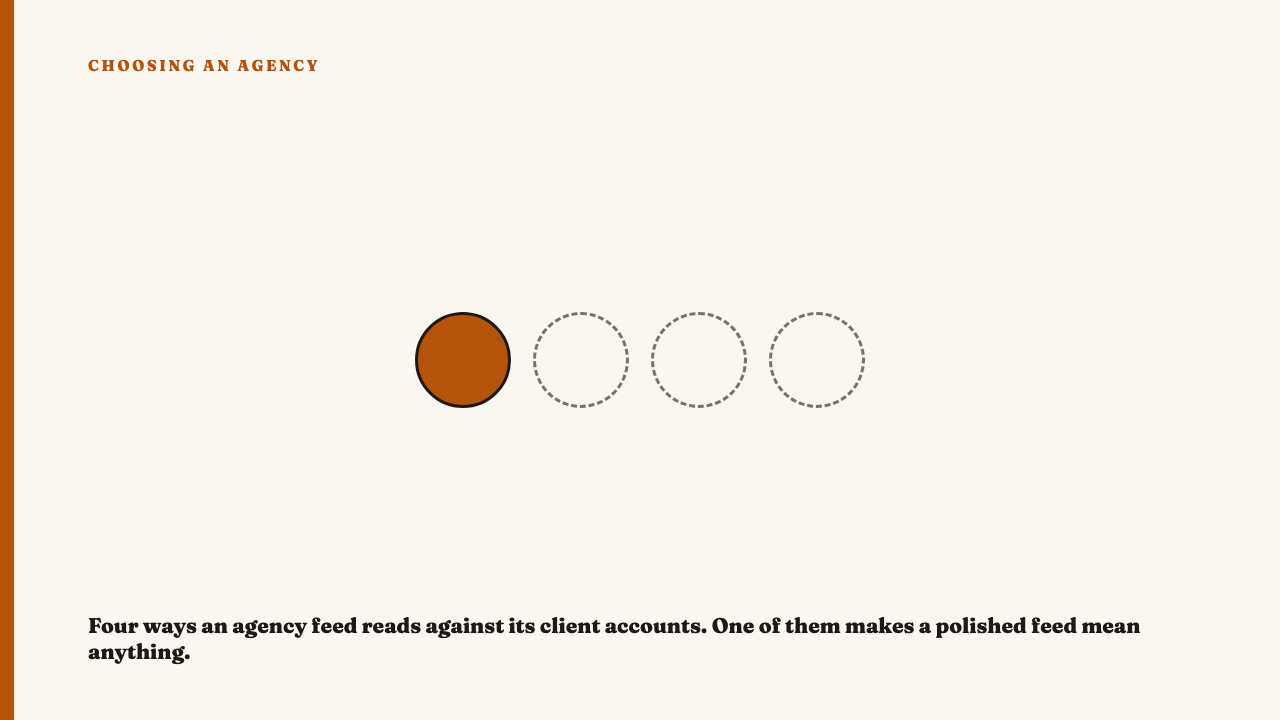
The reading that is worth doing: agency feed against client accounts
| Agency feed | Client accounts | Conclude | Check next |
|---|---|---|---|
| Strong | Strong | Capability survives a client. The only case where a polished feed adds confidence. | One account or several, and whether it held past launch. |
| Strong | Weak or templated | The more troubling finding. Best people pointed at the agency’s own pipeline. | Who staffs the agency channel, and whether any client account matches it. |
| Quiet | Strong | Close to ideal. Capacity went where you would be paying for it. | The client accounts, read across months. |
| Quiet | Weak | Nothing to judge on. Absence of evidence, not incompetence. | Any live account you missed. Ask for two. |
Finding the client accounts to compare against
Take the client names off the agency’s case study pages and open those brands’ accounts, not the images the agency chose, which is also telling work that shipped from work that was only made.
Three things matter: whether posting continued past the campaign window, whether the visual system holds across months or only across the three posts in the deck, and whether replies are handled. Then recency: does it still look like that today, or did the good stretch end?
One ambiguity you cannot resolve from outside, so hold it open: a client account can be weak because the client overrode the work. Otherwise, there is what good work looks like on the right account.
A worked example of the same feed read two ways
Picture a small agency, invented for this illustration, with a good feed: a consistent visual system across a year, a recurring format built on one uncomfortable opinion a week, written rather than assembled copy, comments with real argument. Read the consensus way, that is a pass.
Now open two brands named on its case study page. The first has posted three times a week for eighteen months, visual system intact, replies answered. The second stopped nine months ago after a launch burst, its last dozen posts one layout with different product photographs in it.
What flips the reading is the template, not the second client going quiet, which could be a cancelled contract. A dozen posts of one layout, from an agency whose feed never repeats itself. The first client account is the only evidence the standard travels.
Where the agency feed still earns weight
- Good evidence of a point of view, and whether there is one.
- Good evidence of a craft floor, the standard it publishes under its own name.
- Reasonable evidence of how public conversation is handled, since replies are hard to stage.
- Poor evidence of strategy under constraint, of working inside someone else’s identity, and of sustaining work past launch week, where reading strategy from public output has to start.
Where to look next
See this year’s selections. If an agency’s accounts hold up, nominate an agency.
FAQ
Is a dormant agency account a reason to walk away?
Not on its own. It tells you how the agency allocates attention, which earns a question rather than a rejection: who runs that channel, and do they work on client accounts too?
How much weight should the agency’s own feed get?
Treat it as a tiebreaker, not a primary source. It can confirm a point of view and a craft floor. It should not pick between two agencies when live client work is there.
What if the agency has no client accounts I can find?
A real limit on the method. Ask for two live account handles the agency works on now. A refusal with no stated confidentiality reason is more informative than the feed ever was.
Does a large following on the agency’s own account mean anything?
Very little for judging work quality. An agency’s audience is largely other marketers and prospects, so its engagement is no test of whether the work reaches a client’s customers.
Sources
All fetched 2026-08-26.