Where using a format ends and copying an idea begins
You are looking at a post that uses a structure you have seen before, landing on beats you could have predicted. Something about it feels cheap, but saying so sounds like you are just annoyed the agency used a trend. You call it derivative, they say that is how the platform works now, and the argument stalls because nobody has named the actual line.
Why “it’s just a format” is both a bad excuse and a fair one
A format is a container. A POV setup where the camera plays the customer. A before and after reveal built on a hard cut. A day in the life sequence timestamped through a shift. These are structures everyone in the medium draws on. Using one is not, by itself, evidence of unoriginality. It is evidence that somebody understands the medium.
The excuse stops being fair the moment it covers the other half of the work. The container is shared. What gets poured into it cannot be, not if the post is meant to do anything for a specific brand. Listen for whether the agency is defending the structure or the substance. The first is legitimate. The second is a dodge.
The removal test
Here is the method we use when a post feels familiar and we need to decide whether that matters. Strip out the borrowed structural element, the transition, the caption pattern, the setup beat the joke is built on. Then look at what is still standing.
If a specific observation survives, something true about this product, this audience, this particular claim, the format was a vehicle and the work is adaptation. If what is left is a logo and a sentiment that would fit any client in any sector, the format was the whole idea, and the brand was pasted on top of somebody else’s thinking.
This is our own working method, not an industry framework and not a term anyone else uses. It turns a vague feeling into a question with an answer.
What a lifted idea actually looks like on screen
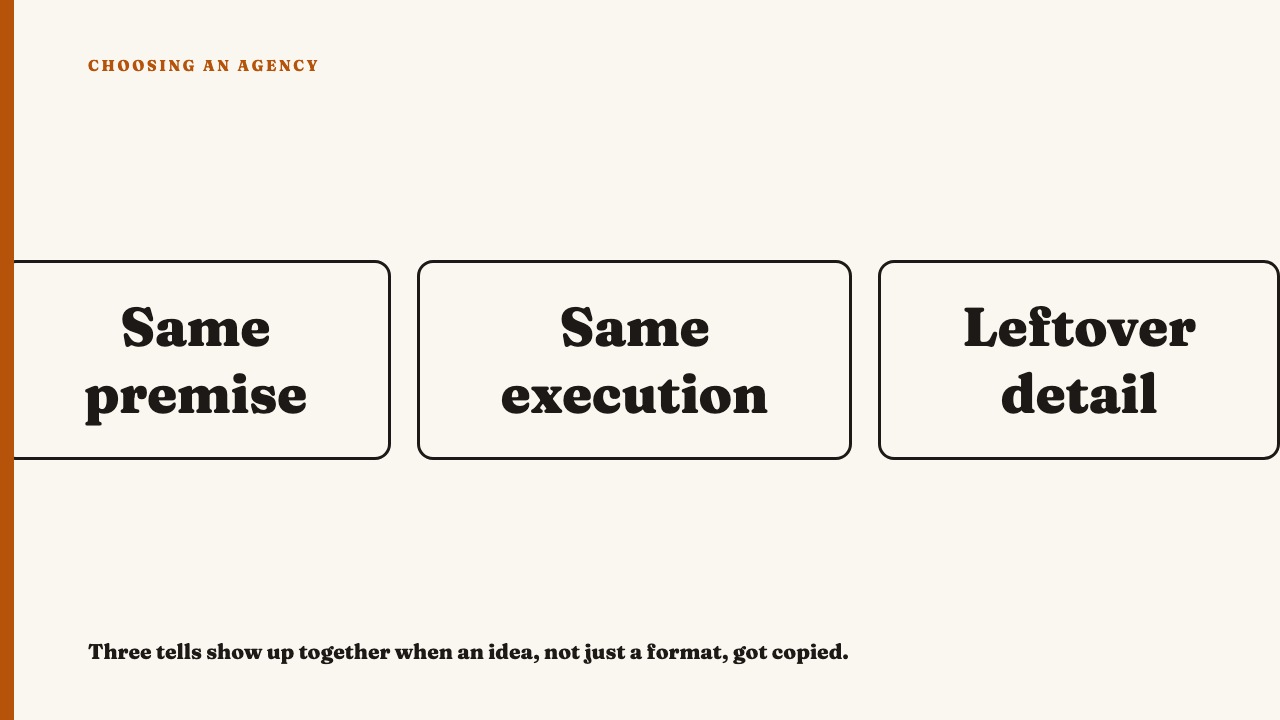
Picture a regional plumbing supply company whose agency posts a reel built on a joke a coffee chain made popular a month earlier. Three tells, and they travel together.
The premise never shifts. The original worked because of something specific to coffee, the way a morning rush compresses everything into ninety seconds. It sits in the new post exactly as it was, so the punchline only lands if you saw the coffee version. A viewer coming to it cold gets confusion where the laugh should be.
The execution is close enough to the source that swapping the logo was the only edit. Same cut points, same on screen text with two nouns changed, same music cue in the same place. Not the same category of joke, the same joke.
Then the leftover detail. Something that should reflect a fact about this brand instead reflects the original’s context, carried over unexamined. A line about being open before sunrise, in a post for a company with trade counter hours. Nobody thinking about the client would have left it there. It is the same lapse behind telling platform native work from a crossposted asset.
Why “that’s just a trend post” is lazy criticism
The reflexive dismissal of all trend participation deserves less respect than it gets. Its implied alternative is that an agency should invent a new visual grammar from scratch for every post. Nobody works that way, so demanding it is not a serious critique. It is a way of sounding discerning without doing the work of looking.
The real question is not whether they used a format that existed before them, but whether they added anything to it that belongs to this brand and this subject. That is where our criteria for what actually separates good social media work from average get tested hardest.
Where platforms themselves draw a version of this line
The distinction is not only an editorial preference. In March 2026 Meta published updated original content guidelines for Facebook, and the shape of the line is recognisable. Reels that selectively incorporate third party material, such as remixes or overlays, count as original when the focus is a creator on screen presenting something genuinely new, described there as fresh information, analysis, or substantial improvements to a storyline. Content that is duplicative or involves minor edits to another creator’s post counts as unoriginal and gets deprioritised, with borders, inserted captions and a changed reel speed given as examples.
Be careful what that establishes. It shows a platform separating reuse that adds something from reuse that adds nothing, and enforcing that in distribution. It is a ranking and monetisation policy, not a definition of good creative work, and our judgment about craft is not derived from it. A post can satisfy every line of that guidance and still be dull.
A quick checklist, if you are looking at a specific post right now
- Does the joke, hook, or premise change to fit this brand’s actual subject, or would it read the same with any logo on it?
- Does the caption or voiceover reference something specific and true about this brand, product, or audience?
- Would the insight or the joke still exist if you removed the format device entirely?
- Have you seen this exact structural conceit, not just the format category, from two or three other accounts with nothing else changed?
One no is a question. Three is an answer. These turn up in pitch reels, which is part of what a social agency portfolio leaves out.
Put it to work
Run the removal test on the last three posts from any agency you are assessing. For work that held up under that reading, see this year’s selections. If you know an agency whose work survives its own formats, nominate an agency.
FAQ
Does using a popular format automatically make a post unoriginal?
No. Formats are shared containers everyone in the medium draws on, so reaching for one is neutral. Unoriginality is a property of what gets poured in. A two year old format carrying a sharp, brand specific observation beats an invented structure with nothing to say.
What is the fastest way to tell if a specific post copied someone else’s idea?
Apply the removal test. Take away the borrowed structural device and see whether a specific, brand true observation is still standing. If only a logo and a mood are left, it was a copy.
Sources
- Meta, Rewarding Original Creators on Facebook, published March 2026, fetched 4 September 2026.