A Platform Outage Is a Small, Honest Test of an Account’s Voice
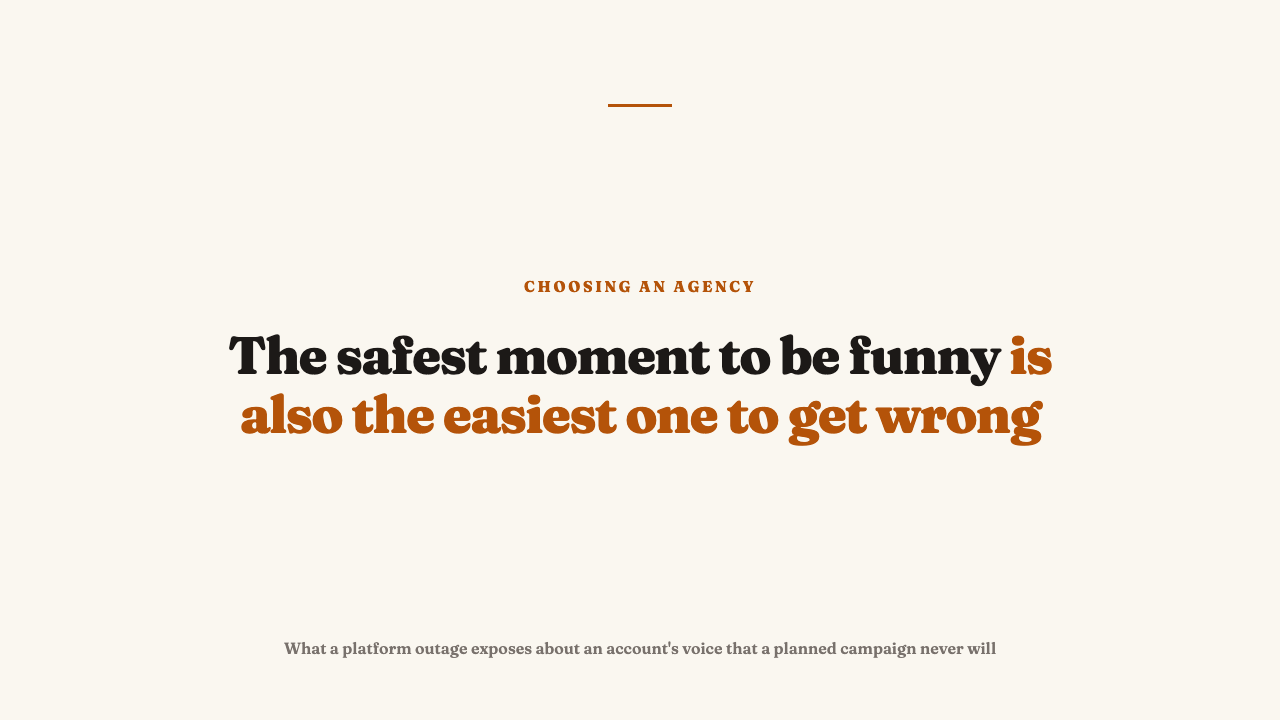
A platform goes down for an hour, or a feature quietly breaks, and every brand account watching it has to make a small decision with almost no time to think it through. That decision costs nothing to get right, and it says more about an account’s voice than the caption calendar it planned three weeks ago.
Why an outage is a cleaner test than a crisis
A platform outage is nobody’s fault. The account did not cause it, a competitor did not win anything from it, and there is no reputational risk in acknowledging it. That absence of stakes is what makes it useful. A weak response cannot be excused as the cost of a hard situation, because the situation was not hard.
Compare that to a brand’s own crisis, where caution is often the right call. An outage runs the opposite way. Caution does not read as prudence here. It reads as an account that is not paying attention, because nothing was actually at stake and the silence protects nothing.
What the account had to choose between
- Say nothing and wait it out, treating the outage as beneath a response.
- Post something dry and functional, acknowledging that something is broken without reaching for a joke.
- Post something that tries to be funny about it, using the shared inconvenience as material.
Each choice is legible after the fact, and none happens in isolation. The one an account made is usually consistent with a broader pattern in how it behaves everywhere else, which is what makes a single outage response worth reading closely.
What a genuinely good response looks like
A response that lands is short. It names the specific thing that actually broke rather than reaching for a generic line about experiencing issues, and it reads like it was written by someone who noticed the exact glitch the audience was staring at, not assembled from a template kept on file for exactly this occasion.
If there is humor in it, the humor is aimed at the shared inconvenience itself, not at the platform in a way that reads defensive, and not at the audience. The clearest tell of a good response is what it does not do. It does not try to extract a sale or slide in a plug while everyone’s attention is briefly on the same broken thing. Forcing a call to action into a moment of shared inconvenience is its own tell, and it separates an account with judgment from one that treats every attention spike as inventory.
What a tone-deaf response looks like
Picture an account that responds to a feed outage with a joke aimed at the users complaining about it, closer to mockery than commiseration. It reads as punching down at people who are, reasonably, annoyed, rather than standing beside them in the same annoyance.
Picture a different account that writes something long, multiple sentences, a callback, maybe a second post building on the first. The length is the failure. It signals the outage was treated as a content opportunity worth real effort, not the offhand aside it actually was.
And picture a third case: an account whose whole identity runs on being quick and current, saying nothing during an outage everyone can see. For most accounts, silence is neutral. For this one, the gap is loud, reading less like restraint and more like an account that was not watching.
Reading timing, not just the words
The same sentence posted at two different moments reads as two different decisions. A response posted while the outage is still live lands as commiseration in real time. The exact same words posted after everyone has moved on read as an afterthought, or as an account claiming credit for noticing something it was actually slow to catch.
Watch what happens after the platform recovers, too. An account that lets one acknowledgment stand is usually reading the moment’s size correctly. One that follows up with a second post once things are back to normal, milking a small inconvenience for more mileage, is usually overstepping how big the moment actually was.
Why silence is sometimes the correct call
It is tempting to assume acknowledging the outage is always the better decision, that any response beats none. That assumption does not hold. An account with a formal, low frequency voice, one that rarely reaches for a joke, saying nothing about a minor glitch is consistent with its own established register. Forcing a quip into that voice just because the moment technically allowed for one would be the actual failure of craft.
The question worth asking is never simply did they say something. It is whether what they did, or chose not to do, is consistent with who this account already is everywhere else, a standard covered in more depth in when a brand voice is distinct and when it is only loud.
See how our editorial selections apply this
If this kind of judgment call is what you are trying to get better at spotting, nominate an agency whose work you think handles moments like this well.
How to actually look for this in a portfolio
- Search the account’s own reply history and captions from around known major platform-wide outages, rather than relying on memory. Memory is recency biased; the post itself is not.
- Read a few posts on either side of the outage window to establish the account’s normal register, which matters most when judging what separates a written caption from a filled in one.
- Weigh a single outage response as one data point among many, and check how much of that work the agency actually did before assuming the fast reply proves anything about who wrote it.
FAQ
Is acknowledging a platform outage always the right move for a brand account?
No. It depends on whether acknowledgment is consistent with the account’s established voice. A formal, rarely playful account forcing a joke into an outage moment can be a worse decision than staying quiet, because it breaks a register the audience has learned to trust.
What is the difference between judging an outage response and judging a brand’s crisis response?
A platform outage is shared and blameless, nobody’s fault and no reputational stakes, so a weak response there cannot be excused the way it might during a genuine brand crisis, where caution is often correct. See the work an agency does when there is no time to plan for that adjacent case.
Sources
- thesocialagencyawards.com/blog/judging-craft-in-real-time-moment-content/, checked 2026-09-09.
- thesocialagencyawards.com/blog/tone-matching-a-specific-audience/, checked 2026-09-09.
- thesocialagencyawards.com/blog/judging-caption-and-copy-craft/, checked 2026-09-09.
- thesocialagencyawards.com/blog/who-actually-made-the-work/, checked 2026-09-09.
- thesocialagencyawards.com/nominate-your-agency/, checked 2026-09-09.