Reposting Your Own Old Post Is Either Curation or a Confession
You are scrolling an agency’s reel or a client account they run, and a post appears that you are fairly sure went out months ago. Same image, same crop. Does that say something good about the people behind the account, or something less flattering? The post itself cannot tell you.
The same post can be two opposite decisions
A self-repost is a blank check. The content is identical in both cases, so it carries no information on its own. What matters is what someone wrote on the check: the words around the post, the moment it appears, and how the original is treated.
There are two readings. The first is an editorial callback: this still holds up, and here is why it is back now. The second is a filler repost: nothing changed, nothing was said, and a slot in the schedule needed filling.
This is a different problem from reposting other people’s content, where the risk is looking derivative. That case has its own piece on what you repost is an editorial decision, and we will not re-cover it here. With your own old post, the risk is looking thin.
What a deliberate callback looks like on screen
These are an editor’s markers, not measured findings.
- The framing does new work. The text says what has changed since the original, what the brand now knows, or why the post earns a second look.
- You can paraphrase the reason in one sentence. After reading the caption you could say, “they brought it back because the advice still holds and here is the update.” If you cannot, there was probably no reason.
- It touches the present. The repost sits next to something current: a season, a product change, an anniversary, or a conversation the account is visibly part of.
- The original is credited as the original. It is dated or labelled as a callback, not passed off as new.
Picture an account that reposts an early explainer, with a caption admitting that the first version got one thing wrong and correcting it. That reads as confidence.
What a filler repost gives away
The caption is the original caption pasted back, or a generic line: a bare emoji, or a vague throwback label with no reason attached. The post has no relationship to anything current, and the only thing it answers is a gap in the schedule. It is also the brand’s strongest old post, again and again, which reads as a safe default rather than a selection.
Now picture the scene. An evergreen post goes out mid-week with no edits, the same crop, the same caption. Someone in the comments says they have seen this before. Nobody replies.
Why does this read as a confession? Because you infer that the week had nothing planned, and that inference colours how you read the posts around it.
Why the framing text is the whole test
The repost is constant. The words around it are the variable, which makes the words the evidence of intent. Framing is cheap to write, which is exactly why it is a reliable tell. An agency that wrote a real sentence made a real decision.
Distinguish framing that explains the choice from framing that merely announces the repost. “Throwback to this one” announces, and could be attached to anything. “We wrote this before the update, and the second half is now out of date, so here is the corrected version” explains.
A repost with no added words can still be deliberate. Then the burden moves to timing and context. If the moment makes the reason obvious, say so. If not, say you cannot tell, instead of assuming the worst. Intent you have to infer is a weaker signal, so keep your judgment provisional.
Callback or filler: a side by side reading
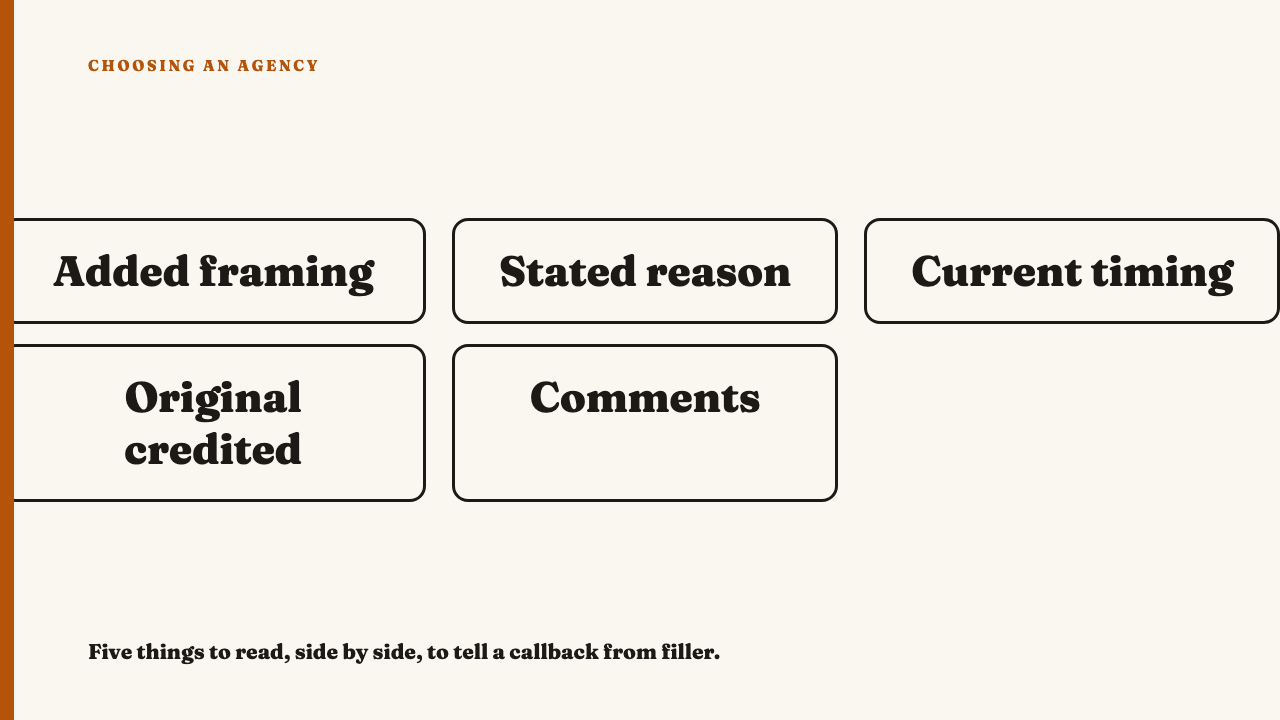
| What to read | Callback | Filler |
|---|---|---|
| Added framing | New sentences that add something | Original caption pasted back, or a bare label |
| Stated reason | Stated, and you can paraphrase it | Absent, or “throwback” and nothing else |
| Timing against current events | Sits beside something live | Answers only the gap in the schedule |
| Treatment of the original | Dated, labelled, credited as the original | Presented as if new, or unmarked |
| What the comments pick up on | The new point, the correction, the context | “Haven’t we seen this?” |
How to check when you are reading a whole account
One repost is a data point and a habit is a pattern. Scroll back and find every resurfaced post, then ask whether the ones with real framing cluster around identifiable moments, such as a launch, a season or an anniversary.
Several framing-free reposts in a row point to a thin pipeline. An occasional well framed one points to editing. Also look at whether reposts replace posts on the days the account otherwise looks busiest, or quietest. Do not over read a single quiet week, though.
The same lens applies elsewhere. What an agency pins and what a highlights row reveals are also choices about old content, as is telling a lazy cutdown from a considered one.
Questions to ask about a repost in a portfolio or reel
These are judgment aids, not a scoring system. This site has no scoring.
- What does the new caption say that the old one did not?
- What is happening now that makes this post relevant again?
- If the original had been deleted, would the account still have had something to post?
Where this leaves your judgment of the agency
A good callback is a mark of editorial taste. A filler repost is a small but honest signal about how the account is run. One repost never condemns an agency.
If you want to see the kind of work we think holds up, see this year’s selections. And if you know an agency whose work deserves a look, you can nominate an agency.
FAQ
Is reposting your own old content always a bad sign?
No. A repost with new framing, a stated reason and a link to the present is an editorial choice, and often a good one. The warning sign is a repost with nothing written around it, repeated as a habit.
Can a repost with no new caption still be good?
Possibly, if the timing makes the reason obvious. But you have to infer the intent, so keep the judgment provisional.