The cliché inventory: spotting stock phrases and formats
You have three agency portfolios open in three tabs. Ten minutes in, you realise you could swap the logos between them and not notice. Nothing is copied, and nothing is obviously bad. It is just that every post seems to have been assembled from the same box of parts.
Interchangeable is a specific complaint
Work can be derivative without borrowing a single idea. If every opener, hook and closer is a standard part, the whole feed is derivative even though no individual post is. That is different from where using a format ends and copying an idea begins, which is about lifting one specific concept. It is also different from when different clients all look the same, which is about sameness across an agency’s roster. This complaint lives lower down, at sentence and shot level.
So define the unit. A stock part is a piece of a post, a sentence or a shot, that appears because it is the default and not because this brief needed it. The question is never “have I seen this before?” but “was this chosen, or just reached for?”
The stock phrases: where sentences go on autopilot
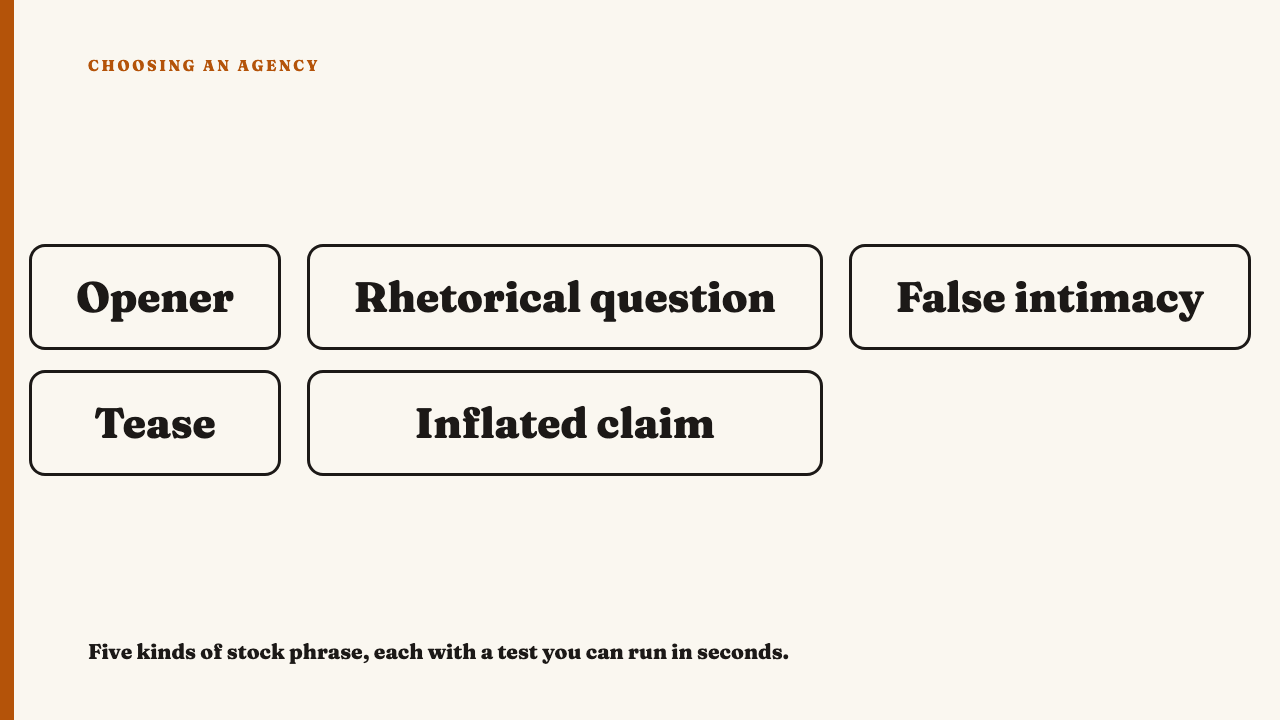
Caption and on-screen text drift into a handful of familiar categories. Every example line below is an invented illustration, not a quote from any real account. Each category comes with a test you can run in seconds.
| Category | Invented illustration | Test |
|---|---|---|
| The opener that announces interest | “You will not believe what happened next.” | Delete it. If the post loses nothing, it was filler. |
| The rhetorical question that answers itself | “Tired of boring mornings? So are we.” | Does anyone actually answer no? If the answer is obvious, the question is decoration. |
| False intimacy with the reader | “Okay, real talk, just between us.” | Swap in a different client’s name. If the sentence still works, it belongs to nobody. |
| The tease | “Here is why. Nobody talks about this.” | Does the post then deliver something that was actually hidden? If not, the tease is the whole product. |
| The inflated claim adjective | “A game-changing, next-level experience.” | Could it attach to any product on earth? Then it describes none of them. |
The stock formats: where the shots and structures repeat
The visual equivalents are just as recognisable once you look for them. The stock hook is a face to camera, or a bold claim over a jump cut, with text slamming in on the first beat. The stock middle is a numbered run of tips, a before and after, or a walk-and-talk where someone strolls while explaining. The stock close is the loop-back to the first frame, or a direct instruction to follow or save.
None of these is wrong in itself. A format is acceptable when the content genuinely needs that shape: a real before and after belongs in a before and after. It is a stock part when it was chosen only because it is safe, and the idea would have been stronger in a different shape. That decision is covered properly in the post on format choice as a craft decision.
How to run the inventory
The method fits in one sitting.
- Take a fixed run of consecutive posts from one account. Not the curated reel, which is built to hide exactly this pattern.
- Tag each post for four things: opener, hook shape, central device, closing line.
- Tally repeats within that agency’s own feed first. Does it reuse its own parts?
- Then run the same tally on one or two other agencies in the same category and compare.
- The count is yours, made on your sample. This post states no numbers about what typical agencies do, and you should not assume any.
Reading the tally: repetition is not always the sin
A repeated part can be a signature or a rut. A signature is a recurring structure that carries a different, brand-specific point each time: the frame is constant, the thinking inside it is not. A rut is a part that could be lifted out and dropped onto any other account unchanged.
The separating signal is a single question. Does this part carry a decision specific to this brand, or could it move to another account without anyone noticing? If you can move it, it is stock.
Be fair about platform conventions too. Vertical video, on-screen text and fast first beats create shared parts that every competent account uses. They are not the finding. Within those conventions, judge execution: the timing of the cut, the choice of which word gets the text, what the first second actually shows.
What remains once the stock parts are set aside
Now judge the residue. Take a post and mentally remove the stock opener, the stock hook, the stock device and the stock closer. What is left?
Picture a post for an invented bakery. Strip the tease, the numbered tips and the “follow for more”, and one version has nothing left at all. That is a stronger finding than “it felt generic”: the post had nothing to say. Another version, once stripped, still holds a particular observation about the queue that forms before the shutters go up, one specific detail about the burnt-sugar smell, and a choice that cost something, such as leaving out the product shot everyone expects. That is a line only this brand could say.
A strong residue has a particular observation, a specific detail, a choice that cost something. A thin residue is the empty set. Then apply a decision rule across the portfolio: an agency whose residue is consistently substantial has a voice, and one whose residue is consistently thin is assembling.
If you want to go deeper on two of the parts, read what separates a written caption from a filled in one and judging a post’s ending.
Questions to put to the agency
Once you have your tally, a conversation can stay on craft. Ask which post in the portfolio the team argued about. Ask what they cut from it. Ask which part of a recent post they nearly used by default and chose to replace.
See the selections
Our selections are editorial, made by reading the work. See this year’s selections, or nominate an agency whose residue you would like us to look at.
FAQ
Is using a common hook format always a sign of weak work?
No. Platform conventions create shared parts. The test is whether the format was chosen for this idea and carries something specific to the brand, or is simply the default. Judge the residue.
How many posts should I look at to run a cliché inventory?
Take a consecutive run from one account, enough that repeats would show if they exist. There is no magic number. A curated reel hides the pattern, so avoid it.
Sources
- The Social Agency Awards selections page, fetched 2026-10-10
- Nominate your agency page, fetched 2026-10-10