Idea and Execution Are Two Different Scores, Not One
You watch a post twice and can’t decide if you liked it. The cut is clean, the type sits where it should, the sound is mixed, and yet something feels hollow. Or a rough post sticks with you all day instead. Your gut reaction to “good work” quietly averages two different things, the same average what actually separates good social work from average is built on. Split them apart and you can say which one is doing the work.
Two Questions, Not One
Every piece of social work answers two separate questions, and most viewers only ask one. The idea question: is there a specific insight, a point of view, something that couldn’t be dropped onto a competitor’s brand and still make sense? The execution question: framing, pacing, edit rhythm, type, copy precision, sound, technical delivery.
These are different skills. An agency can be strong at one and weak at the other, and a single glance produces one impression that is quietly an average of the two. A 9 on execution and a 3 on idea can feel like a 6 and a 6, but those are two different agencies.
What a Strong Idea Looks Like Before Anyone Polishes It
The cleanest tool here is the swap test. Peel off the logo and put a competitor’s name on the post instead. If it would still make complete sense, the idea is generic, no matter how well it’s shot or typeset.
A real insight names something true and slightly uncomfortable about the brand, the product, or the audience, not a restated benefit. “Our product saves you time” is a benefit. A post built around the specific, faintly embarrassing way people spend that saved time is an insight, and it often reads as slightly risky internally: an idea everyone nods along to instantly usually had its edges sanded off. It shows up just as clearly in a shaky phone video as in a produced spot, because it lives in the premise, not the finish, and it isn’t the same as a familiar format done well, which is where using a format ends and copying an idea begins.
What Strong Execution Looks Like on a Thin Idea
Execution has its own tells: a cut landing exactly on the beat instead of flinching early, a type hierarchy where size and weight do real work instead of default sizing, copy that stops where the thought ends instead of trailing on, sound that’s mixed rather than dropped in under the dialogue. The trap: a technically excellent post can execute a thought never worth the craft spent on it, which is exactly what fools a fast scroll.
The Four Combinations, and What Each Gets Mistaken For
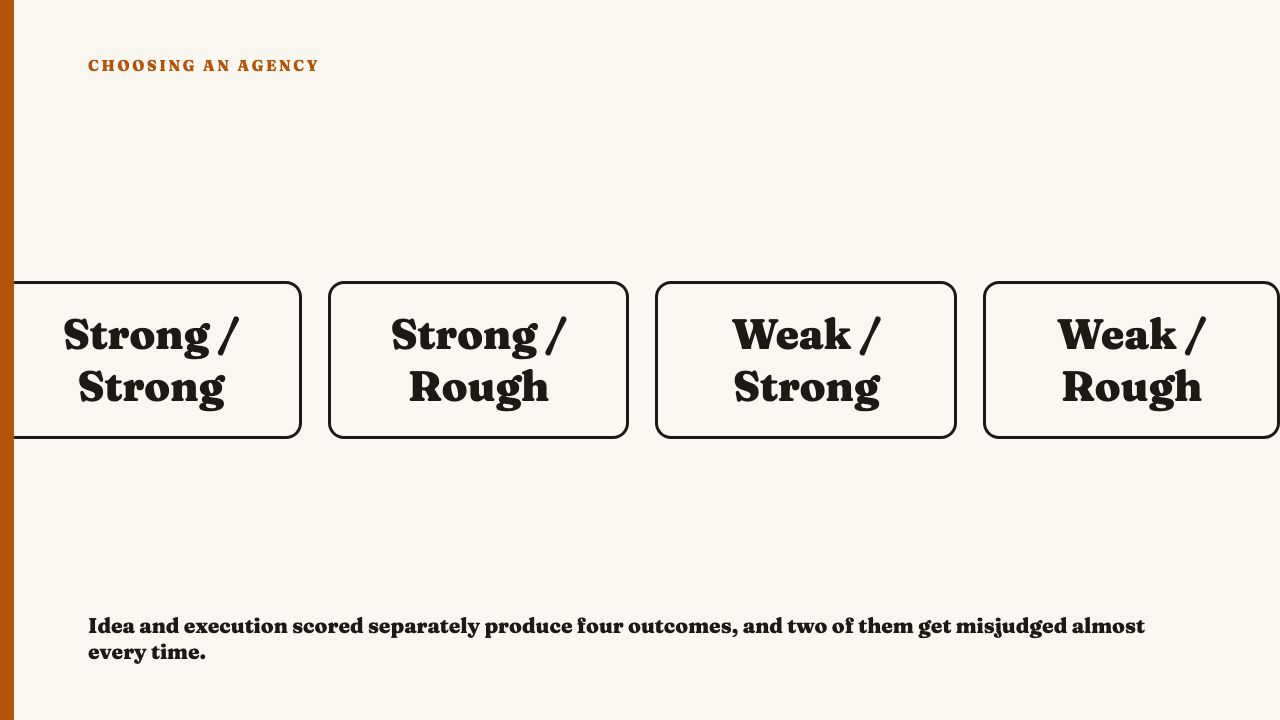
Laid out as a grid, the two axes produce four outcomes, each misread differently by a viewer tracking only one impression.
| Idea | Execution | What it actually is | What it gets mistaken for |
|---|---|---|---|
| Strong | Strong | Rare, earns “excellent” outright. | Read correctly as excellent. |
| Strong | Rough | A real idea, under-resourced. | Amateur hour, a reaction to craft, not thinking. |
| Weak | Strong | A generic sentiment, produced well. | Best post in the portfolio. |
| Weak | Rough | Nothing to recover. | Correctly dismissed. |
The two middle rows are where nearly all the misjudging happens, and both are avoidable once you’re scoring two things instead of one.
A Worked Read
Picture a generic scenario: a brand’s anniversary post. Version one: the brand admits, specifically, to something it got wrong early on, and shows what changed, couldn’t be swapped onto a rival’s post without a rewrite. But it’s shot handheld, captions at default size, a faint echo in the audio. Idea: high. Execution: low.
Version two: “thank you for ten amazing years,” a montage of smiling customers, every frame gorgeously graded, type confidently set, music swelling on cue. Idea: low, the sentiment every brand posts every anniversary. Execution: high.
Scrolled past quickly, both read as “a nice anniversary post.” Scored on two axes, they sit at opposite ends, and that says something about each agency, not just the post: version one’s has real thinking and needs production discipline, version two’s has discipline covering for a missing idea, the harder problem to fix. This is where concept work versus work that actually shipped matters: score the finished post, not the pitch.
Why Averaging the Two Scores Misleads You
Collapsing the axes into one impression produces two failure modes: mistaking production value for creative strength, crediting an agency for thinking it never did, and mistaking rough execution for an absence of ideas, passing over a team whose real strength, the idea, is the harder skill to build.
The second failure is costlier, since the two skills aren’t equally learnable. Execution is teachable: faster cuts, cleaner type, better audio mixing come with tools and reps. A point of view can’t be staffed or scheduled into existence, it comes from understanding a brand and audience well enough to say something true. When the two disagree, weight the idea score more, since it’s the harder one to fix.
See the Selections
To see both axes scoring high at once, see this year’s selections, or nominate an agency whose idea outpaces its polish.
How to Score Each Axis While You’re Still Scrolling
- Idea: would this post still make sense with a competitor’s logo on it? If yes, it’s generic.
- Idea: what specific, uncomfortable true thing is the post actually saying, versus a safe restatement of a benefit?
- Idea: would this sail through a pitch room unquestioned, or would someone hesitate before approving it?
- Execution: is there a specific edit, type, or sound choice that’s clearly deliberate, versus just the software default?
- Execution: does the cut land on the beat, or flinch early or trail too long?
- Execution: does the copy stop exactly where the thought ends, or does it pad on?
Ask both sets before deciding whether a post, or the agency behind it, is actually good.
FAQ
Can an agency be excellent at execution and still be a weak creative partner?
Yes. Consistently high execution and flat ideas signals what the agency will keep doing for a client: making things look good rather than helping the client say something worth saying.
Is a weak idea executed roughly ever worth crediting?
No. That combination has nothing to recover on either axis, so there’s little reason to linger on it.
How do you judge idea strength if you don’t work in the industry?
Use the swap test. If the post would work exactly as well with a different brand’s name on it, the idea is generic, no matter how good it looks.