Judging Craft in a Two-Party Brand Collaboration
You are looking at a portfolio post with two names on it: a brand and a creator, or two brands on a joint campaign. The work is good. The caption says the agency made it, but not which half of the screen it made. That is what you need before the piece counts as evidence.
Why a shared byline makes attribution harder, not impossible
A co-created post is not one creative decision. It is a negotiated set of them, and the negotiation leaves visible marks. One party’s guidelines set the color range, one party’s editor made the cuts, somebody accepted a caption line they would never have written alone.
This is not the problem of how much of the work an agency actually did on a client account, where the client has less craft to contribute. Here both sides have a public body of work to check the post against, so you have two baselines instead of one. Two shapes cover most cases: brand-to-brand co-marketing, and brand-to-creator collaboration.
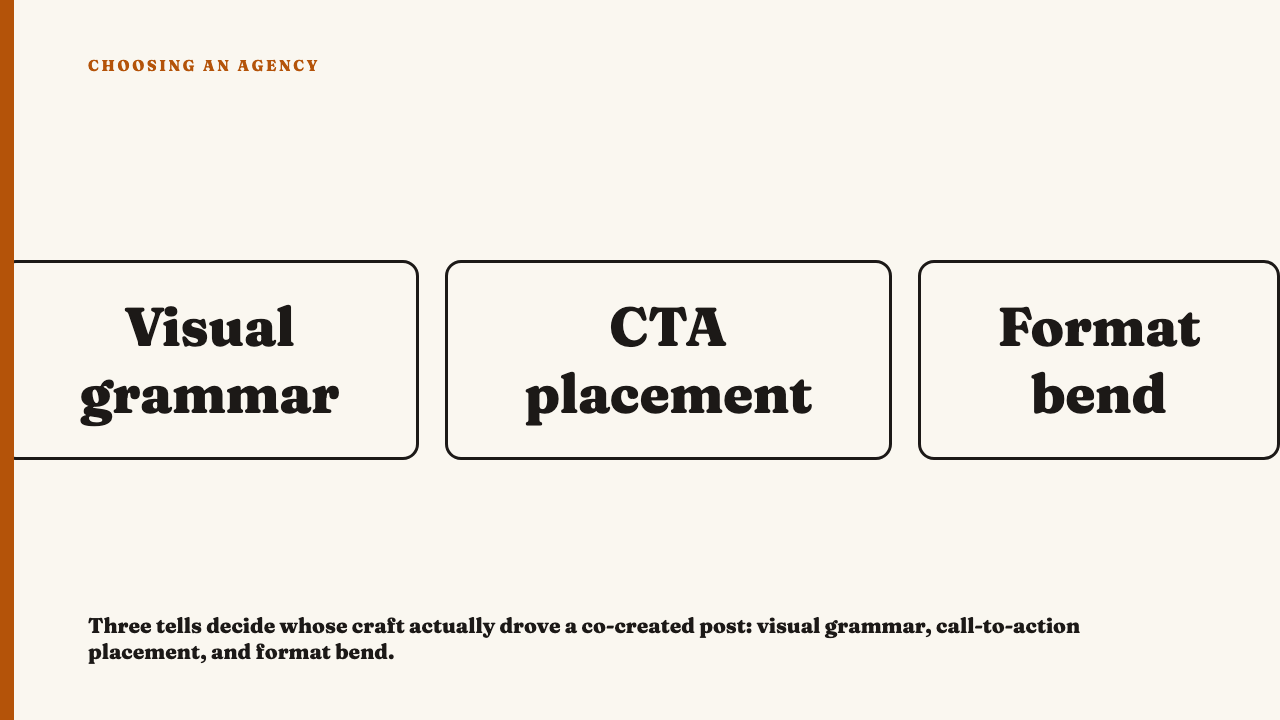
Tell one: whose visual grammar the post actually speaks
Visual grammar is the recurring choices a brand or creator makes when nobody is making them choose differently. Crop ratio, where type sits and how heavy it is, which colors never appear, the pacing of cuts, camera distance at arm’s length or across a room. That is habit, and hard to fake for one piece.
The test is mechanical: open the collaborator’s account in one window and the brand’s in another, both from the period of the joint post, and ask whose habits it follows. A genuinely blended result looks different from either: the cutting rhythm unmistakably the creator’s, fast and slightly untidy, the palette the brand’s controlled three-color range, the type set in the brand’s face at the creator’s usual size. Nothing reads as a concession there, unlike one party’s grammar with the other’s logo in the corner, which always looks like a sticker.
Tell two: who gets the call-to-action placement
Whoever’s outcome the post serves tends to get the best slot: the first caption line before it truncates, the first on-screen text, the link where a thumb lands. Those positions are scarce and somebody lost the argument over them. The party holding the prime slot is usually the one whose brief the concept came from, because everyone else built around it.
Then compare a call to action designed in against one bolted on. Designed in, the graphic leaves room for it and the on-screen text lands on a beat in the edit rather than in a gap. Bolted on, a final frame holds two seconds longer than the edit wanted and a last caption line changes register from the three above it. Mutual promotion is the exception, with equal calls to action on both sides, and equal weight is a signal too: a peer trade, not a brief.
Tell three: whose usual format got bent to fit the other
Adapting your format to somebody else’s constraints costs something visible. A creator who normally runs long and cuts loosely, delivering something short and tightly structured, gave up what their audience turns up for. A brand that swaps its carousel template for a single video gave up its system for the day. Direction flows from the party that did not have to change.
So pull both parties’ solo content from the weeks around the joint post, not their pinned best work. Whichever sits closer to its unadapted baseline set the terms. It is the skill behind telling platform-native work from a crossposted asset, next to where using a format ends and copying an idea begins. Note the limit: concession tells you who bent, not who is better, and a portfolio should not count the other side’s bending as its own direction.
Reading the three tells together
| What the tells do | What it means | Honest caption |
|---|---|---|
| All three favour the agency’s side | It set the look, owned the outcome, did not bend | Full creative credit is fair |
| All three favour the partner | The partner drove it and was accommodated | Credit only what the agency supplied |
| Grammar and call to action disagree | One side conceived it, the other shaped it | Shared credit, named by decision |
| Neither party has comparable solo work | Nothing is established | Not usable as evidence of craft |
A split result usually means genuine co-authorship. Legitimate to claim, but a smaller claim than sole authorship.
What a portfolio does when it wants to borrow the other side’s craft
The first move is cropping. A collaboration where the agency’s client did the least visible work is shown as self-contained, the partner’s handle cropped out of the screenshot, the collaboration left out of the write-up. What reaches you is a good post with an agency’s name under it and no sign it was made with anyone.
The second move is louder. The collaborator’s name sits more prominently than any description of what the agency did, while every visible decision follows that collaborator’s own grammar. Nothing false is stated. The association does the work, and the reader assumes that being in the room means having directed it.
Check for specificity instead. Does the write-up say who wrote the concept, who cut it, who set the type, who owned the call to action? A portfolio confident about its contribution names it. One that is not lets the collaborator’s reputation carry the page, the absence worth auditing across what a portfolio leaves out.
Take this to a real portfolio
Never accept a collaboration as evidence of craft until you have opened both partners’ accounts. Our selections are editorial and we say why each is there, so you can argue with the reading. See this year’s selections, or nominate an agency whose collaboration work holds up.
FAQ
What if the post does not credit either party in a way you can check against their solo work?
Then none of the three tells apply, and the honest move is to say so. Each needs a baseline: the collaborator’s account or the brand’s, from the same period. Without one, a strong-looking joint post is unverifiable evidence of craft. Judge the portfolio on pieces where you can see the working.
Does a brand-to-creator collaboration get judged differently from a brand-to-brand one?
In degree, not in method. Creators carry a sharper personal visual grammar than a second brand does, so tell one is often decisive there. In brand-to-brand co-marketing, where both sides have a polished system, the grammars sit closer together and call-to-action placement is the clearer signal.