How to Tell a Controlled Account Takeover From a Chaotic One
You open an account you follow and the voice is wrong. Not bad, just not theirs. Near the top sits a post saying a guest is running things today. Most people come away with a verdict on whether they liked the guest, the least useful reading available on the one day an agency’s process is visible.
A takeover is a stress test the agency chose to run in public
A takeover is when someone outside an account’s usual voice posts under that account’s name for a bounded window, and says so. Sprout Social describes the format as partnering with someone to run your account for a short period, the guest announcing themselves to the audience and posting throughout. The disclosure and the end date make it a takeover rather than a collaboration.
It is judgeable because the safety net was removed on purpose. Normally, whoever writes the account catches the off-note line before it ships. During a takeover that person stands back, so everything holding the account together has to have been written down or built into the templates beforehand. This is not persona work, where the same one or two people are always behind the character and there is no handoff to watch. The questions in how to judge a brand account built around a persona cover the ordinary days. A takeover asks whether the account survives someone else holding it.
What the guest actually gets to change, and what stays fixed
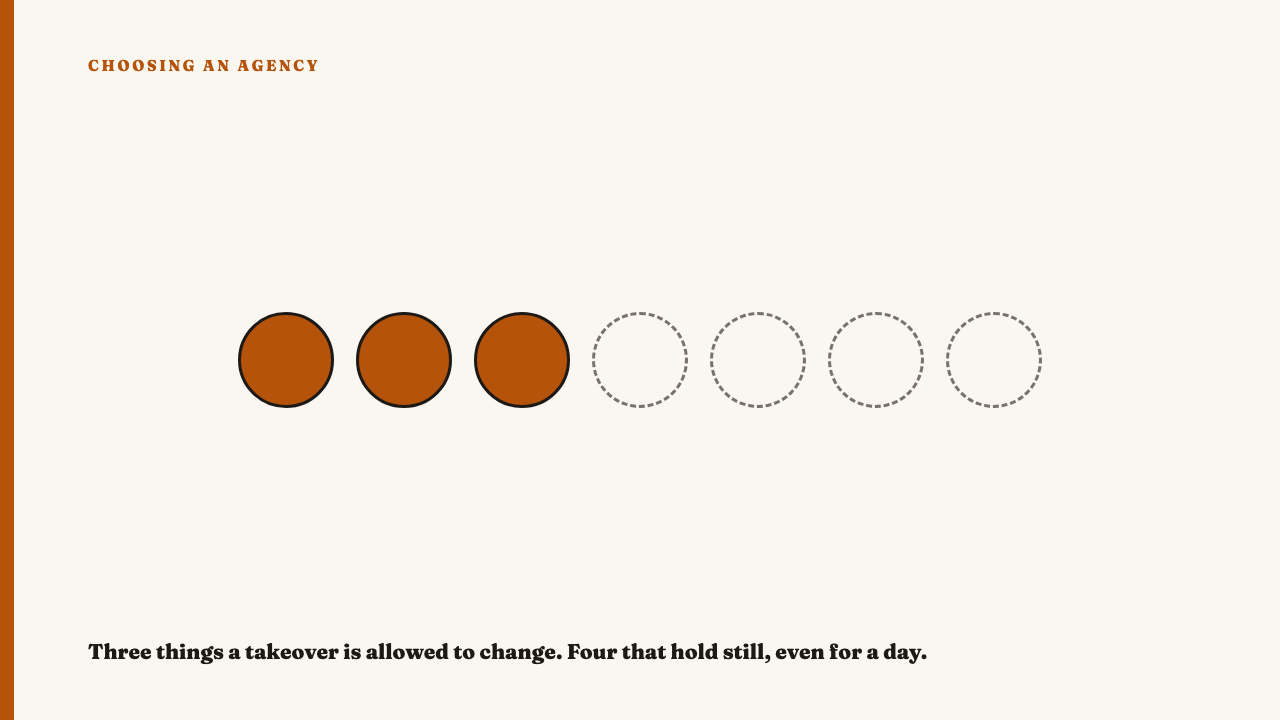
If nothing changes, the takeover was pointless. What moves:
- Word choice and register. The guest’s vocabulary, formality, sentence rhythm.
- Pacing. Bursts through an event read like a person, not a calendar.
- Subject matter. What gets mentioned should shift toward whatever the guest was invited for.
What should not move, even for a day:
- The visual system. Type, colour treatment, crop conventions, logo placement, caption formatting. This is the account, not decoration on it.
- Posting cadence. If the account normally ships three times a day, eleven posts in four hours is a different account wearing the handle.
- Reply behaviour. How it answers people under its own posts is a house habit.
- Declared boundaries. Anything it has established it does not joke about or comment on.
Cover the handle with your thumb. Could you still name the brand from the visual treatment alone, even though the words sound like someone else? If not, the guest was handed the design too.
The tell of a guardrail that is not visible as a guardrail
A takeover where you never see a constraint operate has two opposite explanations. Either there were no constraints, a risk that happened not to detonate, or they were built well enough that the guest never bumped into one on camera. You separate them by watching for collisions. Every account has territory it stays out of, and every interesting guest has material running near it: a subject the account avoids, a competitor category, a claim the brand cannot make. A guardrail built properly produces a post that glides past without appearing to notice, because the guest was briefed before the material existed. A guardrail that was not built produces a visible swerve, or a caption that stops short of the interesting thing.
The clearest failure signal is a caption with two authors. Three sentences in the guest’s rhythm, then a clause in house style, then back. Or a post that opens loose and closes in the account’s normal register. That is somebody stepping in live: the brief did not cover what the guest was writing.
A day that wobbles and a day that breaks are not the same thing
Not every rough edge is a failure. A wobble looks like one post leaning harder into the guest’s voice than the others, energy that dips mid-afternoon and comes back, replies slower than usual. Those are craft notes.
A break is structural. Content that contradicts something the account has said before is a break, because nobody checked the archive. So are followers visibly confused in the replies, and material with no connection to why this guest was chosen. A wobble tells you about one day. A break tells you the agency has no working process for handing an account to anyone.
The handback is where the real judgment happens
Almost nobody looks at the day after, which is why it is the most honest part. A properly scoped account simply resumes. The next morning it sounds like itself, no apology post, no over-explained recap. That cleanness is evidence: the window had a defined end and normal content was queued behind it.
A bad handback announces itself. Sometimes it is a wrap-up post doing too much work, defensive or over-grateful, like an account reassuring itself. Sometimes it is quieter and worse: the next few posts still carrying the guest’s cadence, because nobody reset the brief. An account that cannot find its own voice within a post or two never had a firm grip on it, which loops back to when a brand voice is distinct and when it is only loud. Read the day after as closely as the day itself.
Questions to ask when you watch one happen
- With the handle covered, can you identify the brand from the visual treatment alone?
- Does the guest’s material brush against something this account avoids, and does the post glide past or swerve?
- Is there a caption where the voice changes partway through?
- How many posts before the account sounds like itself again?
- Is it the agency’s own account? A client handoff proves more, per an agency’s own account is weak evidence of its work.
Where to see this applied
We read handoffs this way when assessing the agencies we feature. You can see this year’s selections, or nominate an agency whose work holds up to this reading.
FAQ
Is a takeover the same thing as ghostwriting?
No. A takeover is disclosed and bounded: the audience is told a guest is posting, and it ends. Ghostwriting a founder’s account is undisclosed and ongoing, presented as that person’s own voice. We treat ghostwritten founder voice separately.
Does a rough or uneven takeover day mean the agency did a bad job?
Usually not. Unevenness across a one day handoff is normal, and a post that leans harder into the guest’s voice is a craft note, not a process failure. Look for the structural version: contradiction of the account’s own archive, followers who cannot tell what is happening, or content unrelated to why the guest was there.
Sources
- Sprout Social, How to host an Instagram takeover in 7 steps, fetched 2026-09-07.