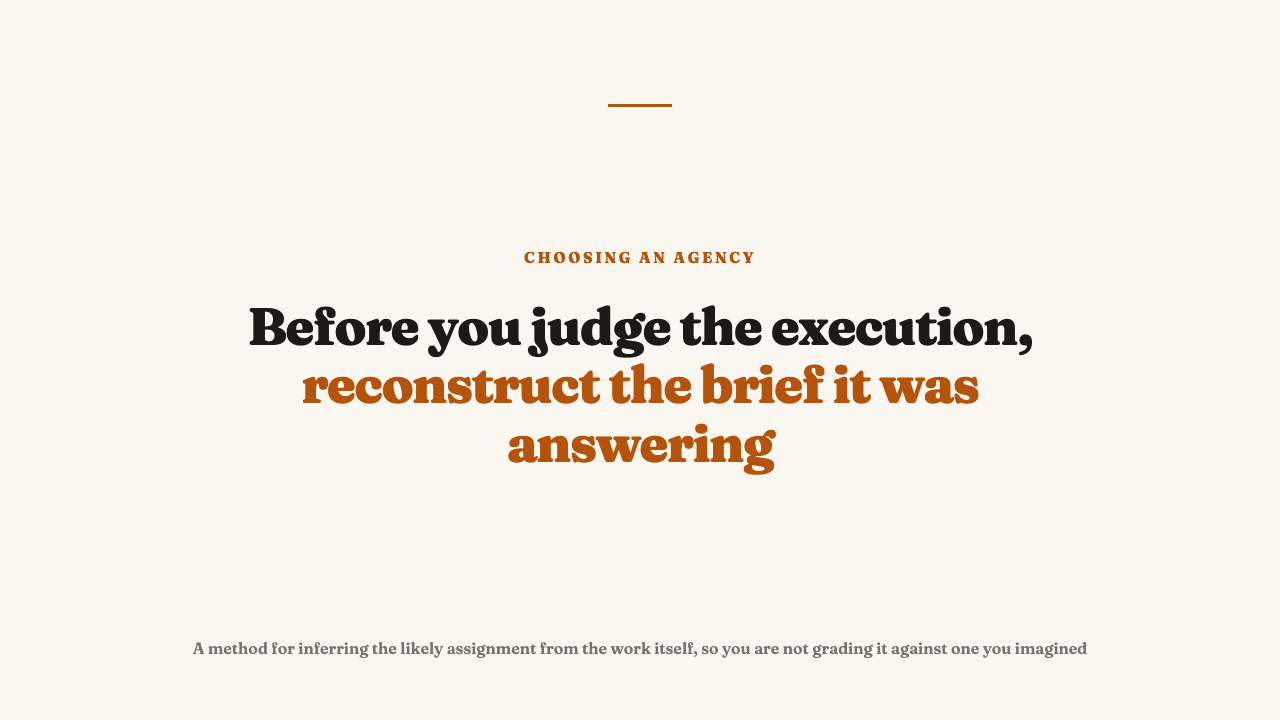
You Are Always Judging Work Against a Brief You Never Read
You are looking at a finished post, trying to decide if the agency behind it did good work. But you never saw the brief. You do not know what was asked for, what was forbidden, what deadline it landed under, or whose approval it had to survive. All you have is the pixels on screen, and you are about to grade them against a standard nobody wrote down.
Every piece of work is an answer to a question you did not hear
Here is the substitution that happens almost every time, quietly enough that most people never notice it. When the real brief is invisible, your imagination fills the gap with the brief you would have written if the assignment had been yours, then judges the agency against that invented standard as if it were the real one. You end up comparing the work not to what was asked, but to what you would have asked, dressed up to look like the same thing.
This is different from the problem everybody already talks about: blaming a bad brief for weak work. That conversation assumes you already know what the brief said. This piece is about the step before that, building a plausible brief at all before you decide whether it was a good one. Skip that step and you are judging craft against a hallucination, and calling the hallucination objectivity.
What the work itself tells you about the assignment
- A recurring visual template implies a locked style guide, not a lack of range. On screen this shows up as identical crop ratios post after post, a logo in the same corner at the same size every time, and a font that never varies even when a caption clearly wants to break loose and use something bigger or looser.
- A caption structure that repeats, the same opening line, the same spot a link or hashtag block always lands, implies a mandated format from someone who wanted consistency more than variety.
- A topic that appears right after a product launch or a news cycle implies a reactive assignment, turned around fast rather than planned weeks out. The signal is timing: a post published within a day or two of an event a slower process could not have anticipated.
- A tone that shifts sharply from the account’s normal register implies a one off ask from outside the usual chain of approval, dropped into a feed not built to hold it.
A worked example: the same post, two different likely briefs
Picture a hypothetical social post: a flat product shot, straight on, plain background, with a caption stating one benefit in a short sentence. No lifestyle scene, no flourish, no mood. That is enough to construct two different briefs, with no way yet to know which one actually happened.
Brief A is a brand safety mandate: legal or a category rule forbids lifestyle imagery and requires the product shown alone, so nothing in the frame reads as an implied claim. Under brief A, the flat treatment is competent compliance with a rule the agency did not choose.
Brief B is an open assignment with no constraint at all. Under brief B, the identical image reads as a missed opportunity, room to build a scene or a mood that went unused.
The pixels on screen are exactly the same in both cases. The only thing that moves the verdict from competent to lazy is which brief you assume sits behind it, which is why guessing the brief has to happen before the verdict, not after you have already decided you dislike the post and gone looking for a reason.
Where the method breaks down and you should stop guessing
Some of what shaped a piece of work is invisible no matter how carefully you look. A legal review note, a client’s personal veto on one color, an executive’s offhand preference that never made it into any written brief: none of that leaves a trace in the post itself. No amount of pattern reading recovers information that was never expressed in the output.
The concrete tell for when to stop: if two plausible briefs would produce opposite verdicts on the same work, and the evidence does not clearly favor either one, say so rather than picking whichever version suits the conclusion you already wanted. A confident verdict on ambiguous evidence is not rigor. It is guessing dressed up as certainty.
Building the habit into how you look at a portfolio
The method gets more reliable once you look across several posts on the same account instead of one in isolation. A single odd choice could be anything: a mistake, a one off request, noise. But a constraint that shows up post after post, the same crop ratio, the same caption shape, the same restraint around a kind of imagery, is not noise. Repetition turns a guess about one post into a reasonable inference about the brief governing all of them.
Keep the sequence explicit and do not run it backward. Infer the likely brief first, from the patterns across the account. Decide what an acceptable range of execution against that brief would look like. Only then look at what was actually made and place it inside that range. Reason backward from the work to whatever brief justifies your gut reaction, and you have rebuilt the substitution this piece opened with, just with extra steps.
Look closer before you take anyone’s word for it
None of this requires taking an agency’s own account of its work at face value. What a portfolio leaves out covers the adjacent problem of information a viewer never gets access to, and the same discipline runs through reading strategy from the public output alone. The worked example above, where a brand safety constraint alone flips the verdict on identical execution, is explored further in judging craft under a brand’s own constraints. To see this scrutiny applied across a wider set of agencies, nominate an agency whose work you think holds up under it.
FAQ
Is guessing the brief just making excuses for weak work?
No. The method is symmetrical, not one directional. It can explain a flat execution as compliance with an inferred constraint, but the same reasoning can just as easily show that no plausible constraint accounts for a genuinely lazy choice. The goal is accuracy about what likely happened, not leniency.
What if the account gives no clues at all about the brief?
Some accounts are too thin, too inconsistent, or too new to support any real inference. In that case the honest move is to judge the visible craft on its own terms, rather than inventing a brief just to have something to compare the work against.