What an Agency’s Highlights Row Reveals That the Feed Doesn’t
You have been through an agency’s client account twice and you still cannot tell whether anyone is tending it week to week or whether it was built beautifully once and left running. The grid shows you production, not upkeep. One strip on an Instagram profile does show upkeep, and most reviewers scroll straight past it: the row of circles under the bio.
Everything else on the profile disappears. This is what an agency decided to keep.
Images posted to an Instagram story expire after 24 hours. The only ones that stay are the ones somebody saved into a Highlight, a curated collection pinned to the profile rather than a feed that clears itself out. What survives survived because a person decided it should.
So change what you think you are looking at. This is not a record of what the account did. It is a small standing exhibit, built from disposable material and left up indefinitely. Somebody chose each circle, then at some point stopped choosing and never came back.
The categories tell you whether someone is still maintaining the account or just started it once
Read the labels before you tap into anything. A maintained row describes the account as it exists today: current offerings, a running FAQ that answers what the comments actually ask, coverage of an event recent enough to still matter this week. Nothing in it asks you to care about a moment that has closed.
An abandoned row reads differently, and the tell is temporal. A holiday promotion Highlight still sitting there in the spring. A launch event Highlight that predates three later launches, none of which got a Highlight of their own, which tells you the practice stopped rather than the launches. The row describes a version of the account that no longer exists, and nobody noticed.
Resist counting. The number of categories is not the signal. A tight row of three, all true right now, beats a sprawl of twelve where half point backwards.
Cover art: designed choice versus whatever frame got grabbed
Now look at the row as an object rather than a set of links. A designed cover set reads as one thing at a glance: line icons in a single weight on a flat background, or photography pushed through the same colour wash, or type set in the account’s own face at a size that survives being shrunk into a circle.
The opposite is unmistakable once you know to look. The covers are frames lifted from whatever story sat first in each collection, so you get a mid-blink face, a half-finished transition, a slide cropped so tightly no word is readable. No two share a palette or a crop logic. The row has no visual language at all, which is strange on a profile arguing for the agency’s eye. It is the same test as asking whether an agency built a system or just one good post, run on a smaller surface.
One middle case is worth not over-crediting: a single clean template across every cover, genuinely designed, but visibly of an earlier moment than the feed above it. A typeface the account no longer uses, a colour that appears nowhere in recent posts. Read that as launch effort, not practice.
What stale Highlights say about who is minding the account
Tap in. Here the row stops being a design question and becomes a maintenance one. Look for content that has quietly gone false: a code from a promotion that closed, a booking number the business no longer uses, a link to a retired page, a hiring notice for a role filled long ago. Nobody removed it because nobody has opened the row in months.
What makes this worth your time is the gap it can open with the feed. An account can look sharp at the top and carry a year-old offer three circles down. The feed is where visible effort goes, because it is the part everybody reviews, including you. The row is the part nobody audits, which is why it reports honestly. A beautiful setup that has never been pruned is one good week at the start of an engagement, not a practice. It is the same reading as what a portfolio leaves out.
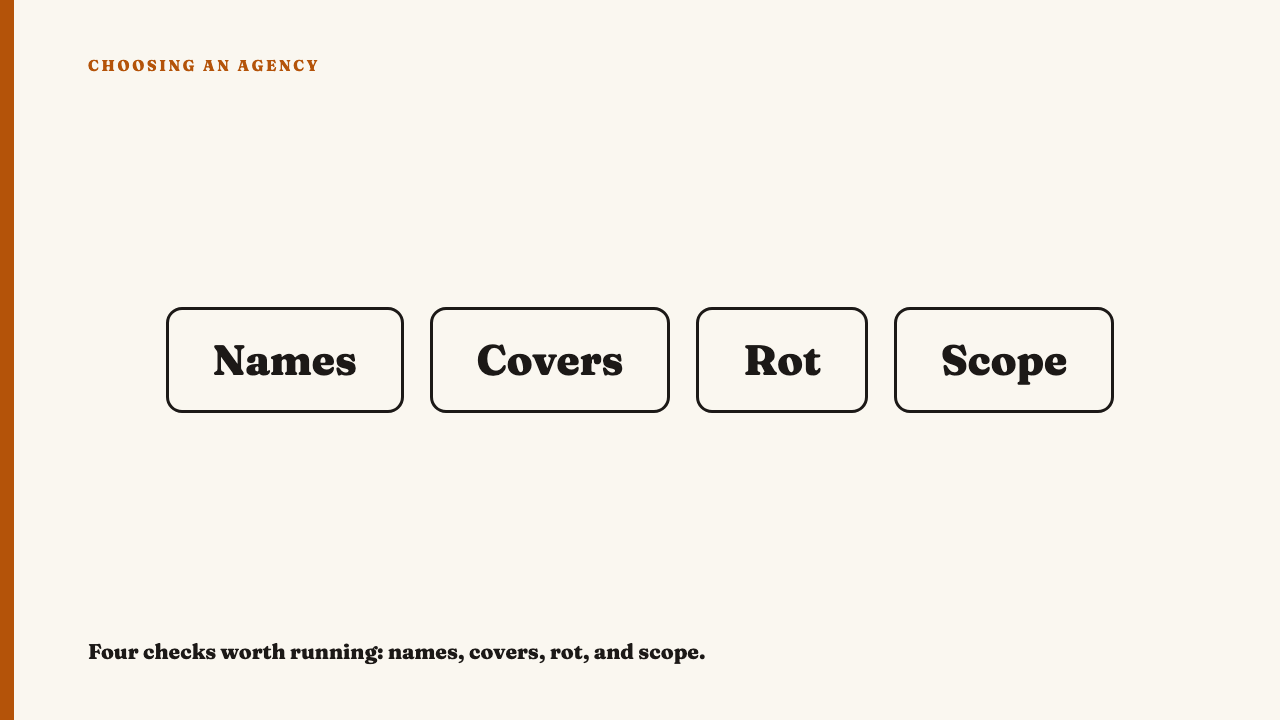
A quick pass: what to check in under a minute
- Names. Does each label still describe something true today, or a moment that has closed?
- Covers. Do they share a visible design system, or are they mismatched default frames?
- Rot. Open two or three. Is there at least one outdated offer, number, link, or claim still sitting there?
- Scope. Does the size of the row match the size of the account? A sprawling row on a small account usually means nothing was ever retired.
This is a small tell, and small tells add up
Keep it in proportion. Highlights curation should never decide anything on its own. It is a minor signal next to the craft of the work itself, and an agency doing excellent work for a client who will not let them touch the profile furniture is a real situation.
But reviewers who skip it give up one of the few places on a public profile where ongoing maintenance is visible at all. Everything else was made to be seen and dated to the day it shipped. The row is the only part that has to keep being true afterwards, which puts it in the same discipline as reading strategy from public output. Intent shows in what somebody bothered to keep current.
Where to see this applied
Entries here are chosen editorially, and this kind of close reading is part of how. See this year’s selections and read the profiles with the row in mind, or nominate an agency whose work holds up to that attention.
FAQ
Do Highlights matter as much as the actual posts when judging an agency’s work?
No. The craft in the feed is the substance and Highlights are a supporting signal at best. What earns them a minute is that they answer a different question. The feed shows what an agency can produce. The row shows whether anyone has been back since.
Is it a red flag if an account has very few Highlights?
Not by itself. Three Highlights that are current, clearly labelled and consistently covered are better evidence of care than a dozen where half point at things that have passed. Check relevance and upkeep, not count.
Sources
- Instagram, Wikipedia, on Stories expiring after 24 hours and Highlights as saved collections that persist. Fetched 7 September 2026.