How Much of That Work Did the Agency Actually Do?
You have found the same social account in two agency portfolios, maybe three. Every entry reads confidently, and none says which parts of that feed this agency made. Some of it narrows from outside.
An account is not a contribution
A portfolio entry names a client. You want a contribution. Nothing in the format connects them.
“Partnered with” states a relationship, no deliverable. “Supported” concedes somebody else led. “Ran social for” spans owning strategy and scheduling posts another team wrote. “Drove the social presence” claims an outcome, not authorship. “Worked with the team on” names nothing.
Assume the duplicate is true twice. Several parties touch one feed, so dishonesty is the wrong first move. Ask which layer this agency owns and whether it shows from outside, the gap in an agency’s own account is weak evidence of its work and telling concept work from work that actually shipped.
The layers that touch one account
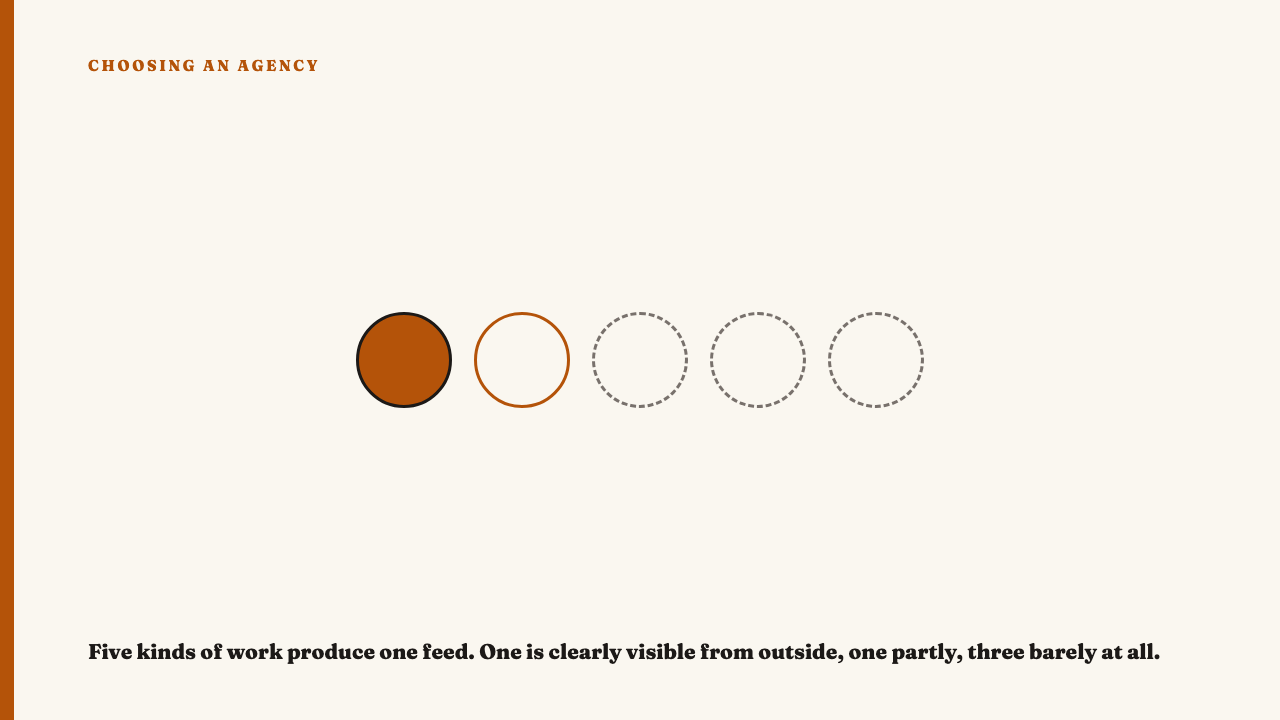
Five kinds of work commonly produce one feed. They are categories, not a count.
| Layer | What it owns | Visible from outside? |
|---|---|---|
| In-house brand team | Brand rules, approvals, the calendar | Barely. Shows as consistency any vendor can claim. |
| Creative agency | Concepts, scripts, art direction, the look | Partly. Craft is on screen, nothing says whose. |
| Media agency | Budget, targeting, boosting | Close to invisible. Nothing separates funded from shared. |
| Freelance editors, post-production | Cuts, captions, grade, cover frames | Barely. The craft shows, the hand does not. |
| Booked creators | Posts a creator publishes for the brand | Most visible: the post usually carries a disclosure. |
The right column is the point. Creative direction sounds largest and leaves the faintest trace; a booked creator post leaves the clearest and is least likely to be theirs.
Date the change in craft signature
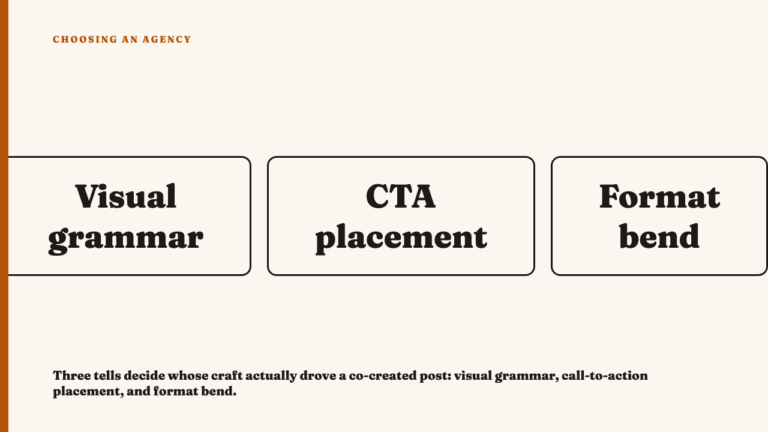
The strongest outside-in method is finding where a feed starts looking made by different hands. Craft signature is specific: caption voice, sentence length, cut rhythm, shot count, cover frame typography, grade, series titling, cadence.
Scroll back until the signature flips, then compare that point to any date the agency gives for the engagement. A flip landing there is real support, one with no stated engagement near it supports nothing. Several elements flipping within weeks is strong, one drifting over a year is not.
Grid ordering, pinned posts, reposts and archives distort a backwards read, and a flip may be an in-house hire, a platform template or a brand refresh. Test the date, do not conclude from it, as in reading strategy from the output alone.
Work the agency made and work the agency booked
Disclosure labels are where the two separate. YouTube’s help page states that a creator with a paid product placement or sponsorship must tell YouTube, which then shows viewers a disclosure message at the start of the video. The FTC tells creators to put that disclosure with the endorsement itself, expected practice rather than courtesy. Instagram’s own documentation could not be confirmed in readable form, so the point rests on those two sources, not Instagram’s wording.
If an entry’s strongest pieces are labelled creator posts, the contribution may be casting and booking rather than making. Booking well is a skill, though not the craft polished video implies. No label does not prove the agency made a post, and a labelled post may still have been scripted and edited by it.
Two entries, same account
Picture one unnamed account. From a creative agency:
We partnered with a regional coffee chain to rebuild their social presence, taking their video from flat product shots to something people finished watching.
Literally: a relationship, and a change in the video. Implied: this agency produced it. The account can date the change, not who scripted, shot or cut a frame, so the implied half stays unchecked.
From a media agency:
We ran social for a regional coffee chain, supporting always-on content and creator activity.
Literally, operational ownership plus creator involvement, with “supporting” conceding it did not make the content. The account shows whether labelled creator posts exist, not who booked them.
Both survive. You now know what each is worth.
What to ask, and the answers that tell you nothing
Ask about a piece, not the account.
- Who wrote this? A named role resolves it. “It came out of the wider team” does not.
- Who cut it? A named editor resolves it. “Production was handled for us” does not.
- Who chose the cover frame? A person and a stage resolve it. “It was a collaboration” does not.
- Was this creator briefed by you, booked by you, or both? Any of those words. “We work closely with creators” does not.
- What did the client’s team own here? A carve out, approvals or the calendar. “We can’t break that out” does not.
Confidentiality is a fair reason to withhold a client’s name, a poor one to withhold the layer.
When nothing narrows it
Unattributable is not false, so the entry drops in weight rather than out of the set. Lean on entries where the contribution is legible, and on the pattern across a set. Take the two strongest and ask who made each piece.
Try it on a portfolio
Take these questions to work you already rate. See this year’s selections, or nominate an agency whose work holds up.
FAQ
Is it dishonest for two agencies to list the same account?
Usually not. Shared accounts are a normal structure and each agency may be describing a different layer. The problem is the format of a portfolio entry, which names a client and says nothing about scope. Dishonesty means claiming a layer it did not do, which needs sharper evidence than a duplicate name.
Can I tell who posted something from the post itself?
No. A public post does not expose which account manager or vendor published it, and nothing you can install will. The visible signals are disclosure labels on creator posts and changes in craft.
Does a paid partnership label mean the agency did nothing?
No. The label says a creator published on the brand’s behalf, nothing more. The agency may have cast the creator, written the brief, scripted or edited it. It narrows the question from who made this to which part the agency made.
How much weight should a contested entry carry?
Less, not none. Judge the agency on entries where its contribution is legible, and read a set of unattributable entries as a pattern in how it presents its work.
Sources
- YouTube Help on paid product placements, fetched 2026-08-28.
- FTC Disclosures 101 for influencers, fetched 2026-08-28.