Engagement Bait vs Real Conversation Design: How to Judge the Difference
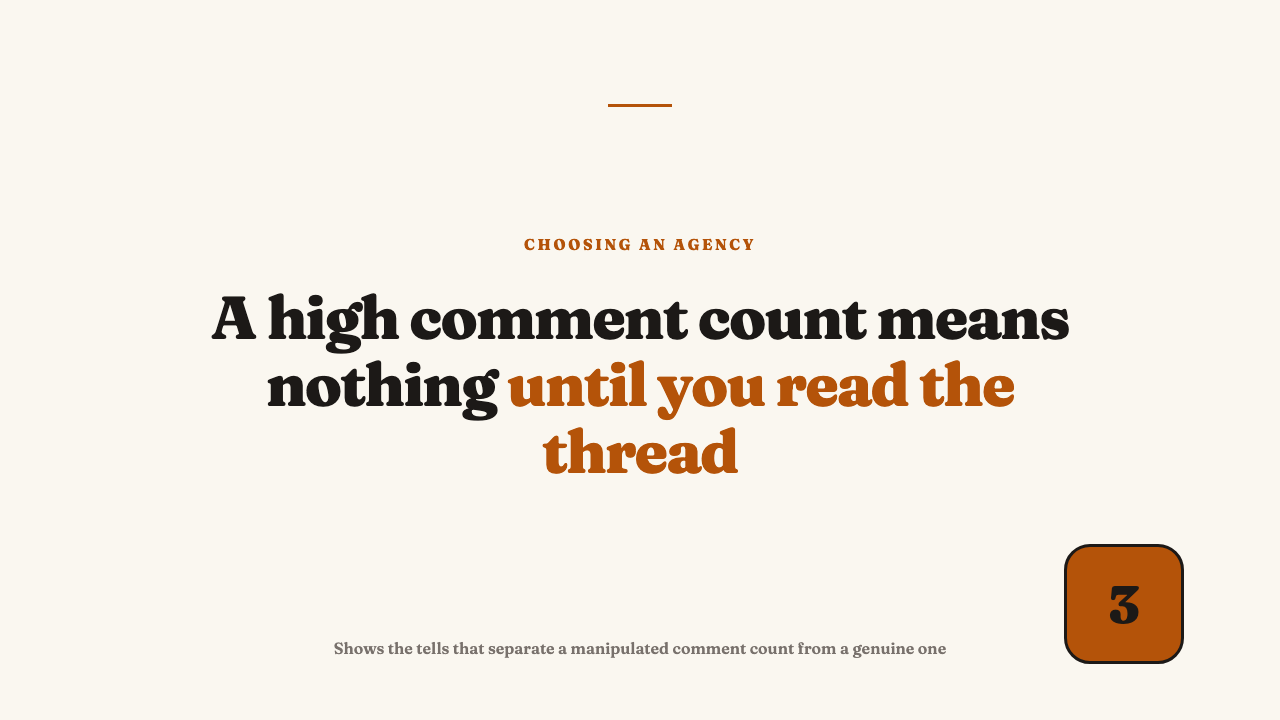
You are working through an agency’s portfolio and one post has a comment count on the slide in large type. Two very different things produce that number: a post can earn a long thread by being worth responding to, or extract one by making a comment the price of admission. They look identical until you open the replies.
What engagement bait looks like on the post itself
The first tactic is the forced either/or. Coffee or tea. Beach or mountains. Pick one in the comments. Nobody holds a position either way. Answering costs nothing, which is why the answers are worth nothing.
The second is the comment-to-unlock mechanic. Comment a keyword and a link gets sent to you. That comment is not a response, it is a transaction with a publicly countable receipt.
The third is manufactured controversy: a caption staking out a disagreement the brand does not hold, phrased to sound bold while risking nothing. An unpopular opinion that is in fact the popular one.
The common thread runs through all three: each prompt can be answered by someone who never watched the video or looked at the image. That tell sits in the caption, which is where what separates a written caption from a filled in one gets decided.
Why the comment count on its own tells you nothing
A high comment count can be produced by a cynical prompt or by a genuinely good one, so the count is not evidence of craft. Judging it instead of the thread is the mistake that lets weak work pass inspection, because bait is cheap to make and photographs beautifully in a deck.
Keep the boundary clear. You are assessing a decision made before any reply existed: how the post was built to invite one. How the agency behaved in the thread afterwards is a separate question, covered in what the replies under a post reveal.
Read the thread, not the caption
Picture a garden centre account posting a photo and asking whether you are a roses person or a succulents person. Scroll the replies. One word long, alternating between the two options, near-identical all the way down. Nobody says why. Nobody mentions the photo. That thread is a tally, and it would read the same under a different picture.
Now picture the same account posting about a plant that keeps dying in a north-facing flat. The replies are uneven. One runs four lines: killed two of these, third one lived once it came off the windowsill. Another disagrees with the caption and says what worked instead. A third adds a detail the post left out, and the same few names come back three or four times, answering each other.
Bait threads, by contrast, are almost entirely first-time one-liners that never speak to each other. Check the real comments, not the caption’s shape, since a well-made open question can still land flat.
The design decisions that separate the two
- A forced binary against a specific question. Bait offers two options with no stakes either way. Craft asks something that only makes sense to a person who watched or read this post.
- Manufactured controversy against a real position. Bait picks a disagreement nobody holds. Craft states something the brand believes and accepts that part of the audience will push back in public.
- A comment-to-unlock trade against a prompt that pays off in the reply. Bait exchanges a comment for a link or a file. Craft asks for the reader’s own version of something, their worst attempt, their workaround.
- A portable prompt against one only this audience could answer. Bait asks something that works identically on any brand’s account. Craft asks something that could only have been written for this audience, and the replies would read as nonsense anywhere else.
Where the line gets genuinely hard to call
A strong, properly opinionated post can also pull a flood of short reactions, because plenty of people answer something good with three words. Volume and thread quality are not neatly correlated.
So use a harder test. Read a sample of replies cold, without the caption, and ask whether they make sense as responses to a specific piece of content or would sit under almost anything.
Expect mixtures. Many threads carry both patterns, one-word answers layered over a smaller pocket of real discussion. Judge those on the real discussion.
What this means when you’re looking at a portfolio
Do not accept a screenshot. A cropped comment count in a deck is trivial to produce and survives no scrutiny. Find the live post and scroll the comments yourself, one instance of what a portfolio leaves out.
Once there, sample at random: something from the middle, the bottom, a week later. The top of a thread is often curated, with the sharpest replies pinned or featured, so the first few are a selection, not a sample. And hold the scope: you are grading the post’s design, not how the agency handled what came back.
Where to look next
To see how this reading applies across a body of work, see this year’s selections. If an agency’s work holds up when you open the comments, you can nominate an agency.
FAQ
Is every post that asks a question engagement bait?
No. The distinction is whether the question depends on the post. One that only makes sense to someone who watched the video or noticed a detail in the image is a legitimate craft choice. A prompt that works above any post on any account is the tactic described here.
Can a post be designed to get comments without being bait?
Yes, because designing for conversation and designing for volume are different goals that share a metric. A post can pursue the first honestly by taking a real position the brand will defend, or by asking something specific enough that a generic answer looks out of place.
What should I actually look at in a portfolio to check this?
Open the actual post rather than the screenshot, then scroll past the first few replies and sample at random from the middle and the end. Read what you find without the caption in view. If the replies work as specific responses to that post, the prompt did its job. If they would fit under anything, the structure did the work.