Judging B2B Social Work Without Borrowing Consumer Standards
You have two pieces of B2B social work open side by side. One is dry: a flat graphic, a caption written by someone who does the job. The other is lively, with real art direction and a punchline. Every instinct you have for social craft favours the lively one, and the dry one nags at you anyway. You are holding the wrong ruler.
Why the consumer scale gets reached for first
Almost everything published about B2B social content is written for the person making it. Sprout Social’s guide to B2B social media strategy is a fair example: it tells brands that younger decision makers expect authentic, engaging content rather than stale corporate speak, and devotes a section to prioritising authenticity. It addresses the marketer planning posts, never the reader judging finished ones.
As production advice that is reasonable. Notice the material. Human. Authentic. Engaging. Not boring. That vocabulary comes from consumer entertainment and answers a production question, not an evaluation one. Using it to judge finished work is a category error: a post can be funny, well shot and empty, and none of these words register that.
What the specialist reader is actually doing when they read a B2B post
A consumer post meets an idle thumb. That reader arrived with no question, so the post has to earn attention it was never owed. Entertainment craft is the right standard there.
A B2B post is read mid workday by someone who already does the work it is about, three weeks into a decision it might bear on, reading the first line to find out whether it does. They forgive dryness instantly. They do not forgive being told what they already knew. That is a difference in reader, not in taste, and it is why the entertainment criteria stop applying.
The three things precision actually looks like on screen
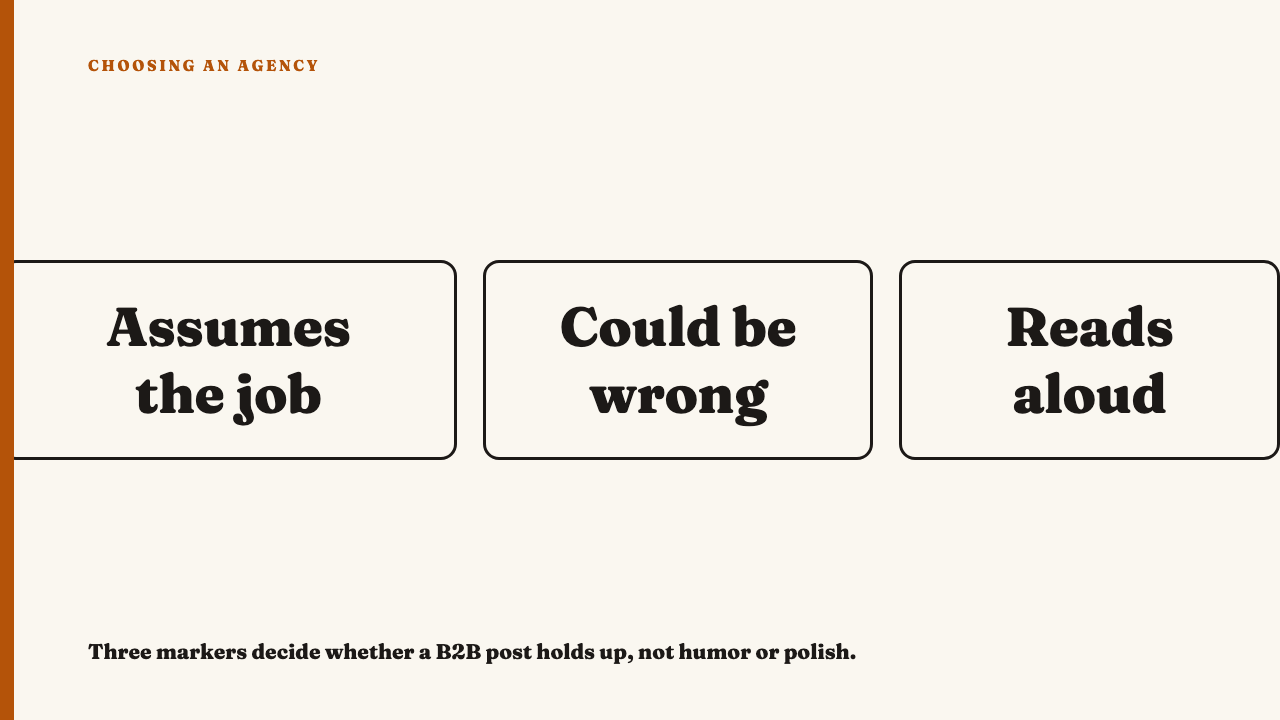
- Does the post assume the reader knows their own job? Passing: a carousel whose first panel opens on the edge case where the standard approach quietly stops working. Failing: a carousel that spends three panels defining the term in its own headline. Over-explaining is not generosity, it says the post was built for an imagined beginner.
- Is the claim specific enough that it could be wrong? Passing: a caption stating that an approach breaks down once a team crosses a particular kind of complexity, and naming the mechanism that breaks, so a specialist can hold it against their own experience. Failing: a caption saying the best teams focus on outcomes rather than activity, which nobody would contest. A claim that cannot be wrong carries no information. The same instinct is at work in reading strategy from what an agency actually published.
- Would it survive being read aloud to someone who does the work? Passing: a caption whose middle sentence states a condition a practitioner could contradict out loud, that this only holds while approvals sit with one person. Failing: a caption of three clauses that read fluently at speed, consistency compounds, relevance beats reach, meet buyers where they are, and put no question in front of anyone.
A plain post that passes, a lively post that fails
Picture two posts, both hypothetical composites rather than anything a real agency published.
The first is unlovely: one flat colour, a default-weight headline, ninety words of caption explaining that a common way of structuring an internal handoff fails when two teams share ownership of the same output, and what breaks first. A specialist can agree or push back, because they were handed a mechanism and a condition.
The second is a pleasure to look at: considered typography, a funny opening line, a visual gag that lands. Its caption says too many teams still treat this channel as an afterthought, and the ones seeing real results have made it central. At scroll speed that feels like a point. Read aloud there is nothing to answer: no mechanism, no condition, no way to be wrong. Polish was never what was tested.
Where personality still legitimately belongs in B2B work
None of this argues for dullness. A specific post that is also well written beats one that is merely specific, because wit gets a precise claim forwarded to whoever decides. Voice rides on top of the test rather than being it, the subject of what separates a written caption from a filled in one.
The opposite mistake is easier to miss. Once you accept that dry work can be good, it is tempting to read flatness as seriousness. A clinical tone can sit on a claim as empty as the funny one, and hide it better. Austerity is a style, not a credential. The general version of this standard is what actually separates good social work from average.
How this shows up in the agencies selected for Best for B2B
Best for B2B is a standing editorial category on this site, and it currently holds 3 entries. Selection is editorial, based on work we read closely, and this is the standard we read it with: claims someone could argue with, posts that assume a competent audience, work that holds up when you slow down. Craft in the delivery counts second.
See the standard in use
You can see this year’s selections and read them with the three markers in hand. If an agency’s B2B output survives being read aloud to a practitioner, nominate an agency and say which piece made the case.
FAQ
Does this mean B2B social content should be boring on purpose?
No. Boring is not a virtue any more than funny is. The test is whether the claim underneath is specific enough to be checked and whether the post assumes a competent reader. Dryness bears on neither.
Can a B2B post be both entertaining and precise?
Yes, and that is the best version of the form. Voice sits on a separate layer from the specificity of the claim it carries, so no trade is being made. The error is treating one as evidence of the other.
Why do most guides about B2B social content focus on making it less boring?
Because they are written for the person producing the work, who needs help avoiding a common and real failure mode: publishing something nobody finishes reading. That advice was built to correct production, not to grade it, and it does not hold up as an evaluation standard.
Sources
- Sprout Social, How to build a customer-centric B2B social media strategy, fetched 2026-09-02.