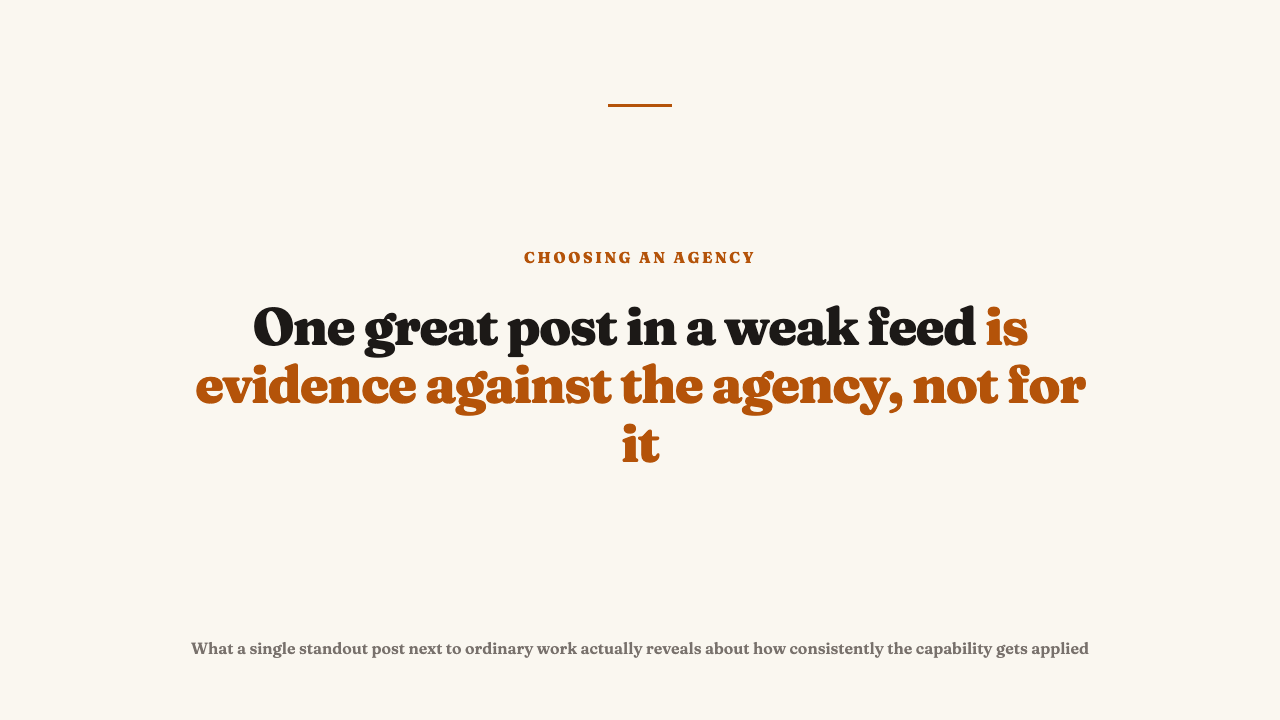
One Great Post in a Weak Feed Is Not a Compliment
You have found one genuinely great post on an agency’s account. The rest of the feed is ordinary, some forgettable. The instinct is to let the great post pull the whole account up in your estimation, as if it proves the agency is capable of that level whenever it matters. It does not. The gap between that post and everything around it is telling you something more specific, and less flattering, than “this agency is good.”
The instinct to average is the wrong instinct here
When a feed looks mixed, the natural move is to average it out. Ten posts, one excellent, nine forgettable, so call the account a seven out of ten and move on. That treats every post as an independent, equally weighted sample of the same underlying quality, the way you’d average ten dice rolls to guess whether the die is loaded. But a feed is not ten dice rolls. It is decisions made by the same team, under whatever mix of attention, budget and deadline pressure applied to each one. The better question is not “what is the mean quality here” but “what does the spread itself tell you.” An evenly mediocre feed and a mostly mediocre feed with one exceptional post are two different diagnostic situations, and they can average to the same score while meaning opposite things about what this agency will deliver.
What the gap between the best post and the rest is actually measuring
Here is the central claim: a strong outlier post demonstrates that someone on the team can do the work at that level. That rules out one explanation for the weaker posts: you cannot say the agency lacks the skill, because you are looking at direct evidence that it doesn’t. Once that’s off the table, the weak posts stop being a skill problem and become an application problem, a resourcing or process problem wearing a craft costume. The capability exists but is not being applied consistently, more useful to know than “this agency isn’t very good.” An agency that can’t do the work is a dead end. An agency that can but doesn’t, most of the time, is a question about why, and whether that why is manageable.
Two explanations for the same gap, and how to tell them apart from the outside
Picture two hypothetical agencies producing the same looking feed: one hero post, a run of ordinary ones. In the first, a single strong specialist produces the occasional standout piece while the bulk of the calendar gets filled by junior staff working faster and with less oversight. In the second, the agency deliberately concentrates time and budget into a small number of flagship posts, treating the rest as necessary filler by design, the way a store’s window display and its stockroom get different care. Both produce the same looking gap from the outside.
The tell is in the ordinary posts, not the standout one. Look at whether the routine posts still hold a baseline of competence: correct crops, clean captions, colour and type on brand. Or whether they look genuinely rushed: typos, stretched assets, a voice that wanders as if no one shared a brief. The first pattern is a deliberate hierarchy of investment. The second is unmanaged inconsistency.
What counts as “surrounded by mediocrity” before the outlier means anything
None of this works on too small a sample. Judge it against the same window used to judge any body of work, roughly the last two to three months of posts, not a handful you happened to scroll past. A single outlier next to only three or four other posts is not a pattern either way, it is just a small number of posts, and reading a hierarchy into it is reading a story into noise. This is a rule about window size, not volume, and it says nothing about how many posts an agency typically publishes, since no such figure exists in this site’s own data.
Questions to ask before you decide what the gap means
- Is the strong post for a favoured client, a newer, larger account, or one treated as routine?
- Does the strong post line up with a launch or campaign moment, while the rest is routine maintenance?
- Is there a strong post from more than six months ago too, suggesting the capability once applied broadly and has narrowed?
- If you removed the outlier entirely, would the remaining posts pass on their own, or does the account only look acceptable because of it?
Why this matters more than it looks like it should
Almost all of the work an agency does for a new client will be the ordinary week, not the hero moment. Launch weeks are the exception on any retainer, so the flat baseline is closer to what you are buying than the outlier is. The natural mistake is anchoring on the best post, because it stopped your scroll. The companion argument runs the other way: one excellent campaign tells you almost nothing, and whether an agency built a system or just one good post covers the broader test this one narrows. A portfolio is a curated set of outliers, so what a portfolio leaves out is worth reading too. See this year’s editorial selections, or nominate an agency whose work belongs there.
FAQ
Does one exceptional post mean the agency can do great work whenever they want?
It means someone on the team can do it once, under whatever conditions produced that post. It does not mean that level is available on demand, since demand, budget and attention were not distributed evenly across the feed you are looking at.
How many ordinary posts do I need to see before the pattern means anything?
Look at the same two to three month window you would use to judge any body of work. A single outlier against only a few other posts is too small a sample to read either way, so widen the window first.
Is it a bad sign if an agency clearly puts more effort into some posts than others?
Not by itself. Every account has posts worth more investment than others. The distinction is whether the ordinary posts still meet a basic competence bar or look rushed and uncared for, since the first is a deliberate hierarchy and the second is unmanaged inconsistency.
Which post should I weight more heavily when deciding, the best one or the average one?
The ordinary week is what most of the retainer will look like, so it deserves more weight than the outlier, even though the outlier stopped your scroll.
Sources
- Why one excellent campaign tells you almost nothing, checked 2026-09-09
- Judging whether an agency built a system or just one good post, checked 2026-09-09
- What a Social Agency Portfolio Leaves Out, checked 2026-09-09
- This year’s editorial selections, checked 2026-09-09
- Nominate an agency, checked 2026-09-09