A stunt made for social is a film first and an event second
An agency sends you a case video of a stunt: a pop-up, a prank, something physical that people stopped to look at. You cannot tell whether you are admiring the work or the idea. Look at the footage, the only part you were given.
Three places the craft can live, and why the reel blurs them
A documented stunt carries three kinds of craft. The idea is what the stunt is. The event is whether it was built and run well in the room. The footage is whether it was shot and cut as a film someone can watch on a phone.
This post covers only the third. You cannot see the first two directly, only through what was filmed, so a weak film can hide a strong event and a strong film can flatter a thin idea.
Picture a pop-up that is clever as a concept and chaotic on screen: one shaky angle, nobody’s face clear. Now picture a modest prank with one prop and one hidden camera that is superb on screen, because every second was framed to show the moment. The layers came apart, and only one of those is good social video.
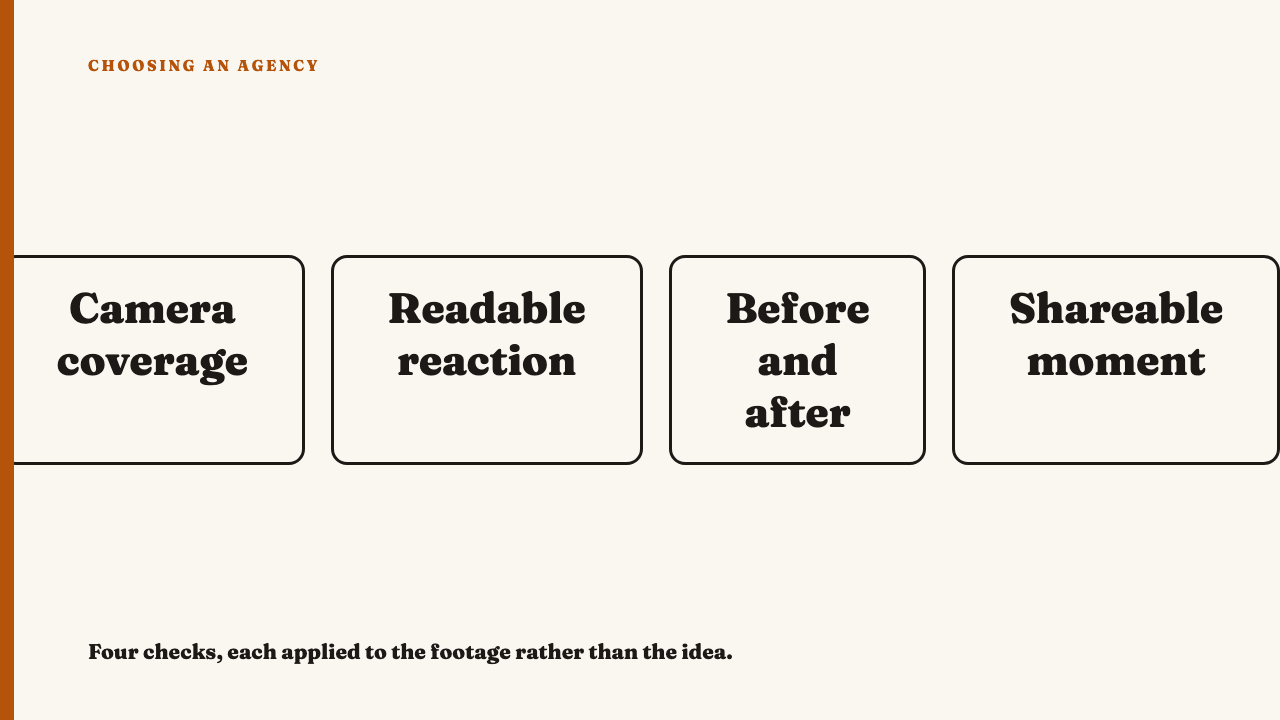
Check one: could the shoot have been planned, or was it only survived
A stunt happens once and cannot be reshot, so the number and placement of cameras is direct evidence of planning. Look for:
- A wide shot that establishes the space before anything happens.
- A close on the person reacting, framed before the reaction arrives.
- A view from the target’s point of view.
- A cutaway to the trigger, the thing that set the moment off.
Single-camera survival looks like one handheld angle, a missed reveal, the camera arriving a beat late, an operator visible at the edge.
The practical test: pause at the reveal and ask whether the camera was already pointing at the right place before it happened. Hidden cameras and planted operators signal planning, not cheating.
Check two: can you read the reaction on a phone
Most people meet this footage in a vertical feed on a small screen, so the human response has to be legible at that size. See the post on how to judge social work at the size it actually shipped at.
A readable reaction is a face filling a meaningful share of the frame, held long enough to register, with the cut landing on the expression rather than after it.
The unreadable version is a crowd in a wide shot, faces the size of a grain of rice, reactions lost in motion, and applause you have to take on trust.
Reaction shots stitched in from a different moment are a craft question. A smile a second early, or a face lit differently from the scene, looks staged and costs the film its credibility.
Check three: is there a before and after you can see
A good stunt film has a shape: an ordinary state shown first, a disruption, then a changed state held long enough to register.
Take a hypothetical pop-up, shown first as a shuttered, ordinary unit, then full and crowded. The transformation does the explaining.
The failure is footage that starts mid-event. The viewer never sees what was normal, so they cannot feel the disruption.
To check, mute the video. If the change is still obvious from the picture alone, the film is doing its job.
Check four: does one moment travel without context
A shareable moment is a few seconds that make sense to someone who has seen nothing before it and read no caption.
Then run the caption test. If you need the post text or a voiceover to explain what you are looking at, the footage was not shot as a film. The story lived in the words.
Notice too whether the stunt was shot to be cut into one clip or needs the full ninety seconds to land.
Keep this apart from content designed to leave the app, which is about a designed still surviving outside the feed. This is about a moving moment surviving without its setup.
Telling a documented event from a filmed stunt
The neighbouring case is covered in the post on judging event coverage.
| Event coverage | Filmed stunt | |
|---|---|---|
| Why it exists | It would have happened anyway | It exists in order to be filmed |
| What you ask | How well the plan handled unpredictability | Whether the footage was the point |
| At the trigger | The camera catches what it can | The camera is already placed on it |
A signal that a stunt was designed for the camera is where the trigger sits relative to the camera positions. If the reveal faces the lens and the person reacting is placed so a close shot is possible, someone arranged the room around the film.
What a good film of a modest stunt looks like next to a bad film of a big one
Imagine a cheap stunt: one table, a hand-lettered sign, a hidden camera behind the counter. The film opens on the untouched table, cuts to a close of a passer-by noticing the sign, holds on their face as it changes, and ends on a wide of a small queue forming.
Now imagine an expensive one: a huge installation, hundreds of extras, a drone overhead. The footage is an aerial with tiny figures, a handheld shot that reaches the reveal late, and a recap where the music does the emotional work. The event impressed; the film does not. Scale and cost are not evidence of craft in the footage.
Be careful with behind-the-scenes cutaways, which can make staged footage look spontaneous. See behind the scenes content when the access is staged. If the portfolio only shows a recap edit, ask for the longer cut, other angles, and how the stunt looked at the moment of reveal.
We bring this attention to our own editorial selections: 16 published entries across five categories, none a contest result. See this year’s selections, or nominate an agency whose footage passes all four checks.
FAQ
Does a big budget stunt mean good social work?
No. Scale shows up in the event, not necessarily in the footage, so judge the film separately. A modest stunt filmed well can beat a large one filmed badly.
What if I can only see a recap edit of the stunt?
Treat it as partial evidence. Ask for longer or alternate cuts, and see whether the reveal and the reaction survive outside the recap’s music and pacing.