The editing decisions that separate good social video from filler
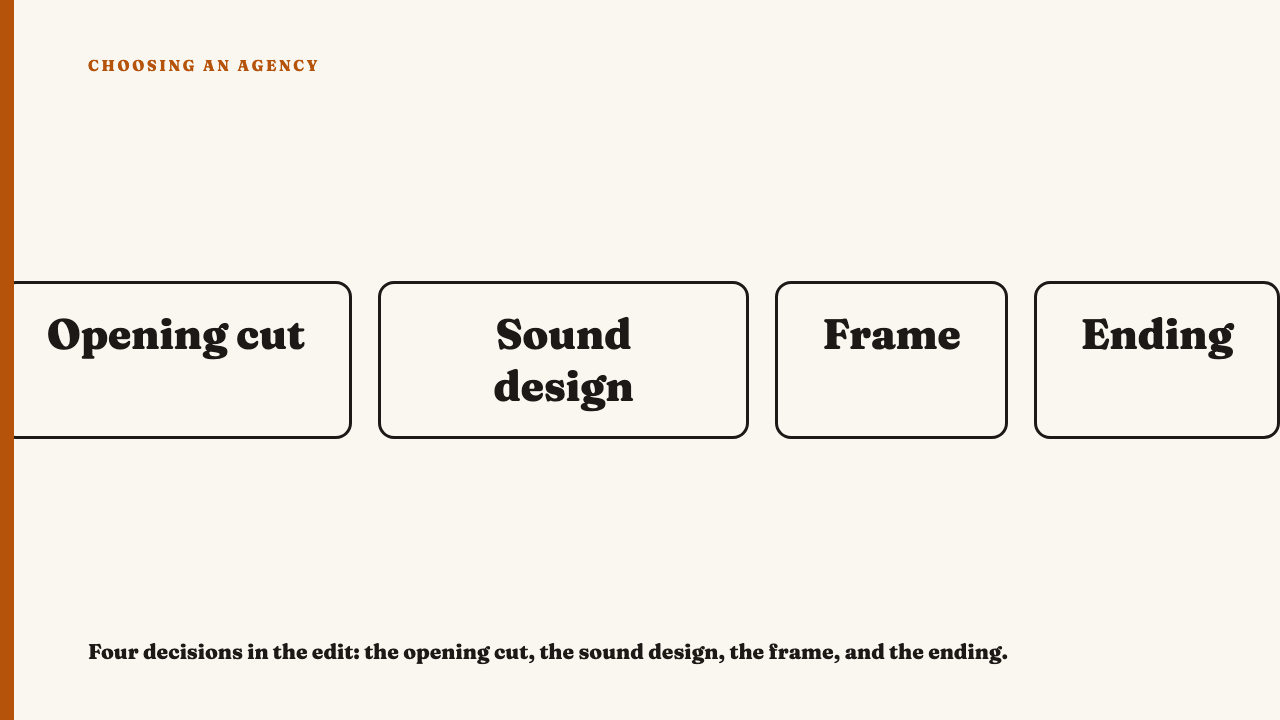
Two videos from the same agency, back to back. One feels tight, the other slack. Most people call that a feeling. It is four decisions in the edit, and once you know where they live you can point at them.
This is about the cut, not the shoot
Assume the format question is settled: vertical because it lives somewhere vertical, the right length, not a crosspost. If not, start with telling platform-native work from a crossposted asset. This piece picks up after: the footage exists, and someone made choices with it.
Production value and editing craft are separate skills. Production value is what the money bought before the edit began: camera, lighting, location, talent. Editing craft is what gets decided afterward, when someone picks which two seconds of a long take survive and what sits next to them. A brand can spend real money on a shoot and still hand the rushes to someone who lays them end to end in capture order and drops a track underneath. Handsome footage, no judgment. The edit is one of the cleaner signals of how much of that work the agency actually did.
These tells are near invisible on a first watch, which reacts to content. They surface on a second, which can watch structure instead.
Where the first cut falls
A considered edit opens on something already happening. A hand mid-motion, a face mid-sentence, an object coming apart. An unconsidered one spends its opening on setup: a logo sting, a title card, an establishing shot of a room you do not need yet.
The distinction is not speed, it is assumed knowledge. A skilled edit trusts you to catch up mid-action. An unskilled one over-explains before anything happens, because whoever cut it did not trust the opening image.
Picture a demo of a countertop appliance. One version opens on the machine already running, ingredients going in. The other opens wide on a kitchen, then a hand reaching for the counter, then the machine switched on. That opening was spent on transportation.
Whether the sound was designed or laid on top
Sound design is not the same as having music. It shows up as checkable events:
- Hard cuts that land on a beat rather than wherever the picture happened to change.
- Foley on a real movement, a lid closing, fabric shifting, a whoosh on an actual push.
- Music ducking under a voiceover, then lifting when the voice stops.
- Split edits. An L cut lets audio from the preceding scene run over the start of the next one.
- A deliberate half second of silence as punctuation before a reveal.
The alternative is easy to hear. One track at one volume throughout. Cuts that ignore where the music is. Voiceover and music bed fighting for the same space.
Much of this is watched muted. Digiday reported in 2016 that as much as 85 percent of Facebook video views happened with the sound off, according to multiple publishers it spoke to. The figure is old and platform specific, but a well cut piece still has to survive silence, so the design shows up visually: the cut lands on an implied beat, the text hits on the emphasised word.
Composing the frame for a screen held at arm’s length
The frame is tall or square, a few inches wide, held at arm’s length, with the platform’s interface drawn over it. A captions bar, the account name, action buttons down one side, all over fixed regions that differ by platform and shift when platforms redesign. [EVIDENCE NEEDED: current platform safe-zone guidance for those regions.]
Good composition treats those regions as occupied. Faces and key action sit toward the middle. Shots run closer than on a large screen, because detail in a wide shot disappears at thumb size. Text goes where nothing will cover it, typeset and timed in the edit rather than left to the platform. [EVIDENCE NEEDED: current platform documentation on automatic caption appearance.]
Bad composition is just as visible. A face or a line of text half covered by an overlay. A wide shot that reads as texture rather than information. Motion so small or fast it is gone before you parse it.
Whether the piece ends, or just stops
An edit that ends has a final beat. A last frame held a moment, a visual or audio button telling you it is complete. It can be quiet. What it cannot be is accidental.
An edit that stops cuts off mid-motion, loops back in a way that jars, or lands on whatever frame the timeline reached. The tell is the final second: is there a beat there, or just the absence of footage?
Take an assembly piece. One closes on the finished object, held still, audio resolving. The other is mid-assembly when it cuts to black, because the cutdown had to fit a length cap. Only one was finished.
Watching a piece twice, on purpose
- Watch once at normal volume, phone in hand, the way any viewer would.
- Watch again muted. Does the rhythm still read, or was the track doing the structural work?
- Watch a third time looking only at the first two seconds and the last two.
Then answer four questions. Did the opening commit to an action or an announcement? Was the sound built into the cut or laid across it? Was the frame composed for a screen with an interface over it? Was the ending chosen, or did the footage run out?
This assesses one video. It says nothing about whether the same care shows up every time, a separate question about a body of work. For the broader craft argument, see what actually separates good social media work from average.
If you know work that holds up
We select agencies editorially, and the pool is better when people who watch closely point at work. If an agency’s video work survives a second watch, nominate an agency and name the piece.
FAQ
How do I know if the sound in a video was actually designed for it?
Look for cuts that land on audio hits, music that drops under a voiceover and comes back, and sound attached to movements on screen. Then watch it muted. If it holds together, the audio was built in. If it collapses, the track was just running underneath.
Does every good social video need a big, cinematic ending?
No. Minimal, abrupt and deadpan endings are all legitimate, and an elaborate closing sequence can be worse than a single held frame. The question is whether the last frame was chosen or is simply where the footage stopped.
Sources
- Digiday, “85 percent of Facebook video is watched without sound” (2016), fetched 2026-09-05.
- Wikipedia, “L cut”, fetched 2026-09-05.
- Wikipedia, “Foley (sound design)”, fetched 2026-09-05.
- Wikipedia, “Ducking”, fetched 2026-09-05.