The Craft Bar Changes Once the Audience Is Gated
You have gotten a look at something you were not meant to see easily, a screenshot from a broadcast channel, a forwarded close friends story, a paid tier post an agency used in its own case study deck. You are trying to judge whether the agency’s craft holds up here the way it does on the feed, and grading it against the feed’s standard is the wrong move almost everyone makes by default.
The Feed Voice and the Gated Voice Are Not the Same Instrument
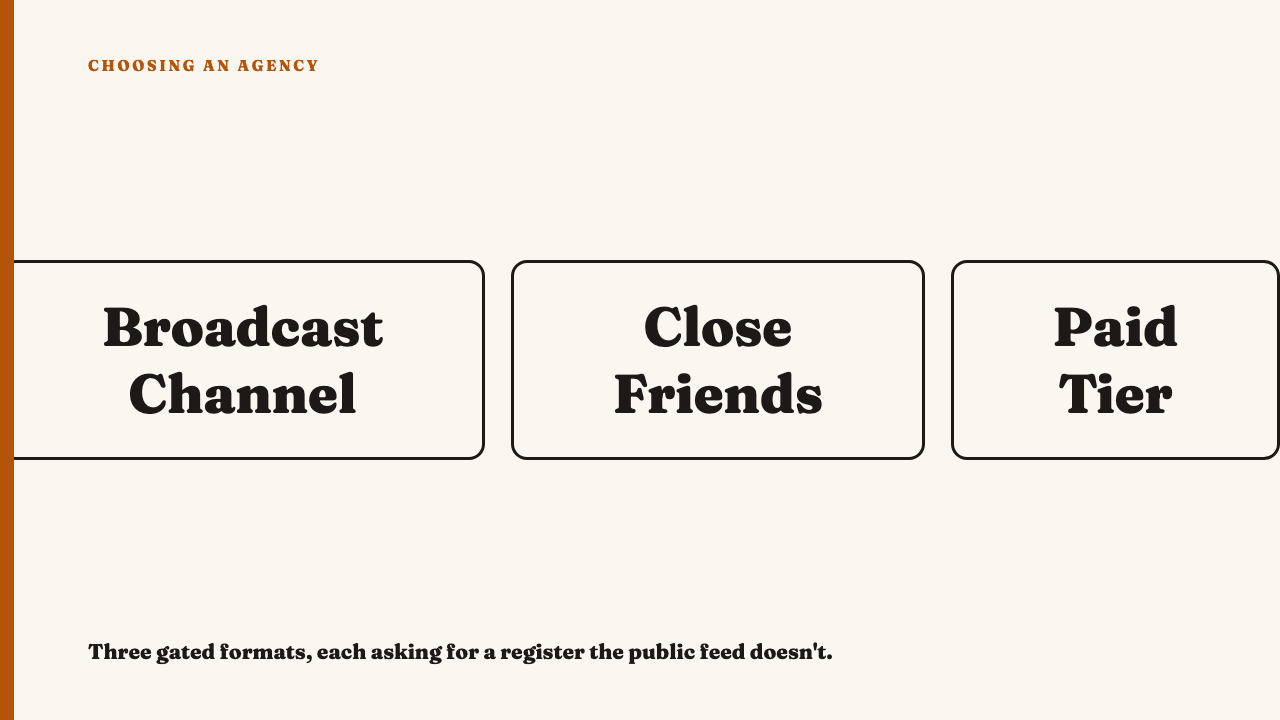
Three formats sit behind this piece, none interchangeable with the feed. A broadcast channel is one to many messaging, text, voice notes, and polls sent the way a person sends a message, not the way a brand publishes a post. A close friends list is a visual layer shown only to a self selected small circle. A paid or subscriber only tier gates content behind ongoing payment, not one time access. Each carries an implication the feed does not: a broadcast message reads like it came from a person, a close friends story implies the viewer was chosen, and a paid tier implies the value has to hold up over dozens of posts, not one viral moment. Judging any of these formats by the polish or cadence of the public feed misreads what the format exists to do.
When the Gated Space Gets Overproduced
Picture a broadcast channel where every message arrives studio lit and captioned like an ad, when a raw phone shot would read as honest. Picture copy written in third person brand voice, “we are so excited to share,” instead of a person actually speaking, “here’s a thing before anyone else sees it.” Picture a cadence either too sparse and visibly scheduled, like a newsletter, or so polished that nothing reads as unscripted. Any one of these is a tell, together describing an intimate channel treated as a smaller ad. The viewer opted into seeing something not everyone sees, and got another version of the same ad through a narrower pipe. Access was technically restricted. Nothing about the experience felt restricted.
When the Gated Space Gets Neglected
The opposite failure comes from the same root problem: an agency that has not thought about the format. Neglect looks like long unexplained gaps between posts, content identical to what already ran on the feed with zero adjustment, and a caption that gives no sign the sender knows this audience differs from the general public. The test that separates neglect from calibrated informality is whether a decision is visible anywhere. Intentional rawness still shows a choice, why this moment, why this small group saw it. Neglect shows no decision at all, just access nobody used. This is where restraint itself can be a craft decision becomes relevant: a quiet channel is not automatically a lazy one, but quiet only counts as restraint when something confirms someone was behind the wheel.
What the Calibrated Middle Actually Looks Like
- A voice note or a short unscripted video stands in for the edited clip, because the format rewards a voice you can actually hear over a cut you can actually see.
- The phrasing reads like a text message someone would send a friend, not a caption written for an audience of thousands.
- The content or information is genuinely unique to that tier, something a public feed follower does not already have, rather than a repost with a different border.
- The frequency acknowledges the audience exists without treating them as a captive channel for constant asks, discount codes, or “don’t forget to” reminders.
None of this is low effort. The effort is redirected, from production value toward feeling personal, which is harder to fake than a good edit.
Why This Corner of the Account Is Worth Judging at All
It would be easy to treat gated spaces as a minor footnote you glance at once and move past. That undersells what they reveal. An agency that cannot shift register between a public post and a private one is likely running one voice everywhere and calling it consistency, when consistency and range are different skills and only one is hard. Range means a broadcast message, a close friends story, and a feed post each asking for a different register, delivered correctly. This connects to another low visibility corner of the account worth checking for the same reason: an agency that misjudges register in a gated space tends to flatten other low visibility surfaces too, because the missing skill in both places is the same, reading what a format is for before publishing into it.
Judging What You Cannot Fully See
Here is the honest part. Evaluating an agency’s work, you will usually see only a screenshot, a forwarded broadcast message, or a short window of close friends content someone happened to catch. That is a real limit on what you can know, not a failure of diligence. Some evidence is legitimate even secondhand: a brand’s own public reference to what it sent, a case study screenshot the agency chose to publish, or a pattern across more than one gated touchpoint rather than a single isolated post. What does not count is assuming tone or quality from the public feed alone, the same trap that applies to judging content that was never meant to last. Partial evidence handled carefully still tells you something real. Full confidence built on no evidence tells you nothing.
See More of This in Practice
Reading about calibrated craft is one thing, seeing it applied is another. See this year’s selections for agencies whose work holds up across visible and less visible corners of an account, or, if you work with an agency whose gated content handles this well, nominate an agency.
FAQ
Should a brand’s broadcast channel or close friends content look the same as its main feed?
No. These formats exist to signal proximity and selection, so content that is visually and tonally identical to the public feed wastes the format regardless of polish. Matching the feed exactly is itself a sign the agency has not thought about what the gated space is for.
What if I can’t get access to a brand’s close friends list or broadcast channel to judge it myself?
Weigh the legitimate secondhand evidence: the brand’s own published references to what it sent, case study screenshots the agency has shared, and patterns visible across more than one gated touchpoint. Do not assume quality or tone from the public feed alone, since a strong feed and a strong gated presence are not the same evidence.