Judging Craft in a Genre You Would Never Personally Follow
You get handed a folder of work from a category you have never opened on your own time. Maybe it is gaming content, maybe beauty, maybe finance. Your first honest reaction is a shrug, or mild irritation, and it arrives before you have looked closely at anything. That reaction feels like a verdict. It is actually just a fact about you.
The gut reaction is measuring the wrong thing
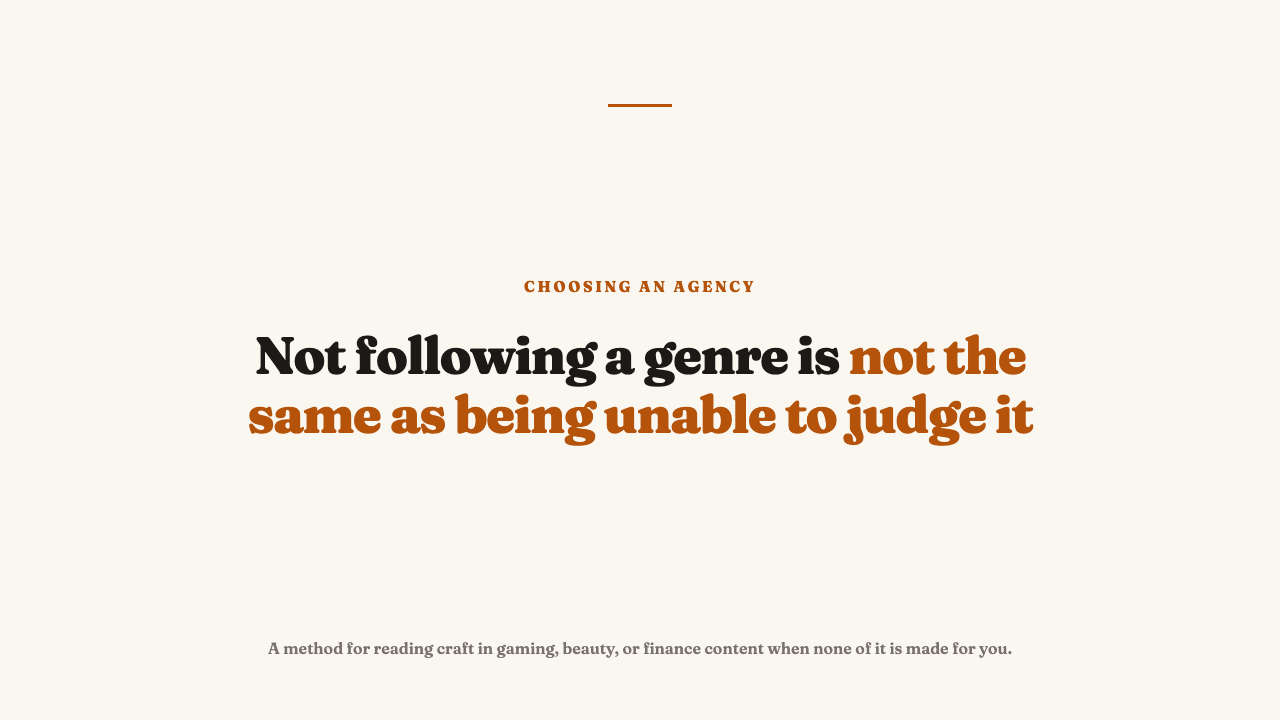
A reviewer’s immediate like or dislike of an unfamiliar genre measures fit: how close the content sits to the reviewer’s own taste and prior exposure, not the competence of execution. Someone who has spent years around a genre internalises its rhythm without noticing; someone who has not will register the same choices as strange or chaotic, regardless of execution. That gap between familiar and competent is the entire trap.
This matters more in social work than in most creative fields, because a single reviewer is routinely asked to cover every category an agency might submit. A film critic tends to specialise; a person judging social work rarely gets that luxury, and trusting the gut alone means categories closest to the reviewer’s own feed will consistently score better than categories furthest from it, for reasons that have nothing to do with skill.
What fluency signals are, and why they replace taste
A fluency signal is a choice that means something specific to a genre’s regular audience and would look like a flaw, or nothing at all, to someone outside it. It is the detail a fan clocks instantly and an outsider misreads as a mistake or never registers. These signals exist because every genre develops its own internal logic for what counts as good, rarely written down, accumulating post by post until the regular audience can tell within seconds whether someone understands the space.
The method follows: judge whether the work is fluent in the genre’s own conventions, not whether you personally would watch it. Fluency is checkable. Preference is not. “Would I follow this account” is a question about the reviewer. “Does this hold up against what already works in this category” is a question about the work, and that is the only one this job requires answering.
Pacing conventions differ by genre, and a genre outsider reads them as errors
Pacing catches the most reviewers, because it feels like something anyone can judge on instinct. Picture two hypothetical categories. In one, fast, list-like cutting is the established competent format, and viewers there read a slower edit as padding. In another, that same rhythm would read as an inability to sustain a shot, evidence the maker did not trust the material enough to let it breathe. Identical edit, opposite verdict, because the genre sets a different baseline for “well paced.”
The check, then, is whether the pacing matches what other strong work already established in that genre does, not whether it felt fast or slow in the moment.
In-genre references and shorthand: the tell you’re not equipped to read alone
Every genre accumulates shorthand: an inside phrase, a format callback, a recurring bit that only lands if you have watched long enough to catch it. Picture a hypothetical gaming account referencing an in-community joke about a notoriously difficult level, the kind of thing that only means something if you already know why it is notorious. Used precisely, the reference signals real fluency: the creator trusts the audience to get it unexplained. Used loosely, dropped in because it sounds like the right kind of reference without landing on what the audience actually associates with it, it signals imitation of the genre’s surface without belonging to it.
A reviewer outside the genre cannot tell those apart by feel, since both look equally unfamiliar. The responsible move is to identify the reference and confirm what it signals to the genre’s regular audience before scoring the post, rather than treating an unrecognised reference as mere noise.
A short method for reviewing outside your genre
- Identify the genre’s regular audience, and what they expect from that category.
- Find two or three examples of strong work already established within that genre, not the closest thing you personally know.
- Note precisely what those examples do: pacing, structure, shorthand and reference, what a satisfying ending looks like in that format.
- Compare the work under review against those examples point by point, not against a general sense of quality.
- Judge fluency to those established norms. Personal preference gets a vote only after that comparison, and a small one.
Skipping the second step, going straight from unfamiliar genre to verdict without finding comparable work first, is exactly what causes taste to substitute for judgment.
Where personal taste is still allowed to speak
None of this erases taste entirely. Once two pieces are both genuinely well executed within their genre’s conventions, taste is a fair way to break the tie. What taste cannot do is fail work that is fluent in its genre because the reviewer would not personally follow that account. That is a mismatch between the reviewer and the audience the work was made for, not a craft judgment.
The opposite failure deserves equal caution. A post that hits the right shorthand and expected pacing is not automatically good; getting the vocabulary right is necessary, not sufficient.
Where to go next
This same instinct, comparing work against its own category rather than a personal baseline, runs through what a portfolio leaves out, through how much of the work the agency actually did, and through when a brand voice is distinct and when it is only loud. Know an agency whose work holds up against its own category’s best? Nominate an agency.
FAQ
What if I genuinely cannot tell what’s good in a genre I know nothing about?
The fix is research, not intuition. Find two or three pieces of work already established as strong within that genre before judging the piece in front of you, and judge fluency against those, not against a baseline invented on the spot.
Is disliking a genre a reason to score it lower?
No. Personal dislike of the genre is not a craft judgment, it is a statement about the reviewer’s taste. A reviewer who cannot separate the two should do the comparative research above before scoring, or flag the conflict rather than scoring on instinct.
Does this mean any use of genre jargon should score well?
No. Getting the references and pacing right is necessary, not sufficient. Execution still has to be strong within those conventions; work that only hits the right shorthand without holding up otherwise is still weak.