What you repost is an editorial decision, not a formality
You are looking at a brand account where much of the grid is other people’s photos. Someone else shot them, the brand put them back out, and the account reads busy and well liked. Whether that is careful work or the least possible work comes down to what got picked.
Reposting is not the same job as running the campaign that produced the content
Designing a hashtag challenge is one skill. Deciding what to do with the pile that comes back is another, and an agency can be good at the first and careless about the second. A tightly built prompt can be followed by months of reposting whatever appeared first in the tag. A generic prompt can be rescued by someone who reads the whole pool and picks the few pieces that are genuinely interesting.
It is a recurring job, not a campaign task. Most accounts repost long after any campaign window closed, because tagged content keeps arriving and someone has to keep choosing. You are judging a habit, not a decision.
What repetition on a repost grid actually looks like
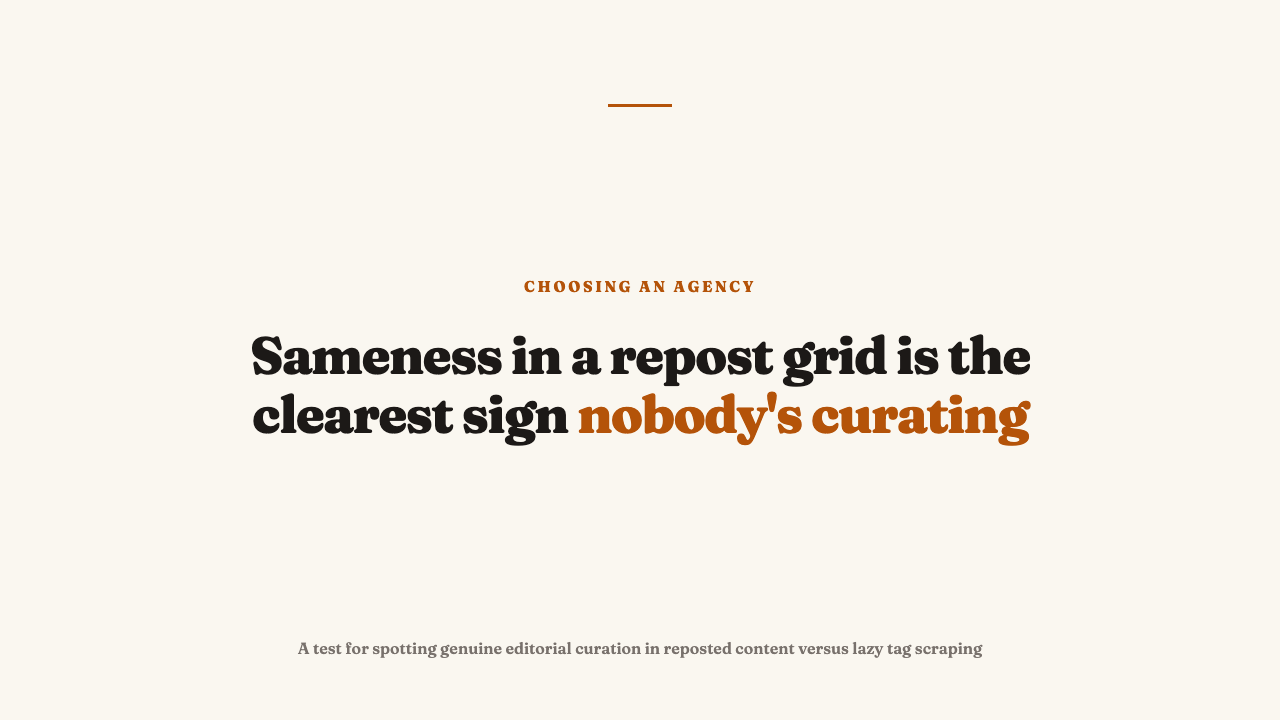
The clearest tell that nobody is really looking is sameness. Check whether every piece is the same shot type, product held at arm’s length, centered, natural light, sitting in the same spot in the frame each time. Check whether the captions follow one structure of creator praise plus brand sign-off, and whether every creator looks like the same person in a different apartment. Any one of those is coincidence. All of them together mean someone is taking the first usable results in the tag and moving on.
Timing is the other tell. Reposts clustered into a tight window right after the mechanic launched, then nothing, means a team cleared an inbox once and never went back. Dates spread across months, including pieces that arrived long after the push ended, mean somebody kept looking.
A set chosen with range looks different. Formats change, a still photo next to a short video next to a piece of text. Angles change, one submission literal and the next sideways. The creators sit in different contexts at different levels of polish, not just different faces.
Credit and framing: the part of reposting that is actual craft
The bare minimum repost is easy to recognise. The image goes up, the caption is an @mention and maybe a thank you, and that is the entire contribution. Credit is an obligation discharged, and the post lands as a receipt.
A considered repost does something the original could not do alone. The framing text says why this piece and not another, or connects it to the ones on either side so the run reads as a sequence. It stays a frame: the creator’s voice still carries the post.
Over-editorialising is the opposite failure. A brand caption that rewrites the creator’s point, or turns their observation into a product claim, crowds out what made the post worth reposting. If you cannot tell from the caption what the creator said or made, the agency has talked over its source.
Signs of an edit pass versus a straight regram
Look at whether anyone touched the asset before it went out under the brand’s name. It is how much of the work the agency actually did, asked of a smaller unit.
- An edit pass: colour corrected toward the account’s palette so the repost sits in the grid rather than fighting it, cropped to the platform’s actual aspect ratio, dead air trimmed off a video.
- No edit pass: screenshot-quality resolution with another app’s interface at the edges, black bars from a mismatched aspect ratio, audio that jumps in mood against everything around it.
- Skipping the edit pass is legitimate where raw authenticity is the point, but it should look like a choice: consistent rawness reads as a position, raw here and graded there reads as whoever handled that week’s batch.
A short exercise: read ten consecutive reposts as a set
Pull up the last ten reposts on any account the agency runs and ask three questions of the set, not of each post.
- Does the mix vary in format and voice, or is it ten versions of the same picture?
- Does the framing text add anything, or are the brand captions ten variations on thanks for sharing?
- Is there evidence of an edit pass, and is it consistent? Either treatment is fine. Inconsistency is the finding.
A set that passes feels edited: someone saw the run as a sequence and picked pieces that do different jobs. A set that fails feels harvested: the variation is accidental, the captions are interchangeable, shuffling the order would change nothing. It is the skepticism you would apply to what a portfolio leaves out, aimed at work nobody expects to be read closely.
Why this is worth judging separately from the rest of the account
A hero campaign asset gets rounds of review and a place in the pitch deck. Reposting gets none of that: continuous, usually junior, usually unreviewed. High-frequency output under low oversight shows the standard a team holds when nobody is enforcing one, a more honest signal than the centrepiece work, and the same reason an agency’s own account is weak evidence of its work.
Look at the work yourself
The agencies featured here are editorial selections, picked by looking at the work. You can see this year’s selections, or nominate an agency whose daily output holds up under this reading.
FAQ
Is it bad for an agency to repost user content with no edits at all?
No. Unedited reposting is legitimate where raw authenticity is the intended feel. The test is consistency. If some posts get a full colour and crop treatment and others go out as screenshots, that is not a house style, it is variable effort showing through.
How often should a brand account repost user content?
No number is worth giving here, and any cadence figure quoted at you is somebody’s habit, not a standard. Judge the selection instead. An account that reposts rarely but with real range is doing the editorial job better than one clearing its tag inbox constantly from the same narrow slice.
Does crediting the original creator matter if the content is already tagged?
Yes, because they are different things. A tag is a platform mechanic that costs nothing to add. Framing text is editorial work: it tells the viewer why this piece was chosen and what to notice in it. An account can be scrupulous about tagging and still contribute nothing.