Judging the Shift From Founder Voice to Brand Voice
An agency shows you an account that used to sound like one person and now sounds like a company. Somewhere in that feed, writing that was an opinion became a communication. Most accounts outgrow their founder, so the change is not the question. Whether the agency translated the voice or just deleted it is.
What a founder’s literal voice actually sounds like
Founder voice has visible markers. Opinions stated as fact rather than hedged, so a post says the thing is bad instead of saying there was room to improve. The reader addressed as “you”, not “our community”. A phrasing quirk belonging to one person, a word used slightly wrong on purpose, a habit of ending on a fragment. Things the founder likes or dislikes, named without a softening sentence after.
The marker people miss is inconsistency. One post is three sharp sentences, the next a rambling paragraph, the third a photo with six words under it. That unevenness is not a defect awaiting correction. It is most of why the account reads as a person and not a style guide.
The moment you can point to
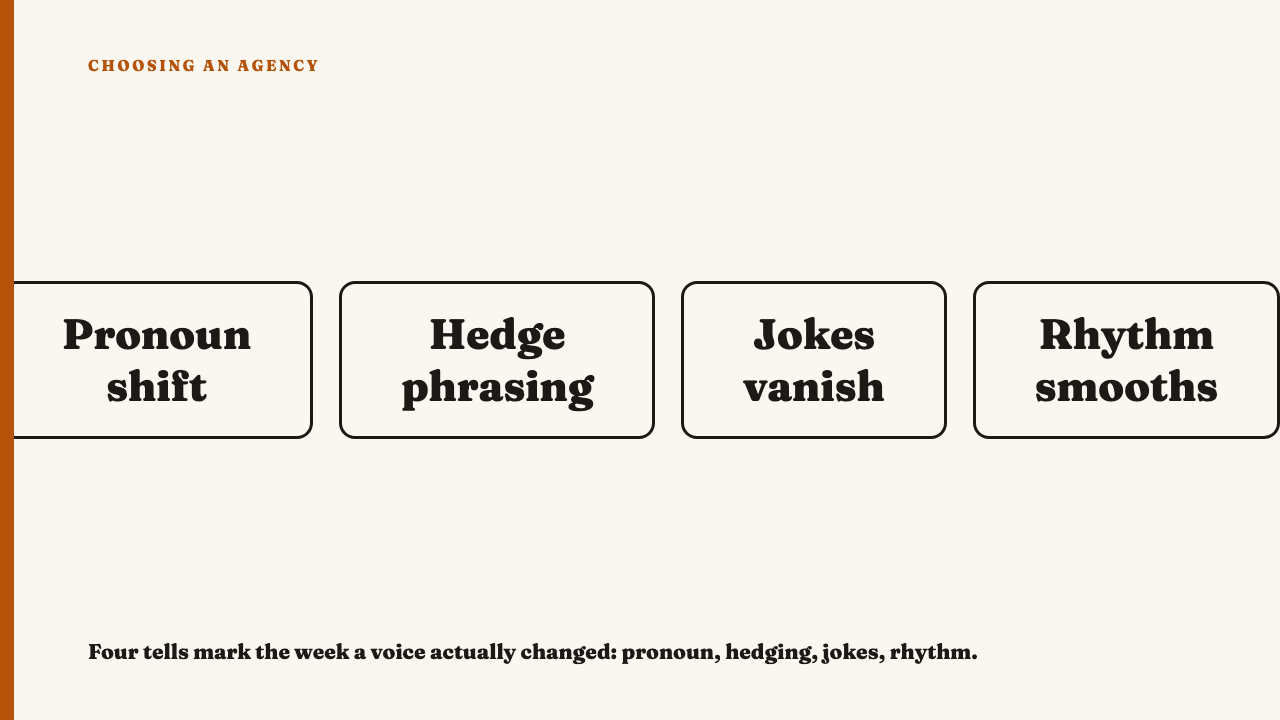
Voice changes get described as gradual. They rarely are. Scroll the grid chronologically and watch for four tells: the pronoun moving from “I” to “we”, hedge phrasing arriving (“we believe”, “we’re excited to”), jokes and asides disappearing, and posting rhythm smoothing into an even cadence.
One tell means nothing, a founder can write “we” on a Tuesday. Look for the week where two or more appear together, because that is a handoff rather than a mood. Captions read in isolation will not find it, the same reason one good stretch of posts tells you almost nothing.
What a preserved transition looks like on screen
An invented example, illustrative and not a real account. A small kitchenware company discontinuing a pan.
Founder era: “We killed the 12 inch pan. Nobody is cooking for eight people on a Tuesday and I got tired of pretending otherwise.”
Corporatized: “We’re excited to share an update to our cookware lineup. We’re always listening to our community and evolving to serve you better.”
Preserved: “The 12 inch pan is discontinued. It sold fine, but it lived at the back of cupboards. We would rather make three sizes people reach for than five that photograph well.”
The third is more formal and has lost the swagger, but not the claim: the pan went unused, and a short range beats a flattering one. The difference between the second and third is not tone of voice guidelines, it is whether a contestable statement survived.
The three-part formula that replaces a voice
Where a transition was done by deletion, the copy collapses into one shape:
- An opening hook that could sit above any brand in the category. A rhetorical question nobody asked.
- A value statement of empty superlatives, where the adjective carries the claim and nothing sits under it.
- A call to action connected to nothing in the post. “Link in bio” under a caption that never named a product.
Screen a week for the vocabulary: “amazing”, “incredible”, “game-changing”, “seamless”, “elevate”, “curated”, plus “we believe”, “we’re excited to”, “we’re passionate about”. Three posts opening and closing with transplantable lines is a formula, not a voice.
Before and after, side by side
| Caption type | Founder era | Corporatized | Preserved voice |
|---|---|---|---|
| Product announcement | Says what it is for and who should not buy it. | Announces a launch, calls it exciting, adds a link. | Says what it does, keeps one honest limitation. |
| Mistake or apology | Names the error in the first line, sometimes too bluntly. | “We’re aware some customers experienced an issue”, plus a promise to do better. | Names the error first, then what changed, without “we take this seriously”. |
| Behind the scenes | A dull photo, one specific personal observation. | A staged team photo captioned about culture and hard work. | Same photo and observation, plural voice, edited down. |
Why some founder voice deserved to go
Distinctive and merely unfiltered are different things. An account that contradicted its own stated positions week to week, or swung with the founder’s mood instead of a point of view, was not showing craft. It was showing an absence of editorial process.
The test: would the line survive if the founder had more time to edit it, as opposed to more reason to be careful. Time to edit sharpens a point of view. Reason to be careful removes it. A line that only exists because nobody looked twice was never the asset.
The half-transitioned account is its own failure mode
Sometimes there is no seam because the change never resolved. Within one month, posts alternate between first-person opinion and hedged plural voice, with no pattern traceable to content type or platform. Monday has a joke and an “I”. Wednesday reads like it went through legal.
That alternation is a stronger signal than either extreme, because it means nobody owns the voice decision. It is worse craft than a clean institutional voice, even a generic one, because inconsistency is what a reader registers before post quality. It is the caption version of judging whether an agency built a system or just one good post.
The strip-the-logo test
Pull five posts from clearly before the transition and five from clearly after. Hide the name and profile photo. Read all ten as anonymous copy and ask whether the account is still distinguishable from others in its category.
A pass looks like a specific claim only this account would make, a joke with a subject rather than a register, or a structural habit present in both sets. A fail looks like captions you could relabel with a competitor’s name and lose nothing. This applies the swap logic in the difference between a distinct voice and a loud one across time rather than at one moment, and pairs with judging a brand account built around a persona when the account was built around one person. You are not measuring polish. You are measuring what survived that a competitor could not have written.
Where to see this done well
For agencies whose caption work holds a point of view rather than a register, see this year’s selections. If one translated a founder’s voice instead of sanding it flat, you can nominate an agency.
FAQ
Is a smoother, more consistent voice automatically worse craft than a founder’s original voice?
No. Consistency is not the enemy, genericness is. A voice that got smoother while still making specific, unhedged claims is a good transition. The failure is losing the claims along with the roughness.
Does keeping the founder’s voice mean the account has to stay informal forever?
No. Formality and point of view are independent variables, and conflating them causes bad transitions. An account can get more formal, drop the typos, move to plural voice, and still tell you which of its own products is not worth buying.
Sources
- When a brand voice is distinct and when it is only loud, checked 2026-09-07.
- How to Judge a Brand Account Built Around a Persona, checked 2026-09-07.