Telling an agency’s direction apart from a naturally good performer
A prospective client watches a reel. One person on screen is simply magnetic, comfortable in a way no single shoot day teaches, and the client hires the agency on the strength of that feeling. Six months later the client’s own content is flat. Nobody lied. The work in the reel was real. But the client credited the agency’s direction for a gift that belonged to the performer, and now they are paying for direction they never actually saw tested.
Why this question matters more than it looks like it does
This is not the ordinary complaint about a portfolio oversell. This is a specific attribution error: the reader watched something good, correctly recognised it as good, and attached the credit to the wrong party. Direction and natural presence were fused together in the reel, and untangling them is exactly what a hero reel is designed to make unnecessary.
The stakes are concrete. A company with an average spokesperson or a rotating cast of staff is buying something different from what the reel demonstrated, and the reel gives no evidence about what that something is. It is one version of a broader problem worth reading directly: how much of the work the agency actually did.
What natural charisma looks like on its own, unshaped
Genuine on camera comfort does not vary much by setup. A naturally strong performer is nearly as watchable in a plain, static shot with unremarkable lighting as in a fully produced piece, because the thing carrying the moment comes from them, not the frame around them.
Another tell is recovery. Watch what happens when something goes slightly wrong: a flubbed line, a joke that does not land immediately. A performer with real presence recovers in character, often turning the mistake into the most memorable second in the clip. A performer propped up by editing goes flat the moment something departs from the plan.
The clearest test, when available, is the part of a piece that would be first on the cutting room floor: an ad-libbed aside, raw footage nobody bothered to polish. If the energy holds up there as well as in the finished cut, that energy belongs to the person, not the edit.
The fingerprints direction leaves that charisma alone cannot
- Framing that moves with the content. A directed piece reframes when the beat changes: tighter when the point sharpens, wider when the moment needs room. An undirected piece is usually shot the same way throughout, in a setup reused because it worked once.
- Consistency across separate sessions. Charisma travels with the person; direction has to be reapplied every time. Look for energy that holds steady across pieces visibly shot in different sessions, different lighting, different wardrobe, months apart.
- Visible improvement over a body of work. If the fourth piece in a series is noticeably tighter than the first, in pacing, in what gets cut, that is someone giving notes between pieces, not the performer becoming more charismatic.
- Even attention on weak material. The real test of direction is the dull assignment: an unglamorous product, a dry topic. If it gets the same care as the strongest piece in the portfolio, direction is doing real work independent of the subject.
Run the test: pull three pieces, not one
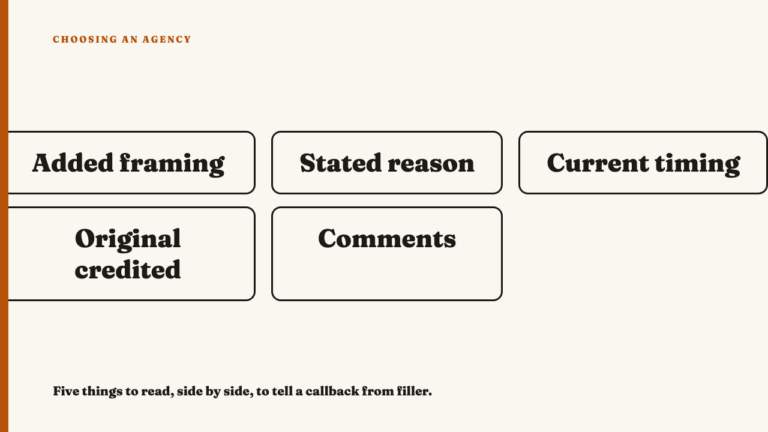
A hero reel is chosen because it is the best evidence available, which makes it the worst single piece to judge an agency by. Pull at least three pieces from the same performer: the strongest, the most ordinary, and, if it exists, the earliest.
Comparing the best against the ordinary tells you whether direction is applied evenly or only to the piece chosen to sell you. Comparing the earliest against the most recent tells you whether skill built over time, which argues for direction, or the performer arrived already finished, which does not.
Sometimes the test cannot be run. A single clip, or one hero case study and nothing else, is not enough evidence either way. The honest conclusion is that you cannot yet tell, and the next step is asking directly for more to look at. The gap this closes is covered in what a portfolio leaves out and, at the level of a whole campaign, why one excellent campaign tells you almost nothing.
The specific risk when your own company has no equivalent person
None of this is abstract if you are deciding whether to hire the agency. A case study built around one charismatic founder proves the agency can produce something excellent with that particular person on camera. It does not prove the agency can do it with someone of ordinary camera presence, which is what most companies actually have.
Ask for a different slice of the portfolio: a spokesperson doing their job rather than performing, a rotating staff member, a piece leaning on stock or B roll footage. Judge the direction there, since that material is closer to what your company likely resembles.
This is not a question of whether the agency has been honest. It can be genuinely skilled and still have oversold what one performer’s presence contributed, without any intent to mislead. The same question, applied to a persona rather than a performer, is covered in judging a brand account built around a persona.
Take the next step
See this year’s selections to look at a wider range of work with this distinction in mind, or if you run an agency confident that its direction, not just its talent, is doing the work, nominate an agency for consideration.
What this is not about
This piece is about reading published work, not about what an agency’s contract with a performer says or how that relationship is structured. That is a different question, and it belongs elsewhere.
It is also not about whether the content performed well or drove engagement. A piece can be beautifully directed and underperform, or thinly directed and go viral anyway. Reading performance is a separate skill from reading craft.
FAQ
What if the agency only has one performer across their whole portfolio?
That is a real limitation of the evidence, not proof of good or bad direction. Ask the agency directly for a piece fronted by someone else, or for raw, unedited footage of an early take, rather than accepting the polished hero reel as sufficient proof either way.
Is it fair to judge an agency worse just because their case study features a magnetic person?
No. A charismatic performer is not the agency’s fault, and it is not automatically its unearned credit either. It becomes a problem only when the agency’s pitch implies the result will travel without that person, and the rest of the portfolio gives no evidence either way.
Does a highly produced reel with lots of cuts make this harder to judge?
Yes. Heavy editing can smooth over inconsistent direction the same way it can flatter a performer. Seek out less edited, more continuous footage, an ad-lib or a longer unbroken segment, since that is where direction and charisma are easiest to tell apart.